Australian water-bombers join Kalimantan firefight
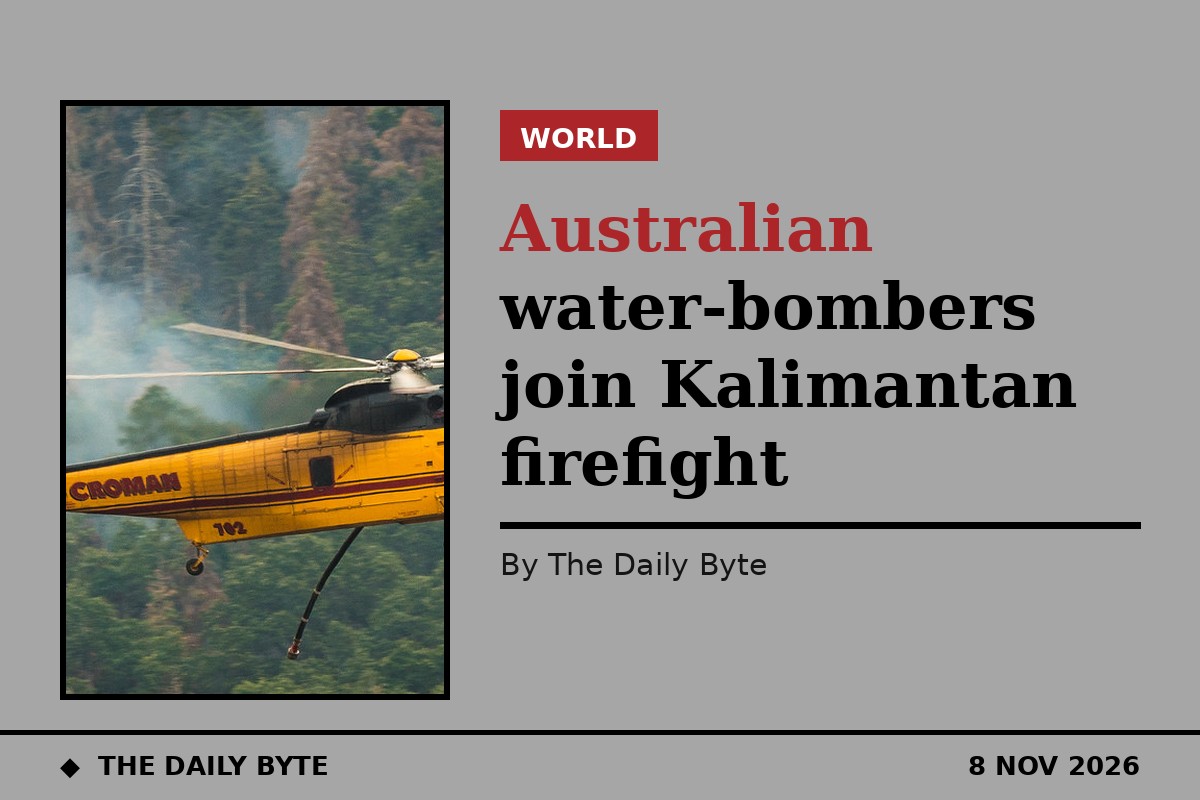
Australian water-bombing aircraft have begun operations against forest and land fires in East Kalimantan, joining Indonesia's response to a fire season described as the country's most intense in 11 years.
The deployment centres on a C-130 Hercules Large Air Tanker operated by the New South Wales Rural Fire Service, supported by a Cessna Citation lead aircraft and a team of 20 Australian specialists. The tanker can drop up to 15,000 litres of water on each sortie, and up to six sorties a day are planned from Dhomber Air Force Base in Balikpapan.
The aircraft were formally handed over at Halim Perdanakusuma Airport in Jakarta on Thursday, 5 November, in a ceremony attended by the head of Indonesia's National Disaster Management Agency, Lieutenant General Kristomei Sianturi, and the Australian Ambassador to Indonesia, Roderick Bruce Brazier. Operations began the following day, with the C-130 completing three water-bombing sorties over the Makroman area of Samarinda by 3pm Jakarta time on Friday, 6 November.
East Kalimantan Deputy Governor Seno Aji, speaking in Samarinda on Saturday, said the provincial government had asked Indonesia's disaster agency for help and that the response had come quickly. He said the aerial campaign would run until 12 November and would focus on fires covering between 40 and 50 hectares across four priority areas: the provincial capital Samarinda, Kutai Kartanegara, Paser and East Kutai regencies.
The first drops were aimed at two fire hotspots close to residential areas. Buyung Dodi, executive head of the East Kalimantan disaster management agency, said the aircraft's capacity meant fires in remote areas that ground crews struggle to reach could now be tackled more quickly. Local disaster units and the provincial forest and land fire task force remain on high alert, cross-referencing satellite imagery with the flight paths of the Australian aircraft.
The deployment comes during a fire season that has affected Sumatra, Borneo and Papua. Indonesia's Health Ministry recorded more than 400,000 cases of acute respiratory infection across seven provinces by 2 November, while deforestation monitor Nusantara Atlas estimated that more than 1.9 million hectares burned during the first nine months of 2026. Smoke from the fires has disrupted flights, closed schools and drifted across borders into neighbouring Singapore and Malaysia.
The mission also follows tragedy. A water-bombing helicopter crashed in Central Kalimantan on 4 November while loading water, killing three crew members. Eight people were aboard the aircraft, according to the Transport Ministry. The accident happened two days before the Australian tanker began flying.
Australia is not the first country to send aerial help this season. Japan conducted a firefighting mission in Kalimantan from 16 to 29 September, using three CH-47 Chinook helicopters and about 350 Self-Defense Forces personnel. Indonesia's disaster agency said the Japanese helicopters completed more than 40 water-bombing operations and dropped about 220 tonnes of water before the mission ended as agreed.
Ambassador Brazier linked the deployment to a history of mutual help between the two neighbours, noting that Indonesia sent personnel to support Australia during the devastating 2020 bushfires. "Australia and Indonesia are close neighbours and enduring friends," he said. "Indonesia stood with Australians during the devastating 2020 bushfires, and we remember that support with deep gratitude."
Indonesian Post reported that Australian Prime Minister Anthony Albanese is expected to visit East Kalimantan in person on Wednesday, 11 November. For now, the priority is the week of flying ahead: up to six sorties a day, weather permitting, aimed at stopping the fires before they reach homes.


