PM Approves Auto Policy 2026-31 After IMF All-Clear
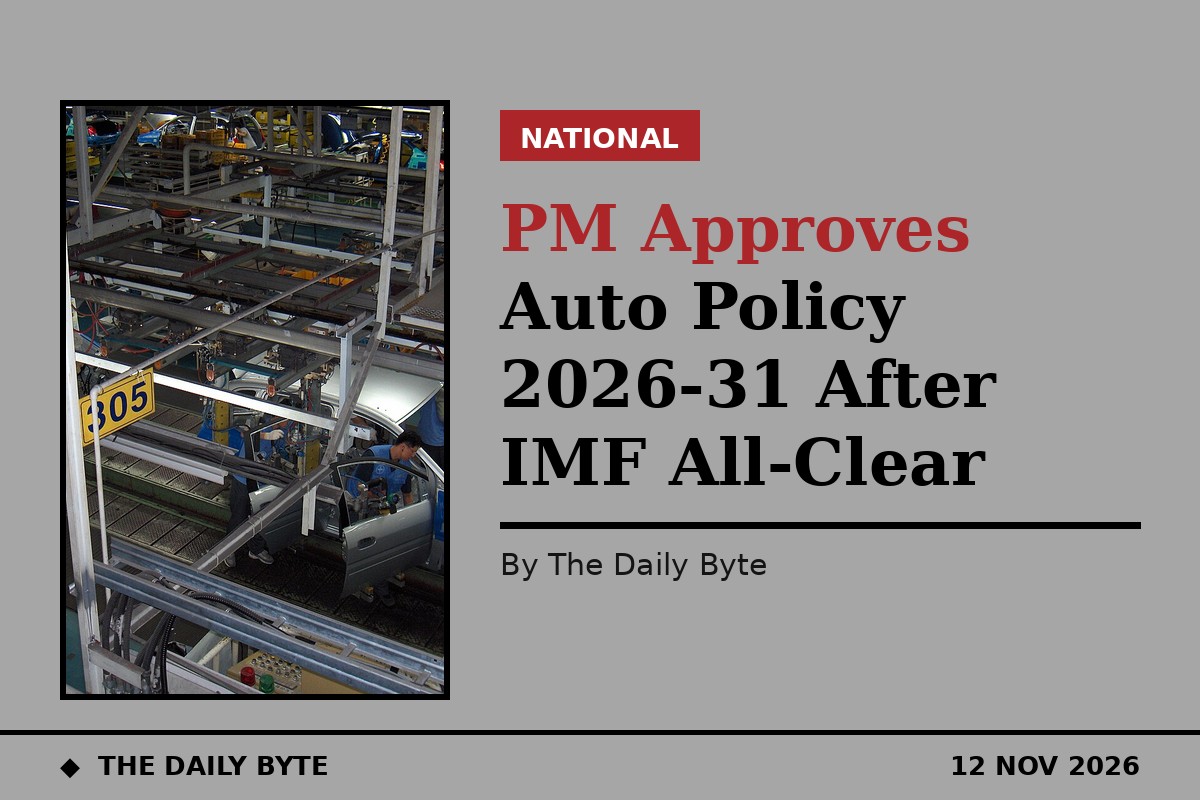
Prime Minister Shehbaz Sharif has approved the Autos and Auto Parts Manufacturing Policy 2026-31 after the International Monetary Fund raised no objections to its draft, clearing the biggest hurdle for the government's plan to turn carmaking into an export industry.
The prime minister approved the final draft last week, according to sources quoted by The Express Tribune, after the draft was shared with the lender. The policy will now go to the federal cabinet for formal approval, and the government plans to introduce a money bill, commonly described as a mini-budget, in Parliament to give effect to its tax and levy changes.
A $6 billion export target
The policy sets a cumulative export target of about $6 billion over five years, up from roughly $200 million a year today. About $3.29 billion, or 55 per cent of the target, is expected from auto parts manufacturers, and about $2.72 billion, or 45 per cent, from vehicle makers, according to the Business Recorder.
Adviser to the Prime Minister on Industries and Production Haroon Akhtar Khan said the policy aims to transform Pakistan's auto industry from import-dependent vehicle assembly into export-oriented manufacturing. He said manufacturers will be given export targets, with a reward of five per cent of export value in the first year for those who meet them and penalties for those who do not.
The policy rests on six pillars: affordable vehicles, especially for the middle and lower-middle classes; exports; localisation; vehicle safety; electric mobility; and transparency. Duty benefits will be conditional on domestic value addition, with a three percentage point duty penalty for missing localisation targets, and a Rs2.1 billion vendor programme is planned to support local parts makers.
What still has to happen
The policy is not yet law. It still needs federal cabinet approval, and the tax and levy changes need Parliament to pass the money bill. The policy will undergo a mid-term review in 2028, with further adjustments planned to support its industrial and export targets.
There are also practical questions to settle. Carmakers said they still did not have an official copy of the policy days after the government announced it, according to ProPakistani. The proposed electric vehicle sales-tax rates, reported at one, six and nine per cent, are proposals that depend on formal notification, and the government says it is aiming for revenue neutrality under its IMF programme.
Cheaper cars and more electric vehicles
The policy was first unveiled at a press conference in Islamabad on 7 November by Haroon Akhtar Khan and Information Minister Attaullah Tarar. It promises gradually lower vehicle prices, cheaper electric vehicles and stronger buyer protection, with lower tariffs on kits and components and tax breaks for electric vehicles. The government is aiming for 30 per cent of new vehicles to be electric by 2030.
The policy replaces the earlier Auto Industry Development and Export Policy 2021-26, which ended on 30 June 2026. Tarar noted at the launch that policies for the sector had been framed for the past decade without any rise in exports. Policy papers cited in reporting project about $17.7 billion in foreign exchange savings over the life of the new policy, and greater use of new energy vehicles to avoid importing roughly 1.823 million tons of oil. Source: Bloom Pakistan