Bangladesh selected for $30m climate resilience funding
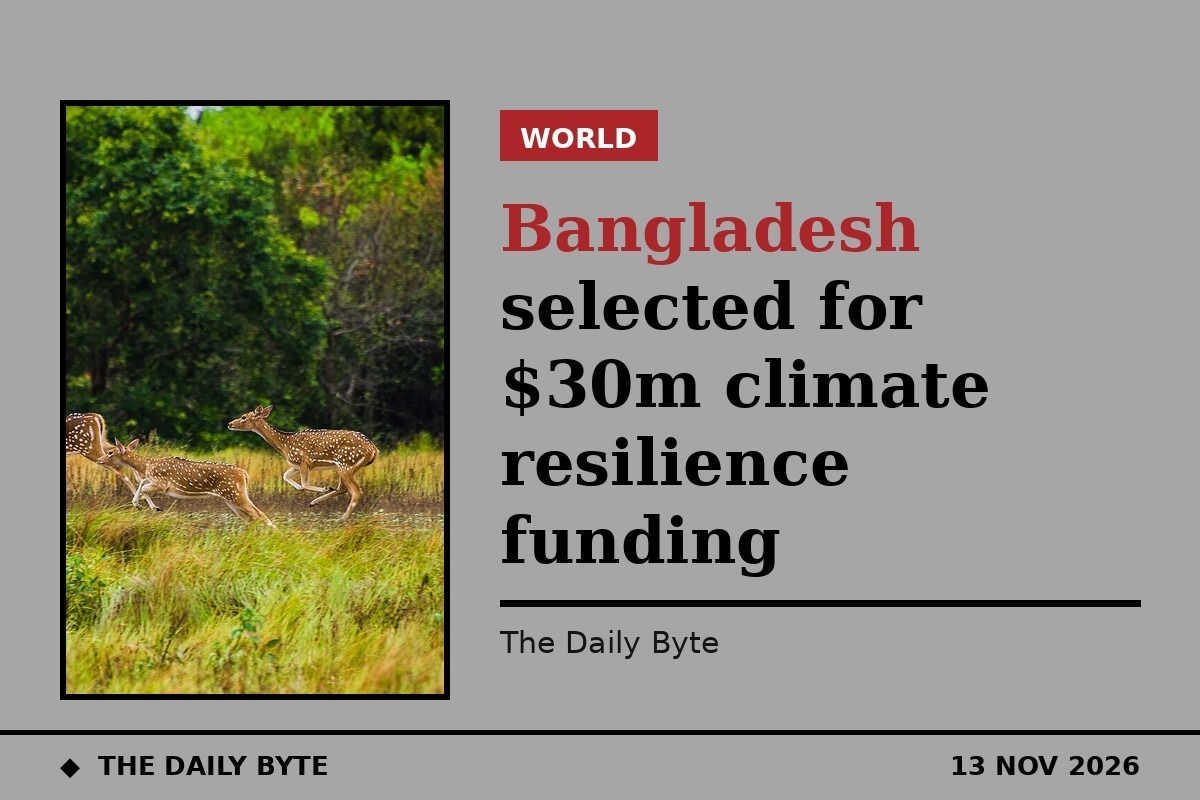
Bangladesh has been selected as one of five countries for the first phase of a new climate resilience investment programme run by the Climate Investment Funds (CIF), opening the way to an investment plan seeking up to US$30 million in financing.
The announcement was made on Thursday 12 November during COP31, the United Nations climate conference in Antalya, Turkiye, according to a CIF press release reported by The Business Standard. Bangladesh will now work with its multilateral development bank partners to prepare a detailed investment plan under the programme.
The programme, known as ARISE, short for Accelerating Resilience Investments and Innovations for Sustainable Economies, is designed to scale up climate adaptation projects and mobilise financing for countries that face some of the heaviest climate risks.
Five countries and one regional programme
Alongside Bangladesh, the countries chosen for the first phase are Haiti, the Kyrgyz Republic, Morocco and Sierra Leone. A regional programme covering Malawi and Mozambique was also selected.
Under ARISE, each selected country can prepare an investment plan seeking up to US$30 million in financing, while the regional programme can seek up to US$40 million. The selection followed a process that identified 25 expressions of interest representing more than US$700 million in potential investment opportunities across several sectors.
Those sectors include agriculture and food systems, water security, infrastructure, energy, coastal resilience, blue economies, natural resource management, financial services and adaptive social protection. Reports of the announcement said the proposed investment for Bangladesh would focus on strengthening coastal protection, restoring mangrove forests and improving the ability of the most vulnerable communities to cope with climate-related disasters.
Where the money comes from
ARISE was launched at COP30 last year. It initially received more than US$100 million in funding commitments from Germany, Spain and Ireland to support a new generation of climate resilience investments. The United Kingdom has since confirmed additional funding of up to US$128 million over the coming years through reflows from CIF's existing resilience programme.
The programme aims to use concessional financing strategically to attract larger flows of public and private investment, strengthen climate-vulnerable sectors, protect livelihoods and support long-term economic growth. Selection for the first phase does not itself release money: the funding follows once an investment plan has been prepared with development bank partners and approved.
Why Bangladesh is a priority case
Bangladesh is among the countries most exposed to climate change, with a low-lying delta coastline facing rising seas, cyclones, river erosion and saltwater intrusion into farmland and drinking water supplies. Its government has used COP31 to press for grant-based climate finance and support for loss and damage, rather than further loans, arguing that countries which contributed little to global emissions should not have to borrow to cope with their effects.
The Sundarbans, the vast mangrove forest shared by Bangladesh and India, sits at the centre of that argument. The forest shields the coast from storm surges and cyclones, stores carbon and supports fishing and farming livelihoods, but it is under pressure from erosion, salinity and extreme weather. Mangrove restoration is one of the areas the new investment plan is expected to cover.
The next step is the preparation of Bangladesh's investment plan with its development bank partners, setting out the projects, costs and expected results. No timetable for that plan has been published, and the final size of any financing will depend on what the plan proposes and what is approved.
The CIF announcement, as reported by The Business Standard, is available here, and further coverage of the selection is available here.