Beccles airfield fatal crash 2022: what the AAIB found
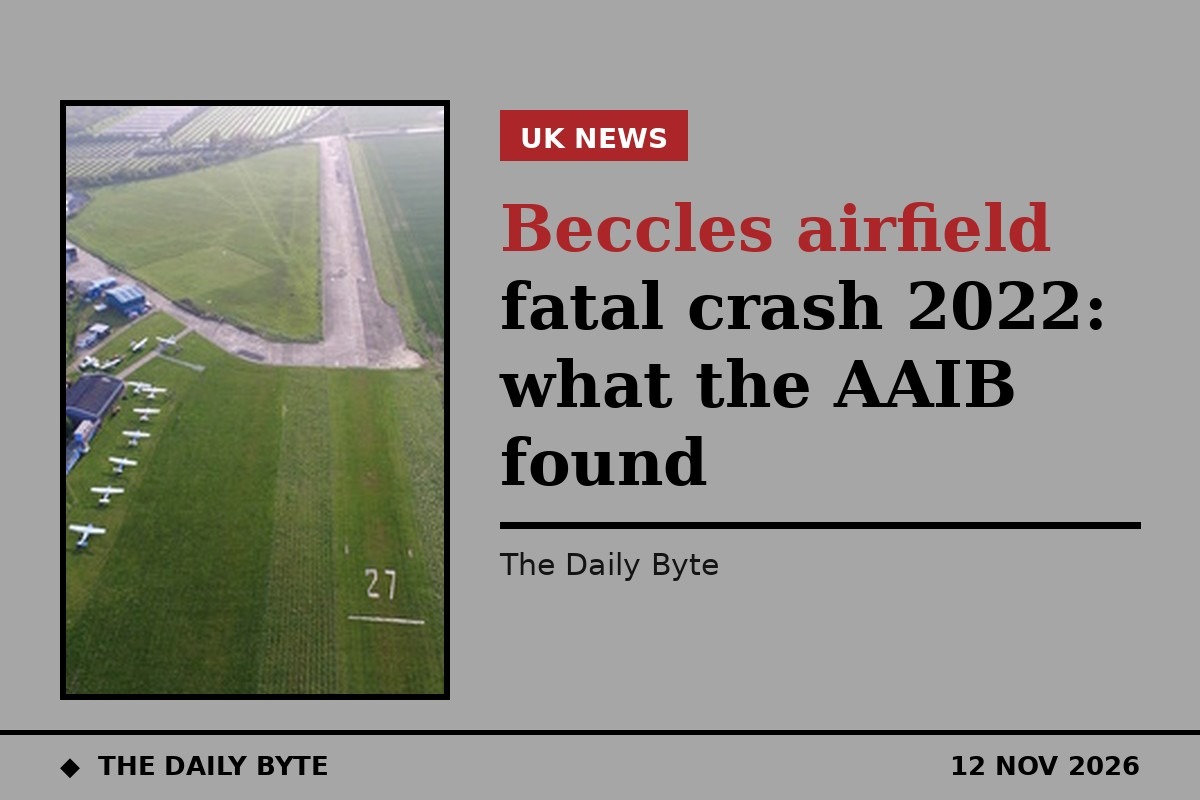
When a light aircraft crashed while landing at Beccles Aerodrome on 28 October 2026, four people on board survived with minor injuries. It was not the first time the Suffolk airfield has seen a landing go badly wrong. In March 2022, a light aircraft crashed on landing at the same airfield and its pilot was killed, and the official investigation that followed led to safety recommendations that are still being acted on today.
The Air Accidents Investigation Branch (AAIB) published its report into the 2022 crash in April 2023. It found an unstable approach, a bounced landing and a probable stall, and it raised wider questions about how older private pilots are assessed. This is what the investigators found, and what changed as a result.
What happened on 24 March 2022
Just after 2pm on Thursday 24 March 2022, a Flight Design CT2K light aircraft, registration G-CBDJ, crashed at Beccles Aerodrome in Ellough, Suffolk. The pilot was the only person on board. Suffolk Constabulary said the aircraft was attempting to land when the crash happened, and the pilot died at the scene. An area of the airfield was cordoned off while police investigated, and the pilot’s next of kin were informed.
The aircraft had been flying from Temple Bruer airstrip in Lincolnshire to Beccles. According to the AAIB, the approach was described as “unstable”. The aircraft bounced on landing and probably stalled, then struck the ground. The pilot was fatally injured.
What the AAIB found
The AAIB’s report, published on 20 April 2023, said the pilot was familiar with his aircraft and in recent practice, but that the landing diverged from his intended plan. The pilot was 87 years old and recognised that he would likely have to stop flying in the near future. The investigators said it was possible that some age-related deterioration in human performance was a factor in the accident.
The investigation also highlighted a wider problem: a lack of medical guidance for both pilots and medical professionals, and a group of private pilots who are not subject to an independent professional assessment of age-related deterioration in their flying ability. The AAIB made four safety recommendations to the Civil Aviation Authority (CAA), three about the Pilot Medical Declaration and one about the revalidation of ratings.
What changed after the report
The CAA responded to the recommendations, and by 30 June 2025 it had published a Pilot Health Safety Sense Leaflet, a guide aimed at helping pilots recognise health issues that can affect their flying. The AAIB has recorded its assessment of the CAA’s response as adequate, and the recommendation is now listed as closed.
The 2022 crash is a reminder of why the AAIB investigates even accidents at small airfields. Its job is not to apportion blame but to establish what happened and to make safety recommendations so that similar accidents can be prevented. In this case, the recommendations were about medical fitness and the way pilots’ ratings are renewed, issues that apply far beyond one airfield in Suffolk.
The 2026 crash and the investigation now under way
The crash on 28 October 2026 was different in outcome: the aircraft, a light aircraft attempting to land shortly before 12.10pm, came down with four people on board. Three were taken to James Paget Hospital in Great Yarmouth with minor injuries, and a fourth person was treated at the scene. No deaths were reported.
The AAIB has been notified of the 2026 crash and is investigating. No cause has been announced, and no date has been given for any report. Until the branch reports, the cause is unknown, and the 2022 report shows why that process takes time: inspectors examine the wreckage, speak to witnesses and the people on board, and look at flight data, maintenance records and the weather before they draw conclusions.
Sources: GOV.UK, AAIB investigation to Flight Design CT2K, G-CBDJ, Glasgow Times and AAIB safety recommendation record.