Bilawal: Elders Learned from Mistakes at SIUT Launch
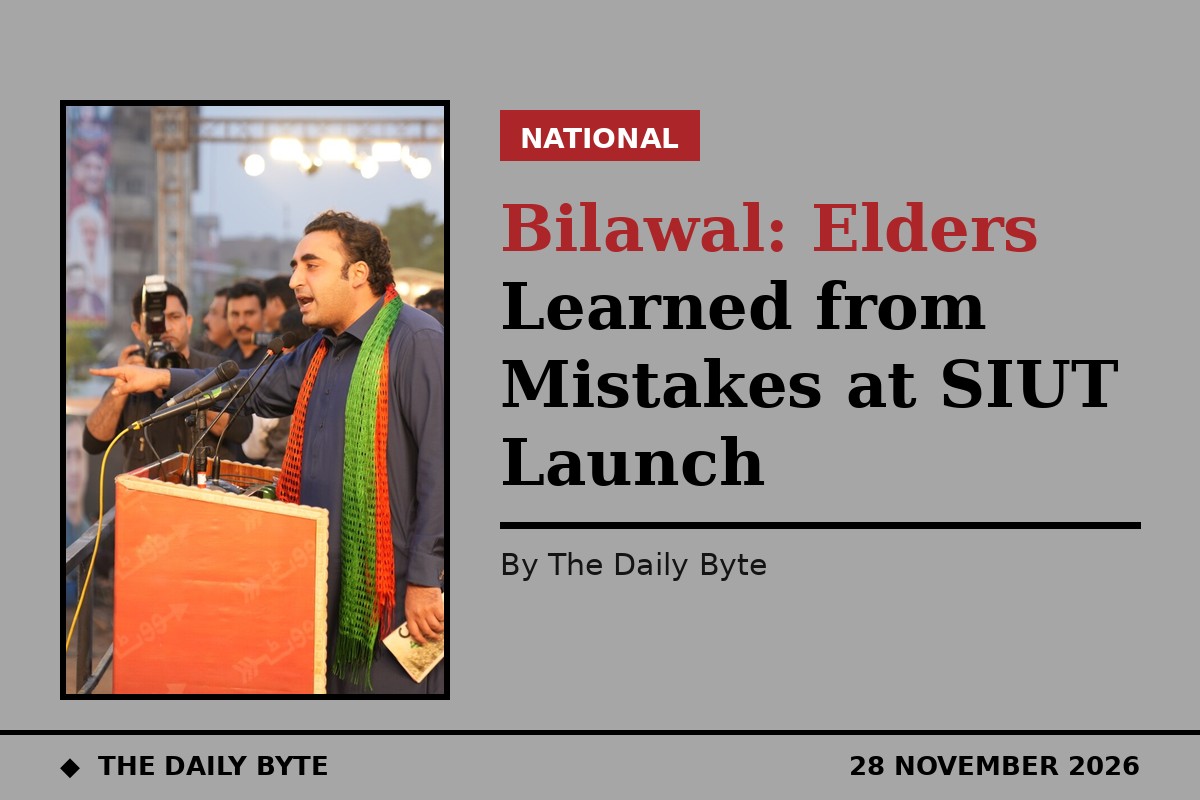
Pakistan Peoples Party Chairman Bilawal Bhutto-Zardari said on Saturday that the leaders of his party and the Pakistan Muslim League-Nawaz had "learned from their mistakes", as he laid the foundation stone of a free-treatment hospital in Rahim Yar Khan and called on political parties to stop trying to topple each other's governments.
Bilawal was addressing the groundbreaking ceremony for the first phase of a Sindh Institute of Urology and Transplantation (SIUT) hospital in Rahim Yar Khan, during his tour of southern Punjab. He said political parties could work for the people if they stopped trying to bring down each other's governments, and warned that continued infighting during an economic crisis would be unfair to the public.
A 50-bed free hospital
The first phase of the SIUT hospital will have 50 beds and provide dialysis, emergency care, laboratory tests, stone treatment, ultrasound and digital X-ray services. Treatment through all of these facilities will be completely free, Bilawal said.
Work on the project began in October 2026, and the aim is to complete the first phase within a year and begin providing free treatment there. Operating theatres and other medical facilities will be added in the second phase.
Bilawal said the project was progressing because Punjab Chief Minister Maryam Nawaz had not obstructed it in South Punjab, and he thanked her for her cooperation. He also thanked Prime Minister Shehbaz Sharif for authorising federal funds to be channelled to the Sindh government for the project. The provincial government worked with SIUT founder Dr Adib Rizvi to develop the hospital's plan.
He said that when a person's illness was known and treatment was available, but they could not afford it, the lack of resources could amount to a death sentence. Free treatment, he said, was part of his party's manifesto, and he had sought since entering politics to ensure that poor people could access world-class medical care.
'Learned from their mistakes'
The sharpest part of Bilawal's speech was aimed at the history of rivalry between the PPP and the PML-N. He said the PPP would receive a government, but it would be gone before completing even a year, leaving its projects stalled. When "Mian Sahib" received a government, he said, it too would end before its term, bringing his projects to a halt.
Projects started by one government had previously been halted when another came to power, he said. New projects would then be launched after a change of government, while earlier ones remained incomplete, with the public ultimately bearing the cost of the political wrangling.
Bilawal said their elders had made mistakes and learned from them, and that his party was trying to persuade the government to resolve all issues through consensus. He said he had never seen an economic crisis like the current one and feared economic difficulties would increase, describing rising inflation and poverty as major problems and saying people wanted politicians to focus on public issues.
The Charter of Democracy
Bilawal reached back to the 2006 Charter of Democracy, signed by Benazir Bhutto and Nawaz Sharif, as the turning point. Under that agreement, he said, the two parties had agreed to believe in the Constitution and democracy, recognise each other's electoral mandates, and refrain from conspiring to topple governments even while competing politically in elections. They had also agreed not to stop public projects started by one another.
He argued that the same approach was needed now: political differences set aside, decisions taken together, and public-interest projects protected from changes of government. Retaliatory politics, he added, would be a grave injustice to the people.
The remarks follow days of public sparring between the two coalition partners, including sharp exchanges over Defence Minister Khawaja Asif's social media posts about Bilawal.
Wider SIUT expansion
Bilawal said the party planned to extend SIUT services beyond Rahim Yar Khan to Kot Addu, Gujar Khan and Dera Ismail Khan, with free, non-discriminatory treatment for heart, kidney and liver conditions provided across Sindh. The Sindh government's current financial year budget allocated an estimated Rs250 million each for SIUT hospitals in Rahim Yar Khan, Gujjar Khan, Sargodha, Dera Ismail Khan and Kot Addu.
The Rahim Yar Khan hospital is the first of those to reach the foundation-laying stage. If the first phase is completed on the promised timetable, free dialysis and diagnostic services will reach a part of southern Punjab where patients now travel long distances, often to Karachi, for specialist kidney and urology care.
The foundation stone is in the ground, the funding is allocated and the timetable is public — giving Rahim Yar Khan residents something concrete to measure the promises against.