Philippines Growth Forecasts Cut by BMI and Nomura
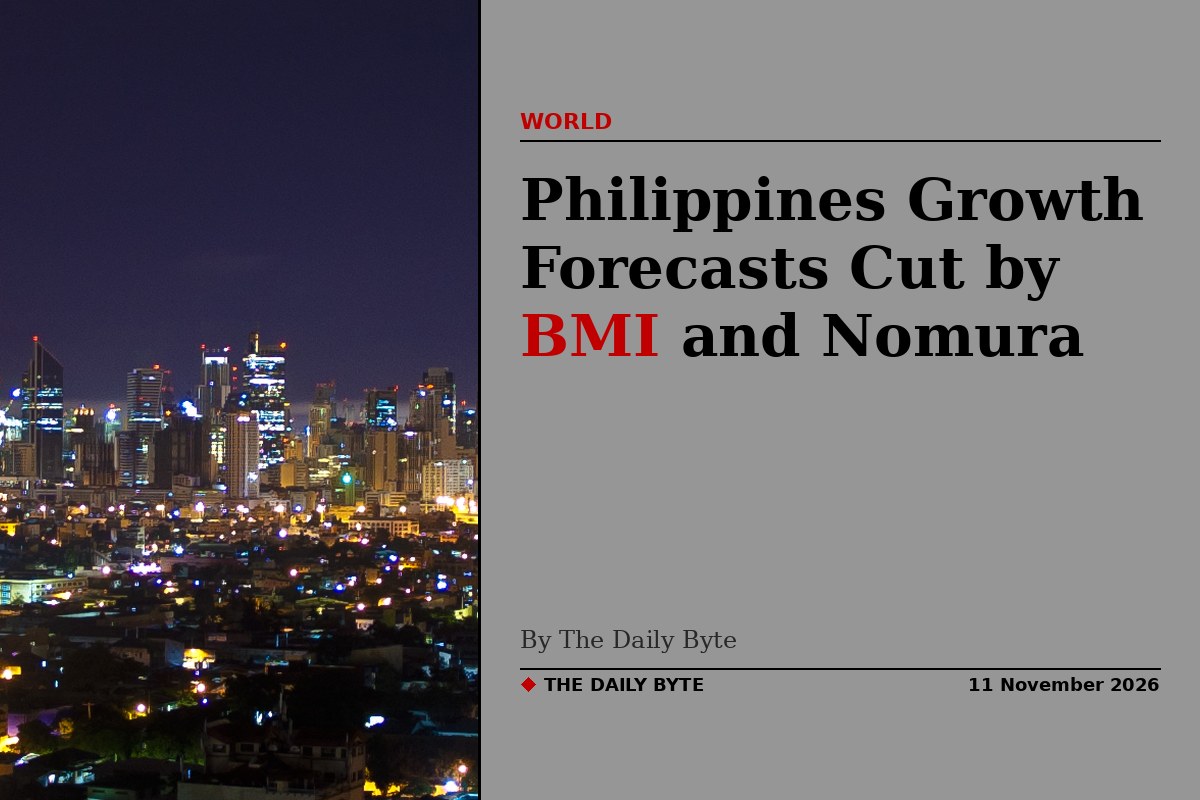
Two international research firms have cut their growth forecasts for the Philippines after the economy grew by just 2.1% in the third quarter of 2026. BMI, a unit of Fitch Solutions, now expects full-year growth of 2.6%, down from 3%, while Nomura has lowered its forecast to 3% from 3.8%. Both figures sit below the Philippine government's own target of 3.5% to 4.5% for the year.
The downgrades, published on Wednesday 11 November, follow the Philippine Statistics Authority's report that the economy expanded by only 2.1% year on year in the July-to-September period. That was the weakest quarterly performance since the pandemic, when the economy contracted by 3.8% in the first quarter of 2021, and the slowest outside the pandemic period since growth of 1.8% in the final quarter of 2009.
Household spending and farming drag on growth
Household consumption, which accounts for more than 70% of Philippine GDP, grew by only 2.4% in the third quarter, its weakest in more than five years. BMI said high inflation would continue to erode purchasing power and dampen spending well into next year. Inflation accelerated to 7.8% in October, its fastest in nearly four years, and has now spent eight consecutive months above the Bangko Sentral ng Pilipinas (BSP) target, taking the year-to-date average to 5.6%.
Agriculture was the weakest part of the economy. The sector contracted by 4.8% in the third quarter as typhoons and a strong El Niño disrupted output. The state weather bureau has said a strong to very strong El Niño is active in the tropical Pacific, is expected to peak before the end of the year and could last into the first quarter of 2027. By 13 October, 109 cities and municipalities had declared a state of calamity because of the phenomenon, according to the National Disaster Risk Reduction and Management Council.
Investment also remained muted. Gross capital formation contracted by 0.2% for a fifth consecutive quarter, while public construction fell for a sixth straight quarter, although the 15.1% decline was smaller than the 33.4% drop recorded in the previous quarter. Infrastructure disbursements fell for a 14th consecutive month in August, to 70.5 billion pesos from 84.9 billion pesos a year earlier.
Government target now looks out of reach
The third-quarter result brought growth for the first nine months of the year to 2.5%. To reach even the lower end of the government's 3.5% to 4.5% target, the economy would need to expand by about 6.3% in the fourth quarter, a pace both forecasters regard as unlikely. BMI said that if its forecasts hold, the Philippines will miss its growth target for a fifth straight year.
Nomura was slightly more hopeful about the final quarter, saying its forecast still implied a pickup in fourth-quarter growth to above 4% year on year, helped by favourable base effects and a pickup in public infrastructure spending. Its analysts said the Marcos administration had a strong incentive to pursue catch-up spending after the flood-control corruption scandal, with President Ferdinand Marcos Jr.'s net satisfaction rating falling to -11, rated "poor", in a September survey by Social Weather Stations.
BMI also cut its 2027 growth forecast to 4% from 4.5%, below the government's medium-term target of 5% to 6%. It said the weak momentum of 2026 would carry over into next year, although faster public capital spending could drive a recovery, with a sharper rebound likely only in 2027 rather than in the final quarter of 2026.
Interest rates still expected to rise
Despite the slowdown, Nomura still expects the BSP to raise its key policy rate by 50 basis points in December, to 6%, citing stubborn inflation risks. The central bank raised its rate by 50 basis points last month to a nearly two-year high of 5.5%, taking cumulative tightening to 125 basis points since April. Its final rate-setting meeting of the year is on 17 December.
BMI offered some offsetting positives for 2027, noting that strong demand for artificial intelligence should continue to support technology exports, while lower oil prices in the second half of 2027 should improve the terms of trade. The Development Budget Coordination Committee is expected to meet next month to review the government's growth targets.
What the new forecasts mean
What did BMI forecast for Philippine growth? BMI cut its 2026 forecast to 2.6% from 3%, and its 2027 forecast to 4% from 4.5%.
What is the government's growth target? The government is targeting growth of 3.5% to 4.5% in 2026 and 5% to 6% in 2027.
When does the Philippine central bank next meet? The Bangko Sentral ng Pilipinas holds its final rate-setting meeting of the year on 17 December, when Nomura expects a 50-basis-point rise. Sources: BusinessWorld and BusinessMirror.