Brent crude falls to $92.57, lowest since August
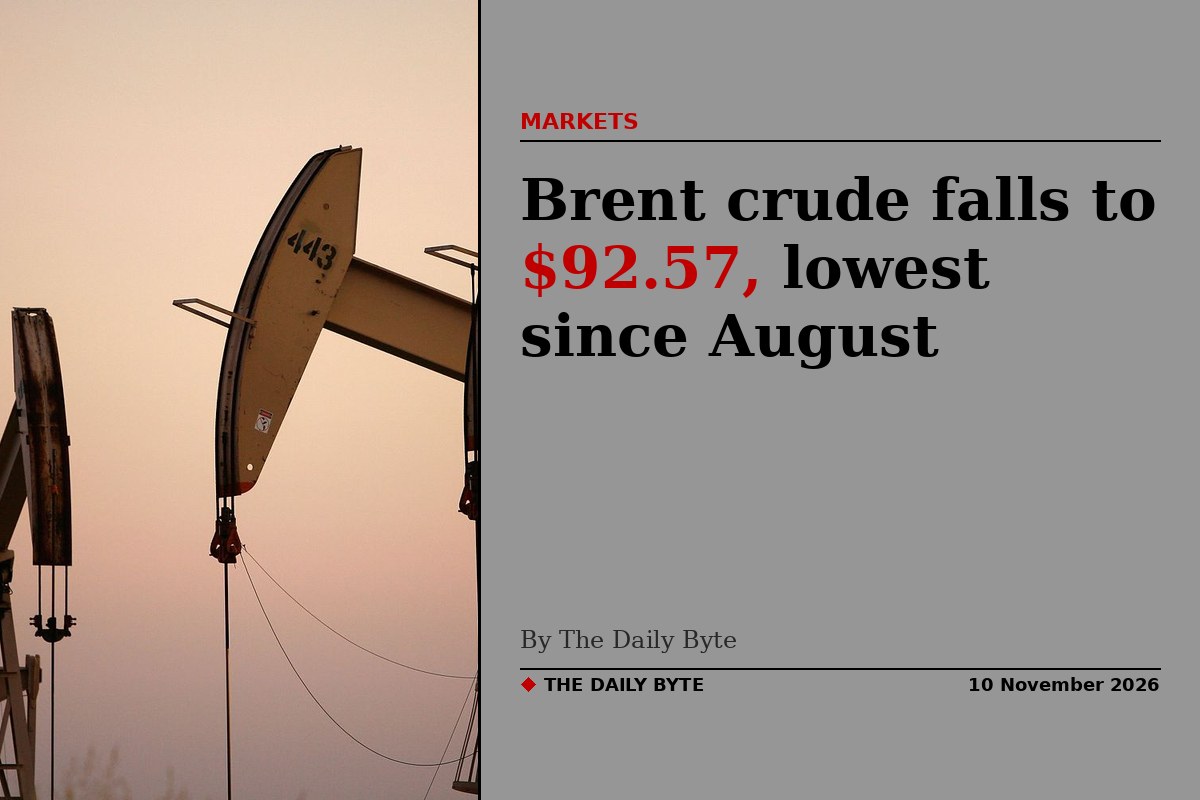
Brent crude fell sharply on Monday, settling at $92.57 a barrel, its lowest level since late August, as traders bet that diplomacy between the United States and Iran will keep oil flowing and strip the war premium out of prices.
Reuters reported that Brent futures settled down $5.75, or 5.85%, at $92.57 a barrel. Prices kept falling after the settlement, dropping more than $7 on the day. US West Texas Intermediate settled down $3.98, or 4.38%, at $86.85 a barrel.
The slide extends a brutal stretch for oil. Brent plunged 16% last week, its steepest weekly fall since the Covid-19 pandemic began, as the market unwound the premium built up during weeks of US-Iran tension.
Trump signals restraint on Iran
The trigger was President Donald Trump. On Sunday he said the likelihood of new US strikes on Iran was “very low” if negotiations made progress. On Monday he met Qatar’s Prime Minister Sheikh Mohammed bin Abdulrahman Al Thani at the White House, with Qatar acting as an intermediary between Washington and Tehran.
Trump had previously hinted that strikes could resume after last week’s US midterm elections, and Tehran had vowed to retaliate against US and Israeli targets. So far there has been no sign of a large-scale US military campaign.
The picture is mixed. US Secretary of State Marco Rubio said negotiations with Iran had made no progress and there was no sign of a breakthrough in the near future. A senior Iranian security official told state media that Tehran has no plans to negotiate unless Washington takes practical steps to meet seven conditions set out in a June interim agreement.
Physical market looks well supplied
Beyond the diplomacy, the physical market looks soft. Morgan Stanley said in a report on Monday that dated Brent, used to price cargoes around the world, had weakened to a discount to the nearby futures contract, a sign of slack demand. JPMorgan estimated the global oil surplus at around 1.4 million barrels a day in October.
Both sides continue to accuse each other of disrupting shipping in the Strait of Hormuz, the narrow waterway that carries a large share of the world’s seaborne oil. In an interview on 8 November, Iraqi Foreign Minister Fuad Hussein said Baghdad and Washington had agreed arrangements allowing Iraqi oil tankers to pass through the strait along a route near Oman.
What comes next
Traders now look to a run of scheduled events. The US October consumer price index is due on Tuesday 10 November at 13:30 GMT, and the US Energy Information Administration publishes its Short-Term Energy Outlook the same day. OPEC’s Monthly Oil Market Report follows on Wednesday 11 November.
In its October outlook, the EIA raised its fourth-quarter Brent forecast to $105 a barrel. Any cut to that figure will show how much of the war premium the agency now sees as lasting. OPEC+ next meets in full on 29 November.
For now, the market’s message is clear: with no deal announced, no strikes launched and supply ample, the fear premium that pushed Brent towards $118 in late October has been cut hard. But with tanker attacks continuing in the strait and talks unresolved, that premium can return quickly.