Brent Crude Falls Below $90 First Time Since August
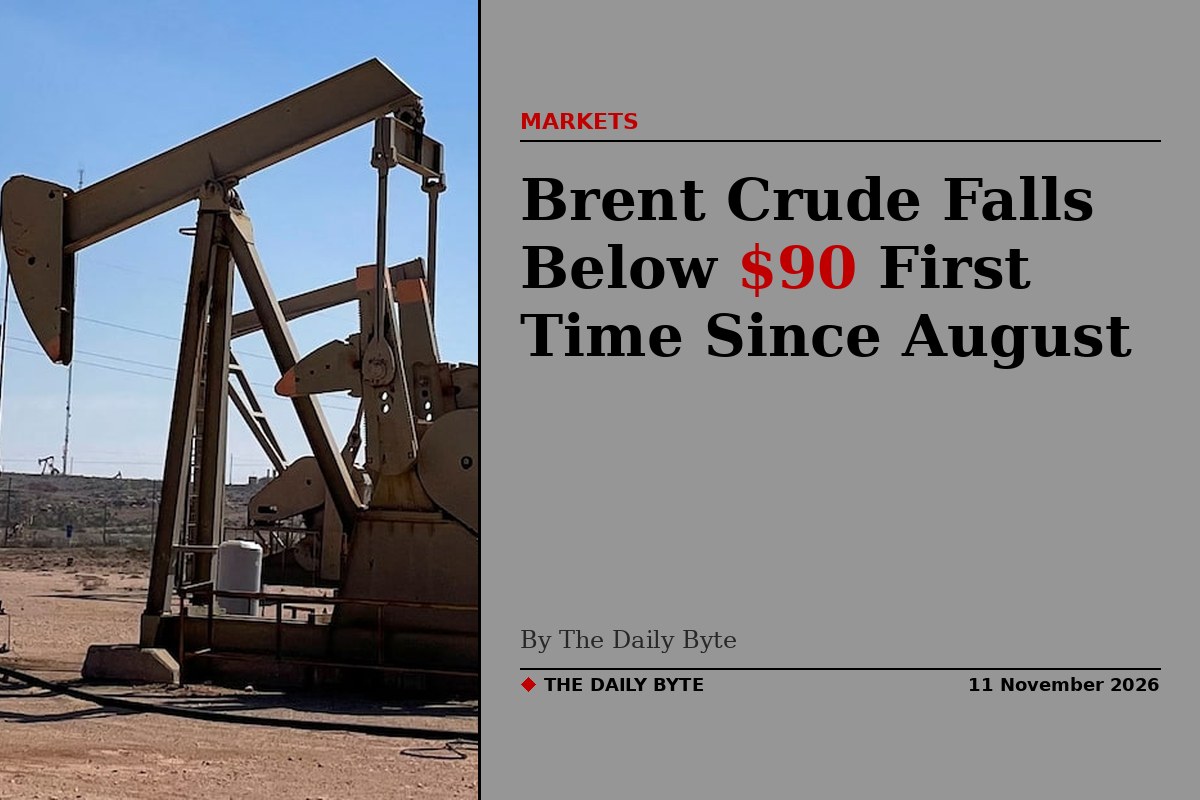
Brent crude fell below $90 a barrel on Tuesday, 10 November, for the first time since August, as hopes grew that the war between the United States and Iran could be coming to an end.
The international benchmark was down 2.9% at $89.92 a barrel at 5:05am Eastern Time, after touching lows of about $89.20 earlier in the morning, its lowest price since late August. US benchmark West Texas Intermediate fell 2.6% to $84.60 a barrel.
The drop extended a sharp slide on Monday, when Brent settled 5.9% lower at $92.57 a barrel.
Trump comments move the market
The fall followed comments from Donald Trump after he met Qatar's prime minister, Sheikh Mohammed bin Abdulrahman Al Thani, at the White House on Monday.
Mr Trump told reporters: "We're seeing momentum toward the end of this conflict. I think it's going to be ending fairly soon." He added that "Iran militarily is effectively over" and described further US strikes as "quite unlikely".
He also said the United States would keep its naval blockade in the Strait of Hormuz in place for now, and he did not rule out further military action if circumstances changed.
Tehran has denied that talks with Washington are taking place. Mohsen Rezaei, secretary of Iran's Supreme National Security Council, said the US should "stop manufacturing fake news about imaginary talks".
Despite the market's relief, analysts cautioned that no peace deal had been agreed. Fereidun Fesharaki, chairman of energy consultancy FGE, told CNBC he still saw no prospects of a lasting deal between the US and Iran.
Supplies recover as Gulf exports return
Rising supply added to the downward pressure on prices. OPEC pumped more oil in October than in September, according to a Reuters survey, led by Saudi Arabia, Kuwait and Iraq.
Analysts at ING said crude exports from the Persian Gulf were estimated to have returned to around 80 to 85% of pre-war levels, including pipeline volumes, while refined product shipments had recovered to roughly 35 to 40%.
The ING analysts, Ewa Manthey and Warren Patterson, added that reports Iran may be softening its position on control of the Strait of Hormuz had also reduced concerns about a prolonged disruption to one of the world's most important oil transit routes. They stressed, however, that oil prices "remain sensitive to developments in the Middle East".
Brent started 2026 at around $60 a barrel before climbing as high as $130 as military strikes escalated in March and April. Even after Tuesday's fall, it remained well above its starting level for the year, and by the London close it had recovered to $91.74 a barrel.
What it means for fuel prices and inflation
The slide reached fuel markets, with diesel futures down 4.0% and petrol futures down 1.9%. In the United States, regular petrol now averages $3.98 a gallon, down from $4.37 a month ago.
Energy shares fell in early trading, with ExxonMobil and Chevron both down 0.8% before the market opened, while the United States Oil Fund lost 2.7%. Gold also slipped, falling 0.6%.
For households in the UK, cheaper oil could eventually bring some relief from high fuel and energy costs, which have pushed inflation higher and led the Bank of England to raise interest rates last week.
The Bank's governor, Andrew Bailey, has said that even if oil and gas prices fall, there is "already a significant amount of inflation pressure in the pipeline". He has also said the best thing that could happen for the UK economy would be for the conflict in the Middle East to be resolved. Read the StockAnalysis report on the Brent slide and the PA Media report on oil prices.