Brent crude rebounds above $93 as Hormuz risks offset output rise
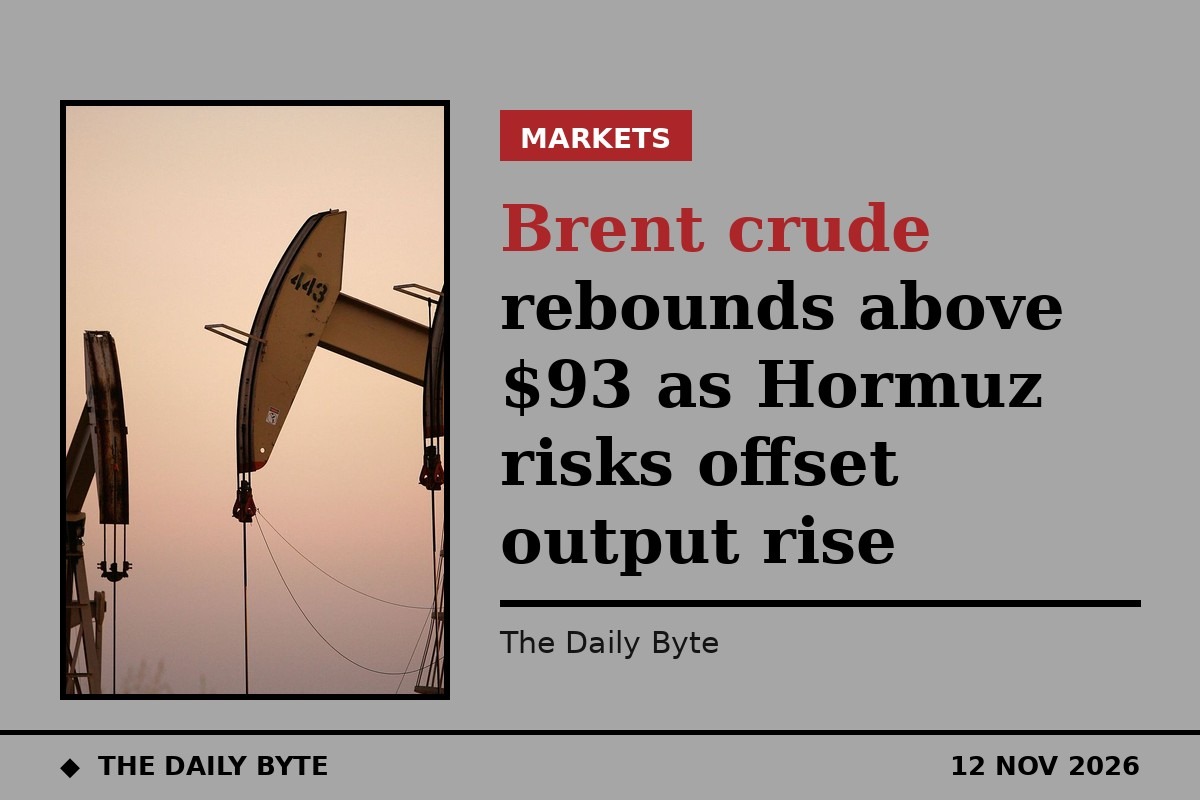
Brent crude rose above $93 a barrel on Thursday, 12 November, recovering from early losses of more than $1 as disruption to shipping through the Strait of Hormuz and tensions over Russia outweighed pressure from rising oil output.
Brent futures were up $1.20, or 1.3%, at $93.96 a barrel by 12:08 p.m. ET, while US West Texas Intermediate crude was up 53 cents, or 0.6%, at $87.06, according to Reuters. Both benchmarks had fallen by more than $1 a barrel in early Asian trading before turning higher, and both remained on course for a weekly decline.
Shipping risks outweigh extra supply
The rebound came despite fresh evidence that supply is returning quickly. OPEC said in its November monthly report that crude production by OPEC+ countries rose by about 2.04 million barrels a day in October to 41.23 million barrels a day, close to the group's 2025 average. Saudi Arabia told OPEC it pumped 10.563 million barrels a day in October, up from 8.372 million in September, although OPEC's own secondary-source estimate put Saudi output far lower, at 9.194 million barrels a day.
Traders set that against continued disruption to shipping through the Strait of Hormuz, the narrow waterway that carries a large share of the world's seaborne oil, and fading hopes of a swift end to the confrontation between the United States and Iran. US President Donald Trump said the US "does not need a deal with Iran", a comment that cooled expectations of a diplomatic breakthrough. Ole Hansen, head of commodity strategy at Saxo Bank, described the position as "neither war nor peace", with Middle East oil production recovering despite the deadlock in the US-Iran negotiations.
US stockpiles add to the pressure
Inventories in the United States also pointed to looser supply. Market sources citing American Petroleum Institute figures said US crude stockpiles rose by about 9 million barrels in the latest reporting week. The official Energy Information Administration report, delayed by a day because of the Veterans Day holiday, was due on Thursday, and traders were waiting to see whether it confirmed the industry estimate.
Earlier in the session, Brent had traded as low as $92.39, and the benchmark had touched a ten-week low of $91.50 on 10 November. By the London close, Sharecast reported Brent up 1% at $93.78, with West Texas Intermediate largely flat at $86.85.
What it means for UK drivers
For UK motorists, the moves matter, but with a lag. Brent is the benchmark that feeds into wholesale petrol and diesel prices, yet pump prices also reflect refining margins, tax and the value of the pound, so a single day's swing does not translate directly into what drivers pay at the forecourt. What the week has shown is how quickly the market can swing between two stories: extra barrels returning from the Gulf, and the risk that shipping through Hormuz is disrupted again.
OPEC, for its part, left its demand outlook unchanged in the November report, expecting global oil demand to grow by only about 0.2 million barrels a day in 2026, to 105.7 million barrels a day, before a much stronger increase of about 2.6 million barrels a day in 2027. With demand growth near flat this year and supply rising, analysts expect prices to stay volatile, moving sharply on each new development in the Gulf.
Sources: Reuters; Sharecast via Hargreaves Lansdown; ADVFN