Brent crude rises to $92.76 as Iran talks hopes fade
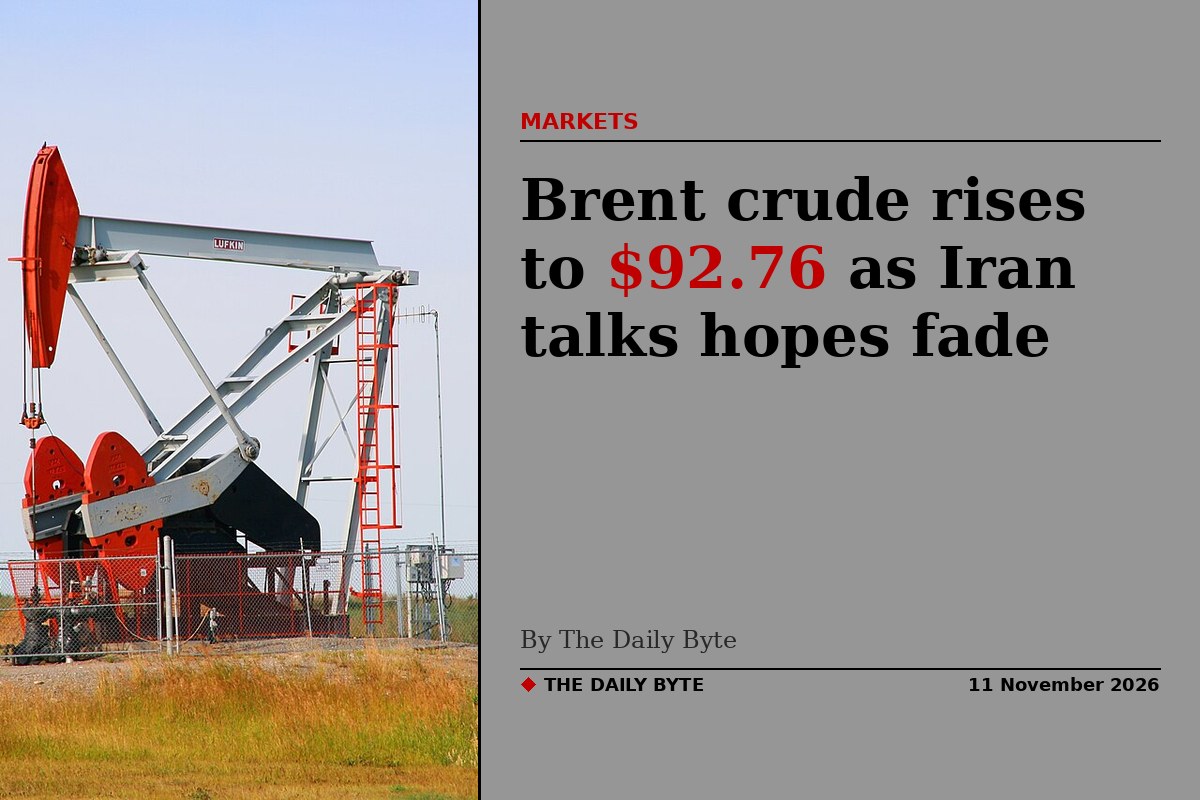
Brent crude settled $1.27 higher at $92.76 a barrel on Wednesday 11 November 2026, a rise of 1.39%, while US West Texas Intermediate crude gained 49 cents, or 0.57%, to settle at $86.53. Oil recovered from the two-month lows reached in the previous session as hopes of an imminent de-escalation in the US-Israeli war on Iran faded, according to MLQ.ai.
Brent had been up nearly 3% at $93.90 late in the morning in New York, and heating oil futures, the US diesel benchmark, gained 4.1%. Earlier in the session, Brent futures were up $2.15, or 2.35%, at $93.64 a barrel by 12:04 p.m. EST, while West Texas Intermediate gained $1.69, or 1.96%, to $87.73, Reuters reported via Kitco.
The rebound came after Mohsen Rezaei, Iran's top security official, said no talks with Washington were under way and called reports of a recent meeting in Qatar "pure lies" meant to push oil prices down. He also said Tehran would not allow any enriched nuclear material to leave the country, feeding supply worries. Washington has said nuclear issues must be part of any initial negotiations with Tehran aimed at ending the war.
"Oil prices are being supported by fading hopes of an imminent de-escalation," UBS analyst Giovanni Staunovo said.
Sharp falls since the start of November
The recovery was relatively modest compared with the substantial declines recorded earlier in November. Brent and West Texas Intermediate prices have fallen about 21% and 17% respectively since the start of the month on hopes of an end to the war. In the previous session, oil prices initially fell by more than $3 a barrel after US officials played down the need for further military strikes against Iran, before paring some losses after an Iranian security official said no talks were taking place.
While OPEC+ crude oil production jumped in October, led by a sharp increase in output from Saudi Arabia, there is little sign of easing disruption in the Strait of Hormuz. Data from the Washington Institute for Near East Policy showed that 37 ships were attacked in October, the highest monthly total since the start of the war. A tanker was struck northeast of Lima in Oman on Tuesday, according to the United Kingdom Maritime Trade Operations agency, and Iran's Revolutionary Guards Navy said separately that two tankers caught fire after hitting naval mines on an "unauthorised route" in the strait.
"This demonstrates that operational risks have not disappeared simply because diplomatic signals have turned more positive," said Simon-Peter Massabni, head of business development at XS.com. "More importantly, even if a political agreement is reached, shipping activity is unlikely to return to normal immediately."
Data from Kpler shows that Middle East crude and condensate outages have dropped to about 3.8 million barrels per day, with Saudi and Iraqi crude output back to pre-war levels. LSEG Oil Research said in a note on 10 November that even in the event of a deal, an increase in flows through the waterway would depend on mine clearance, insurance costs and whether shipowners would be willing to take the risk.
EIA expects Brent near $100 into year-end
A day earlier, the US Energy Information Administration said in its November Short-Term Energy Outlook that it expects the Brent spot price to remain near $100 a barrel for the rest of this year, as falling global inventories, tanker attacks in the Persian Gulf and scarce shipping capacity keep supply tight. The agency expects Brent to average $97 a barrel in 2026 and $86 in 2027, falling to $77 in the fourth quarter of 2027.
Refined products are tighter than crude. The EIA raised its 2027 retail diesel forecast to $5.03 a gallon, 12% above its October forecast, because damaged refineries in the Middle East and Russia keep product markets tight. Households heating with oil are forecast to spend $2,115 this winter, about 21% more than last year, while those using natural gas are expected to spend 9% less.
US crude stocks rose by 9 million barrels in the latest week, market sources said, citing data from the American Petroleum Institute. Official data is due on Thursday, delayed a day by the US Veterans Day holiday on Wednesday. Russian oil refining capacity has been reduced by about 30% since late October following renewed Ukrainian drone attacks, industry sources said.
Sources: Kitco / Reuters and MLQ.ai.