Brent oil steadies near $92 as Hormuz risk offsets glut
Brent crude steadied near $92 a barrel on Monday 23 November 2026, trading at $92.01, with US West Texas Intermediate (WTI) around $83.00, as the risk of further attacks on tankers in the Strait of Hormuz balanced forecasts of a return to oversupply. Oil futures had not yet reopened in full at the time of writing after a volatile week.
Brent had settled on Friday 20 November at $92.57 a barrel, up 59 cents or 0.64 percent, while WTI settled at $83.98, up 77 cents or 0.93 percent, Reuters reported. Friday's bounce was driven by fears of renewed attacks in the US-Israeli war with Iran and by buying ahead of the US Thanksgiving holiday. Even after that rise, both benchmarks were on course for a third straight weekly decline, Brent down nearly 4 percent on the week and WTI down about 5 percent.
Hormuz risk against a glut
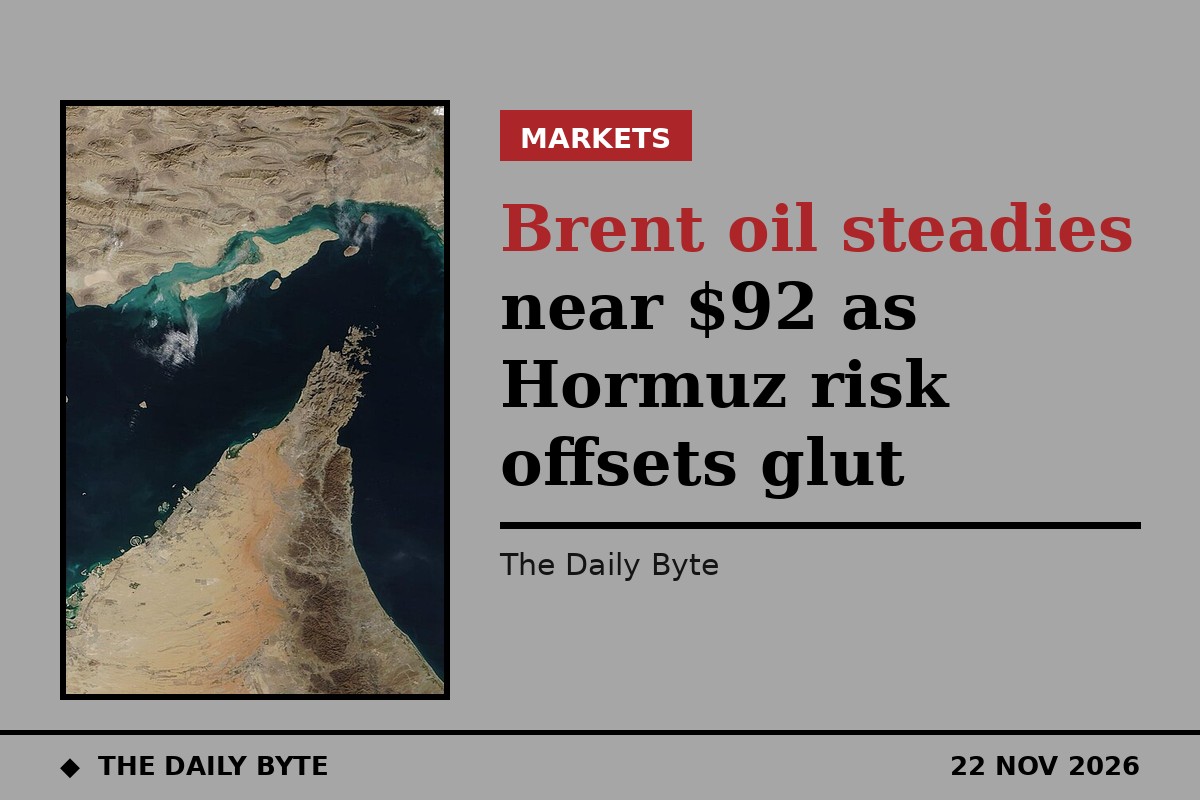
The tension in the market is straightforward: the physical risk to shipping keeps rising while the volume of oil flowing keeps recovering. A tanker sailing outbound through the Strait of Hormuz was hit by an unidentified projectile near Khasab, Oman, on 21 November, according to reports from the United Kingdom Maritime Trade Operations agency. Iran's navy said a tanker caught fire after hitting a naval mine east of the strait, an account Reuters could not independently verify.
Analysts at UOB count roughly one incident a day in November, yet crude shipments through the strait have returned to roughly pre-war levels, which is what has been pulling prices down. Tanker-tracking firm Vortexa said this week that Iran had designated more than 50 percent of the tankers Gulf petrostates use to transfer their oil to the Gulf of Oman, from where it reaches global markets, helping to keep a steady flow out of the Persian Gulf despite the attacks.
What traders watch next
The next big decision point is the OPEC+ meeting on 29 November, where producers will weigh whether to tighten supply against a market the International Energy Agency expects to be in surplus. Trading is also set to thin out this week, with US markets closed on Thursday for Thanksgiving, so sharp moves on low volumes are possible. For now, Brent is pricing the volume of oil available, not the danger of the voyage, and the two have rarely been so far apart.
Frequently asked questions
Why is Brent steady despite attacks on tankers? Because crude shipments through the Strait of Hormuz have recovered to roughly pre-war levels, and forecasters expect a supply surplus. The attacks raise the risk and cost of each voyage, but they have not yet cut the volume of oil reaching the market.
What is the Strait of Hormuz? It is the narrow strait between the Persian Gulf and the Gulf of Oman, separating Iran from the Arabian Peninsula. About 30 percent of the world's seaborne oil passes through it, on shipping lanes only two miles wide at their narrowest, according to NASA.
How far has Brent fallen? Brent closed on Friday 20 November at $92.57 a barrel, down nearly 4 percent on the week, its third consecutive weekly decline. WTI fell about 5 percent over the same week.
When does OPEC+ meet? The producer group meets on 29 November 2026. Traders will watch for any signal of tighter supply, which would be the clearest support for prices if the Hormuz risk premium fades.