Embryo Tech Gives Pakistan Buffalo Farmers New Hope
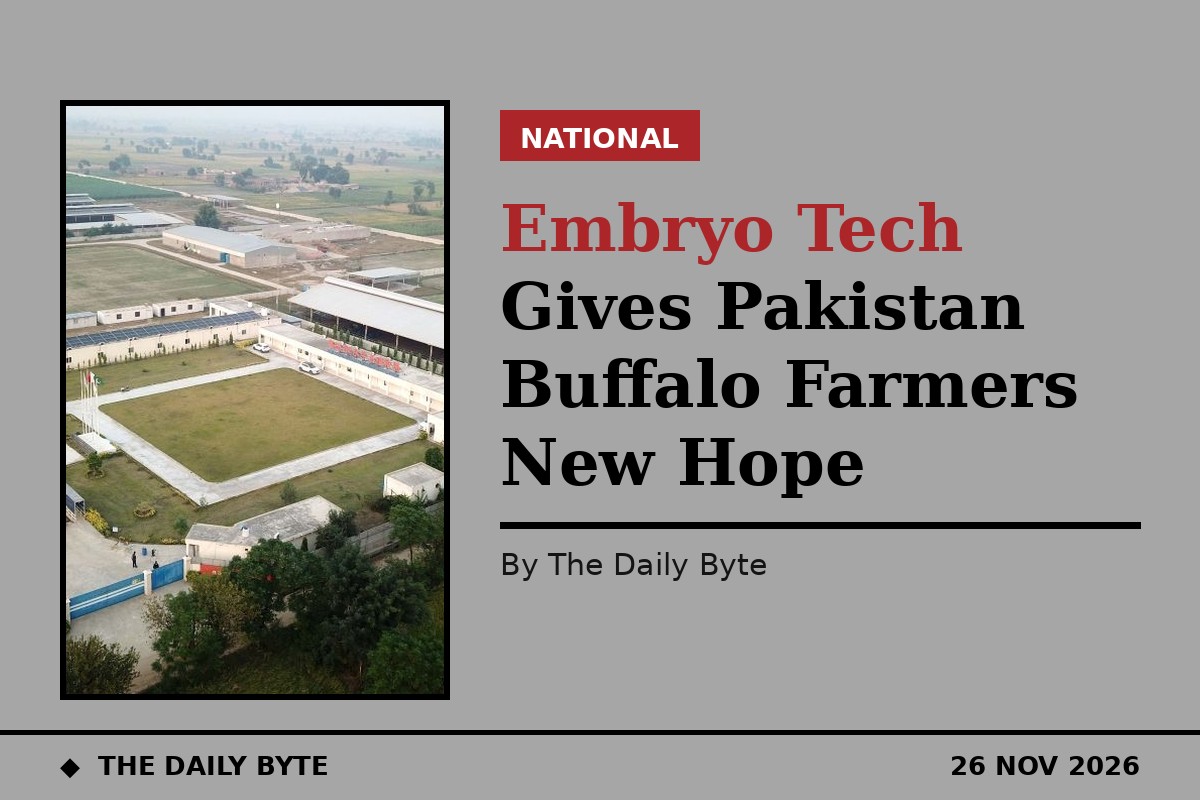
Embryo breeding technology brought to Pakistan under the China-Pakistan Economic Corridor is giving buffalo farmers in Punjab a new way to raise milk yields, after years in which crossbreeding steadily reduced the productivity of their herds.
Usman Haider, a 39-year-old buffalo farmer from Sheikhupura district, told Xinhua that rising herd-maintenance costs had become a burden because milk sales often failed to cover his expenses. High- and low-milk-producing breeds have been crossbred over time, he said, resulting in a significant decline in overall milk production.
A CPEC project that began in 2021
For farmers like Haider, improving the genetic quality of local buffalo herds is essential to making livestock farming pay. A turning point came in 2021, when a cooperation project under CPEC led to the establishment of Royal Cell Biotechnology (Pakistan) Co. (Pvt.) Ltd. and the launch of a China-Pakistan buffalo breeding and dairy processing project.
The project promotes in-vitro embryo breeding technology to increase milk production among local buffaloes, and aims to introduce Pakistani buffalo embryos into China to improve dairy buffalo breeds in the Guangxi Zhuang Autonomous Region. It also seeks to develop deep processing of buffalo milk in Pakistan to increase the added value of the dairy industry.
Pakistan contributes its Nili-Ravi buffaloes, among the best dairy water buffaloes in the world, and its large buffalo population. Royal Cell contributes embryo transfer, frozen semen and genomic selection technology, as well as access to China's premium buffalo milk market.
How the embryo technology works
Under the system, carefully selected donor buffaloes undergo superovulation, ovum pick-up and in-vitro fertilisation, followed by blastocyst culture and embryo verification. Local recipient buffaloes then carry the pregnancies, allowing high-quality herds to expand faster. Wang Li, executive manager at Royal Cell Biotechnology (Pakistan), told Xinhua the approach can achieve breeding efficiency several times, or even dozens of times, higher than natural breeding, while reducing the disease risks that come with transporting live animals.
The project is also building local expertise. It has trained more than 20 Pakistani specialists in embryo production and transfer, created 21 biotechnology jobs and generated 72 jobs in large-scale livestock farming, and supported the establishment of five high-quality laboratories across Punjab where embryos are produced and prepared for transfer. At the company's laboratory in Lahore, technician Anita Mustafa examines buffalo embryos under a microscope.
Free embryos for village farmers
As part of its corporate social responsibility work, the company plans to provide buffalo embryos free of charge to farmers in different villages, so they can breed genetically superior animals and gradually improve the quality of local herds.
Previously, dairy farmers in Pakistan relied on importing high-quality cattle from countries such as Australia and the United States, spending millions of dollars on the imports. With local laboratories now able to produce embryos using elite genetics, farmers can breed high-quality animals at home, Muhammad Waqas, technical manager at Royal Cell, told Xinhua.
Nasr MinAllah, chief operating officer of Royal JW Foods, a joint venture between Royal Cell and Pakistan's JW SEZ, said the goal over the next few years is to help farmers produce genetically superior animals with higher milk-producing potential, raise national milk production, strengthen the dairy industry and eventually open international markets to Pakistani buffalo milk and its products.