Burnham reviews £2.4bn Skynet deal as 3,000 jobs at risk
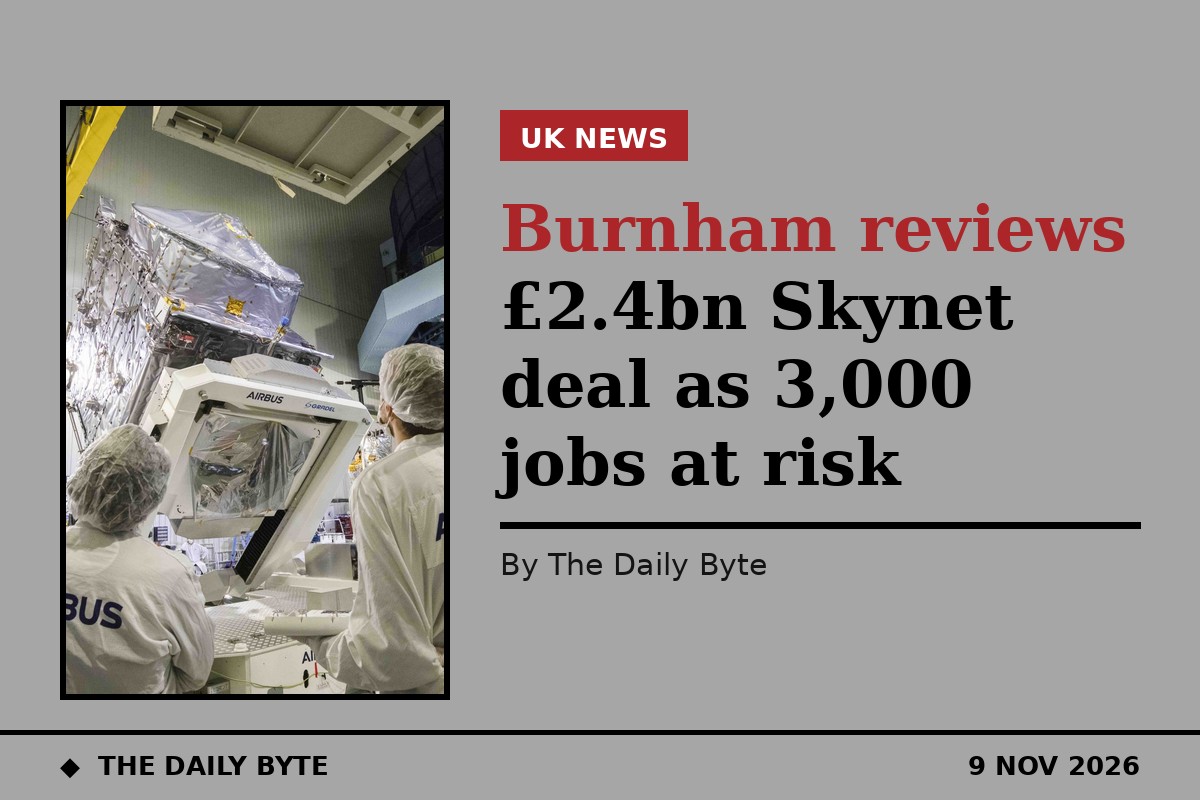
Prime Minister Andy Burnham is personally reviewing a decision on who should build Britain's next military satellites, after reports that the Ministry of Defence favours the American defence giant Lockheed Martin over Airbus for a contract reported to be worth about £2.4 billion.
Four industry sources told Sky News that Mr Burnham is examining a choice thought to have been taken at the Ministry of Defence, and that he has about a fortnight to decide. The Ministry of Defence insists that no final decision has been made, describing the Skynet 6 wideband deal as an ongoing procurement process.
What the Skynet contract covers
Skynet is the satellite system that carries the British armed forces' most sensitive communications. The next stage of the programme covers two new military-grade satellites that would serve into the 2040s, replacing the Skynet 5 system now operated by Airbus. Airbus and its predecessors have built every previous generation of Skynet, with the company's involvement stretching back to 1974.
The decision matters beyond the satellites themselves. Whoever wins the work will shape where Britain's military satellite industry sits for decades, and both sides have been lobbying hard. The head of Airbus, Guillaume Faury, has written to the prime minister arguing that the choice could affect Britain's role in European military satellites for years to come.
Why Airbus says 3,000 jobs are at risk
Airbus has warned that up to 3,000 highly skilled jobs in Britain could be lost if it loses the contract. The work is mainly at its sites in Stevenage and Portsmouth, including about 600 people working directly on Skynet. Senior industry figures have warned that without the next Skynet contract, Airbus's British satellite operations may not remain viable, and the Stevenage facility could close, with Portsmouth operations cut back sharply.
The warning has drawn in the trade unions. Unite, the country's second-biggest union, has pressed the prime minister against handing the work to an American company, and its general secretary, Sharon Graham, has been among those urging him not to sign off the Lockheed Martin bid. Critics of the reported choice say it would sit uneasily with the prime minister's pledge to buy British as he puts the country on a war footing.
What Lockheed Martin is offering
Lockheed Martin UK says its satellites would still be built in Britain. Its proposal includes a new £85 million factory in County Durham and the Tyneside area, with about 500 direct jobs and around 2,000 indirect roles in the supply chain. The company also promises a British design authority and a UK chief engineer, arguing that Britain would keep sovereign control of the satellites built here.
Supporters of the Lockheed Martin bid in the north-east of England, including the region's mayor, Kim McGuinness, have described the factory as a major opportunity for the area's space and defence sector. Lockheed Martin itself has declined to comment on the procurement process while it is still running.
What happens next
The decision is expected within about a fortnight, with the two competing bids due to expire in mid-November. The final call rests with the prime minister. Until then, both companies remain in the running, and the Ministry of Defence says both UK-based bidders are being assessed on the requirement that the satellites are assembled, integrated and tested in the United Kingdom.
Whatever the outcome, the row has exposed a wider tension at the heart of the government's defence plans: how to secure the cheapest and most capable kit for the armed forces while also protecting skilled manufacturing jobs and keeping control of the country's most sensitive communications in British hands.