California overtakes Florida in rocket launches
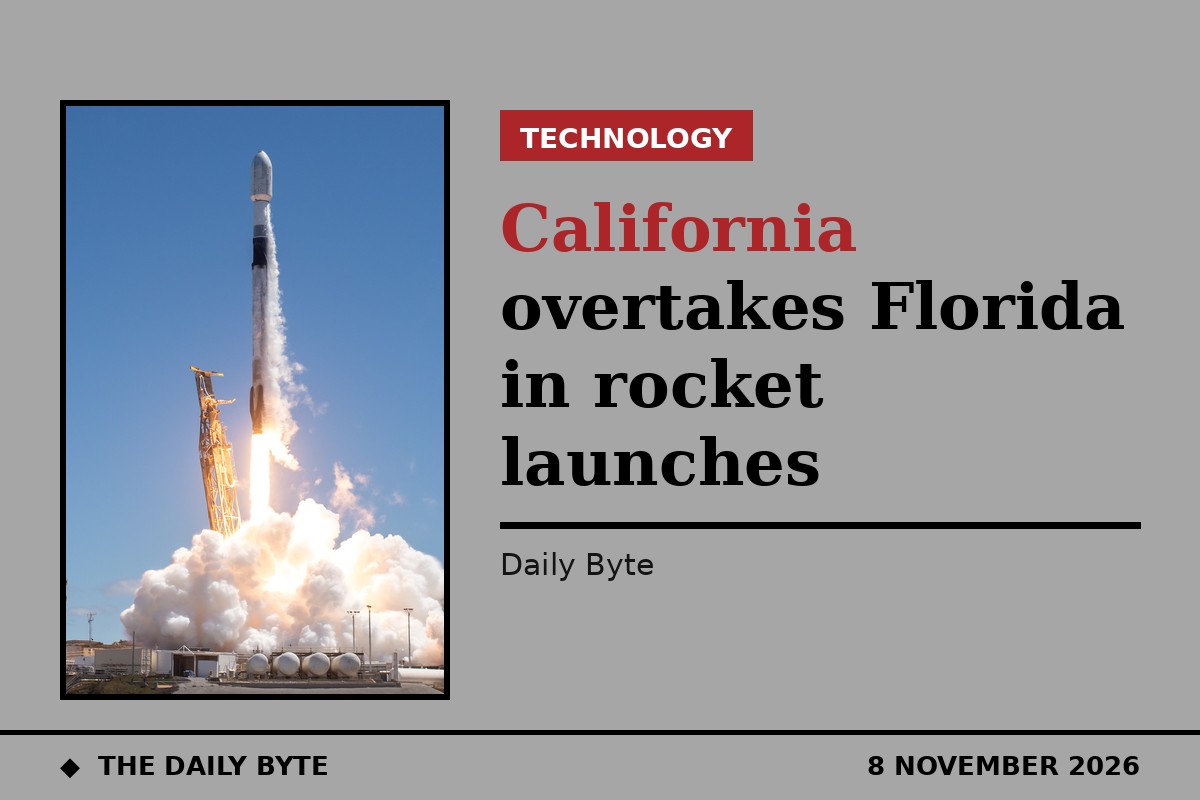
California has moved ahead of Florida in the 2026 race for rocket launches, after a record-breaking run of flights from Vandenberg Space Force Base — while Florida has now gone 17 days without a single liftoff.
The shift was sealed on Friday, 6 November, when a SpaceX Falcon 9 lifted off from Space Launch Complex 4-East at Vandenberg carrying the classified USSF-432 mission for the U.S. Space Force. The Space Force confirmed it was the 74th launch supported from Vandenberg in 2026. Florida, by contrast, has managed 60 launches this year, with its most recent on 20 October.
A record broken with months to spare
California's record was set on 27 October, when a Falcon 9 carrying 27 Starlink internet satellites became the state's 72nd launch of the year, passing the 71 launches recorded across the whole of 2025. With more than two months of the year still to run at that point, Space Force officials had already indicated that around 80 rockets could launch from California before the end of 2026.
The 6 November flight kept that pace going. The Falcon 9 lifted off at 4:48 p.m. Pacific time, and its first-stage booster — flying for the eighth time — landed on the drone ship Of Course I Still Love You in the Pacific Ocean for reuse. Reusable boosters have been central to Vandenberg's tempo: the same hardware now returns to service again and again, keeping the launch rate high.
Why Florida has gone quiet
Florida's drought has several causes. SpaceX's Falcon 9, the most active rocket in the world, has not flown from the state since 20 October, when it launched the Bandwagon-5 rideshare mission from Cape Canaveral. USA Today reports that, based on comments from a SpaceX official, the gap between Falcon 9 flights from Florida could stretch to six weeks.
SpaceX has also scaled back the Falcon 9's role in Florida. An August mission was the last time the rocket was used to deploy the company's Starlink satellites from the state; since then it has been used only sparingly in Florida, mainly for missions carrying astronauts and cargo to the International Space Station.
Other launch providers have been grounded too. Blue Origin's heavy-lift New Glenn rocket has been out of service since an explosion at its Cape Canaveral launch complex in May, and its target for returning to flight has slipped from the end of 2026 to the beginning of 2027. The United Launch Alliance's Vulcan rocket, grounded since a mid-flight anomaly in February, is due to return in mid-November carrying Amazon Leo satellites.
A first in five decades
If the current pace holds, California is on course to end the year with more launches than Florida for the first time in around five decades — a striking reversal for a state that has long been synonymous with American spaceflight. Florida still set a record of its own in 2025, with 109 launches, but it has not come close to that pace this year.
The balance could shift again soon. SpaceX is preparing its giant Starship rocket for a Florida debut, potentially before the end of 2026. Starship, the largest rocket ever flown at more than 400 feet tall when fully stacked, has launched 14 times so far, all from the company's Starbase site in South Texas. Its arrival in Florida would restore the state's launch cadence — and reopen the contest with California.
For now, though, the West Coast is setting the pace. Vandenberg, once a quieter corner of the American launch business, has become its busiest site, serving commercial, scientific and national-security missions alike — and the record it set in October is already being extended, one Falcon 9 at a time.