California Voters Reject Prop 45 CEQA Overhaul
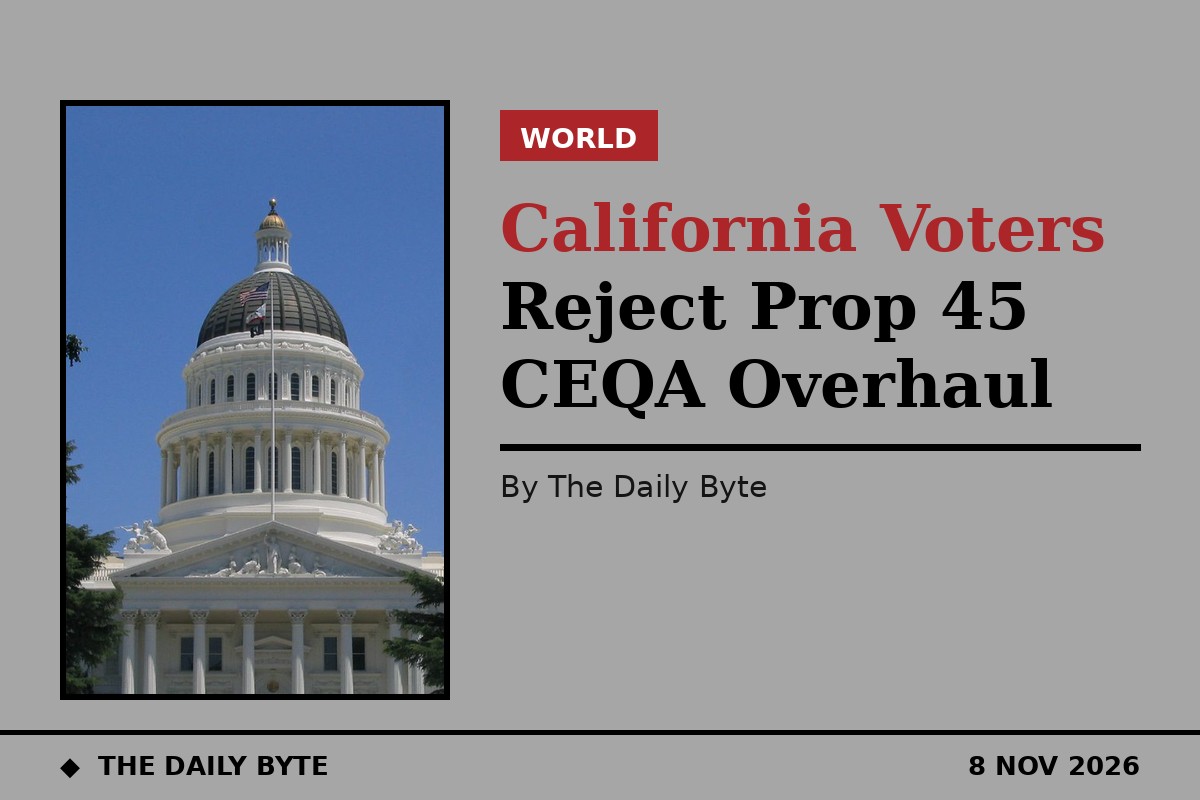
California voters have rejected Proposition 45, the business-backed ballot measure that would have rewritten the state's landmark environmental review law to speed up approvals for housing and infrastructure projects.
The Associated Press called the measure on Saturday evening, with an estimated 76 percent of the expected vote counted and about 56 percent of voters opposed, the Sacramento Bee reported. Unofficial statewide totals compiled overnight showed 5,533,894 votes, or 55.7 percent, against the measure and 4,396,414 votes, or 44.3 percent, in favour. Counting of remaining ballots continues.
Proposition 45, an initiative statute sponsored by the California Chamber of Commerce, would have amended the California Environmental Quality Act, known as CEQA, to put designated projects on a faster environmental-review clock and to speed the lawsuits that often follow approvals. Public agencies would have had 365 days to finish environmental reviews for projects in several categories, and courts would have had 270 days to resolve legal challenges.
The categories covered most housing, transportation, water and health projects, along with clean energy, schools, public-safety work such as wildfire-fuel breaks, and broadband. Supporters said the deadlines were needed to build housing, water works, clean-energy projects and other infrastructure at a more predictable cost. The official ballot pamphlet listed the California Children's Hospital Association, the California Water Association and the California Council for Affordable Housing among the supporters.
Opponents argued the measure would have limited environmental and public review and made it harder to overturn project approvals. The official pamphlet listed the Coalition for Clean Air, California Environmental Voters, Physicians for Social Responsibility Los Angeles and the National Wildlife Federation among the opponents. The No on Proposition 45 campaign said it represented more than 550 labour, health and environmental groups, and its spokesperson, Woody Little, argued before the election that voters were being offered a false choice between affordability and protecting air, water and public health.
The nonpartisan Legislative Analyst's Office estimated in the official summary that the measure would bring initial costs for state and local governments, likely in the high tens of millions of dollars, potentially exceeding 100 million dollars a year, partly covered by fees, with uncertain longer-term fiscal effects.
One of the sharpest fights was over data centres. Opponents warned that the large computing facilities, already a target of local backlash over noise, electricity demand and water use, could seek the faster track. The measure's chief lawyer said data centres were not covered and that he would testify in court against any data-centre developer who tried to use the law, the Bee reported.
Public polling recorded a steep drop in support as that argument spread. The Public Policy Institute of California found backing for the measure falling from 73 percent in July to 46 percent in October, a slide that left support slightly below water in the final weeks.
In San Francisco, voters were more firmly opposed than the statewide electorate. The Department of Elections' Saturday report showed 184,338 votes, or 59.9 percent, against Proposition 45 and 123,274 votes, or 40.1 percent, in favour, with about 15,000 local ballots still to be counted.
The California Democratic Party had endorsed a no vote, while the California Republican Party supported the measure. Governor Gavin Newsom and Governor-elect Xavier Becerra did not take a side, the Bee reported, and the Republican gubernatorial nominee, Steve Hilton, also stayed quiet on it.
Both campaigns now describe Saturday's result as the end of this ballot fight and the beginning of another, in committee rooms rather than in the voter guide. Jennifer Barrera, president and chief executive of the California Chamber of Commerce, said the chamber would continue to advocate for reform and hold elected officials accountable. The No campaign called the result a clear message against what it described as a broad assault on state law protecting air, water and natural resources, and said it would keep fighting in the state Legislature. The law voters were asked to overhaul remains in effect.


