Canada Weighs AI Drone Jets as Warfare Shifts
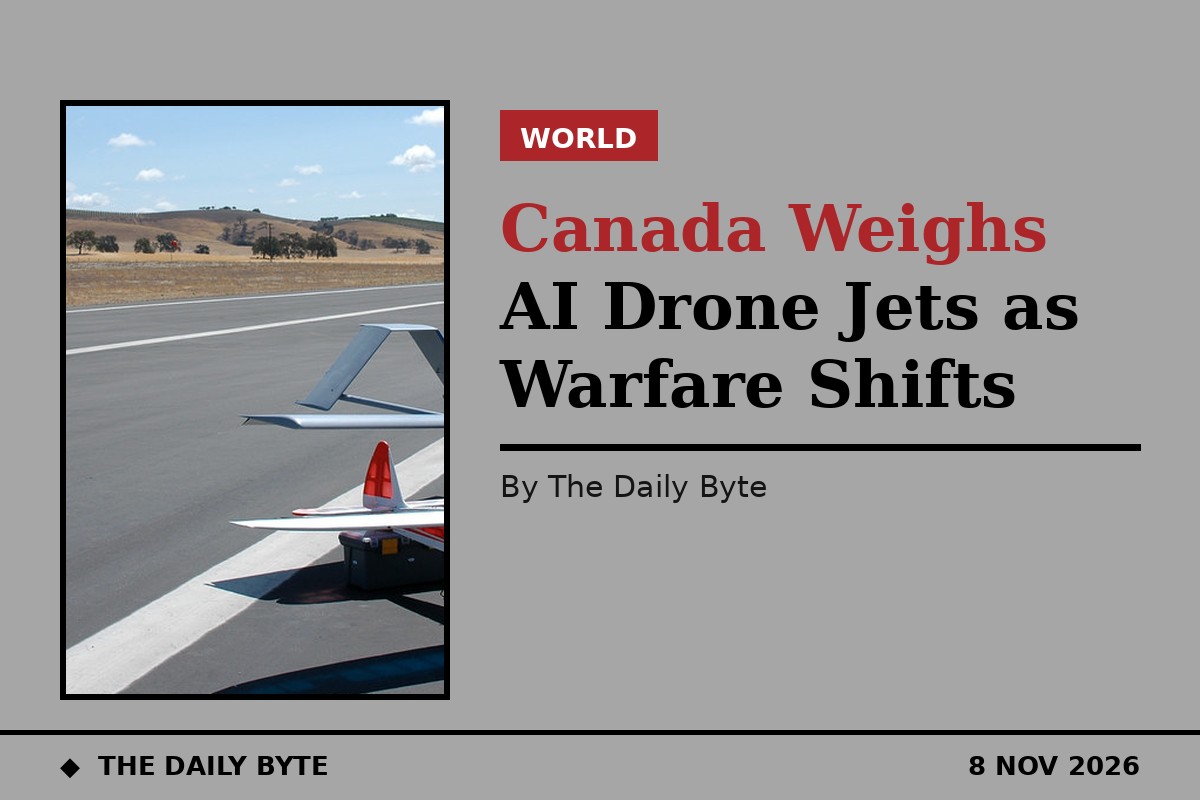
Canada is facing a question it has not yet answered: should it buy into AI-powered combat drone aircraft, the uncrewed jets that fly beside crewed fighters and carry out missions with artificial intelligence? A report by CBC News on 7 November put the issue in the open. The early answer from Ottawa is cautious: the Royal Canadian Air Force is studying the technology, but no decision has been made to buy any of the aircraft.
The aircraft at the centre of the debate are collaborative combat aircraft, or CCAs: uncrewed jets that fly alongside manned fighters, extending the jet's reach while taking on risk the pilot would otherwise carry. They use AI to handle many fighter-jet tasks, including firing weapons on command, and could eventually take part in close aerial combat. In July, the American defence company Anduril's YFQ-44A drone, known as Fury, fired an air-to-air tactical missile at a simulated target in California's Mojave Desert. In October, a pilot in an F-22 got the same drone to carry out simulated combat tasks.
Canada has no collaborative combat aircraft at all.
Canadian officials told CBC that warfare must stay a fundamentally human endeavour, and that no machine or algorithm can be held responsible for complying with international humanitarian law. In a statement to CBC, the Department of National Defence said the Royal Canadian Air Force is examining how these systems could be useful for Canada, but that no decision has been made to procure them. It added that the armed forces support autonomous functionality only within a responsible chain of human command and control.
Not every expert shares that caution. Yvan Blondin, who commanded the Royal Canadian Air Force from 2012 to 2015, told CBC that AI in a deadly platform is now a reality, saying: "You're getting artificial intelligence in a platform that is deadly." He believes these drones will become integral to modern militaries by the 2030s, and warned rivals may not share Canada's limits, asking: "In times of war, would China bother with the step of having a human in the loop?"
A Canadian company wants to build the aircraft at home. Dominion Dynamics, led by chief executive Eliot Pence, who previously worked at Anduril, is building a CCA called Scout. It would fly ahead of a crewed fighter, three or four drones per jet, beyond the edge of the jet's radar, and be able to strike with a missile. Pence argues the case is about sovereignty: the Arctic makes up about 40 per cent of Canada, and the country does not have enough fighter jets to cover it. He told CBC his company will build the aircraft regardless of whether Ottawa buys in, saying: "We don't care. We're going to build it anyway." He says he has raised about a third of the 500 million dollars needed for the prototype, and although Ottawa has bought into Dominion's simulation platform, there is no government contract for one.
Building in safeguards is proving harder than stating them. Benoit Breault, Dominion's senior vice-president for aerospace engineering, told CBC the company wants a human to remain the last decision maker, and that any use of force will require human approval. But he acknowledged that the human-machine interface, how information from three or four drones reaches one pilot, is still at an early stage. Craig Martin, a former Canadian navy officer who teaches armed-conflict law at Washburn University, warned about automation bias, where humans place too much trust in the machine, especially with only seconds to respond. He also warned that AI trained in one environment can fail in another, with errors that can compound and harm civilians.
While the CCA question remains open, Ottawa is already spending on cheaper drones. The government launched the Defence Drone Initiative on 23 July 2026 for uncrewed and autonomous systems for the armed forces and the Coast Guard. Initial contracts worth up to 50 million dollars were awarded in September, aimed at increasing the number of drones deployed tenfold, and the military has built a list of 399 pre-qualified vendors. Qualification is not a contract, but officials have described a steady stream of tenders over the next five years.
The wider rules are also unsettled. Diplomats were due to meet in Geneva this month to test whether countries want to negotiate rules on autonomous weapons. United Nations Secretary-General Antonio Guterres wants a legally binding treaty by the end of 2026, a call he renewed in August after a Russian drone with no human operator reportedly killed three civilians in Ukraine. Canada voted yes to a 2025 United Nations resolution laying the groundwork for possible negotiations. Whether or not Canada buys the jets, Blondin told CBC the debate cannot wait, saying: "This is a discussion we need to have as a society."


