Canada-Philippines free trade deal concluded in Manila
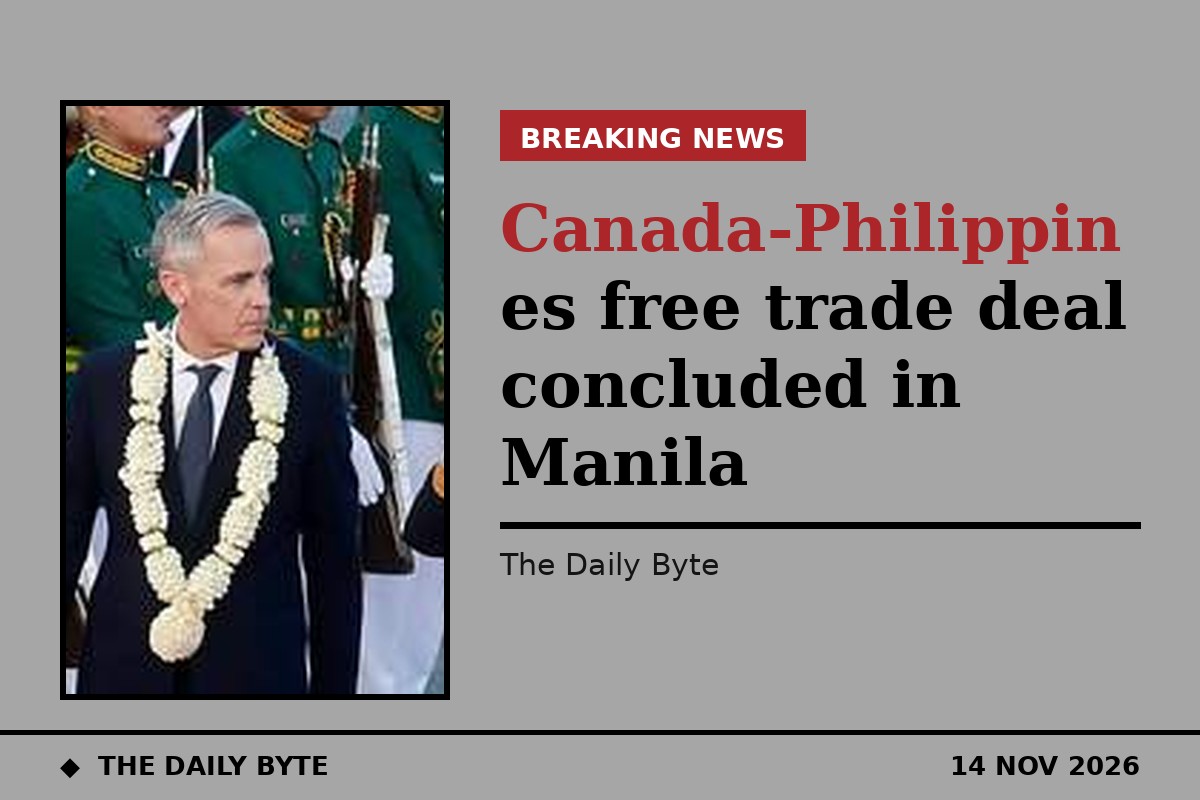
Canada has concluded free trade negotiations with the Philippines and substantially concluded a wider free trade agreement with the Association of Southeast Asian Nations (ASEAN), Prime Minister Mark Carney announced in Manila on Saturday, 14 November 2026.
Mr Carney made the announcements during his first visit to the Philippines as prime minister, where he attended the 49th ASEAN Summit as Guest of the Chair and held a bilateral meeting with Philippine President Ferdinand Marcos Jr.
The two agreements are not yet signed and are not yet in force. Both governments are aiming to sign them in 2027, with the Philippines deal expected to take around six months to reach signature, Mr Carney told reporters.
Canada-Philippines deal concluded in a year
Negotiations on the Canada-Philippines free trade agreement were concluded just one year after the two countries announced their intention to pursue a deal, the Prime Minister's Office said. President Marcos and Mr Carney witnessed the exchange of a joint statement formally concluding the talks, signed by Philippine Trade Secretary Maria Cristina Aldeguer-Roque and Canadian International Trade Minister Maninder Sidhu.
The Philippines has an economy of $680 billion and a market of more than 110 million people, and is one of the fastest-growing economies in Asia, according to the Canadian government. Once in force, the agreement could increase Canadian exports to the Philippines up to three times by 2035, with particular opportunities in agriculture and forest products.
"In a more dangerous and divided world, a dense web of connections holds strong," Mr Carney said. "With the Philippines, we concluded a new free trade agreement in just one year – creating new opportunities for our farmers, ranchers, foresters and miners, and putting us on track to triple our exports by 2035."
Two-way merchandise trade between Canada and the Philippines totalled $3.4 billion in 2025, up 7.4 per cent on the previous year, while Canadian direct investment in the Philippines stood at about $1.7 billion, up 44 per cent.
Digital trade, services and micro, small and medium enterprises are among the areas covered by the proposed agreement, according to the Philippine Presidential Communications Office, which said the deal should expand opportunities for Filipino businesses, freelancers and online workers selling into the Canadian market.
ASEAN deal opens a market of 700 million
The wider ASEAN-Canada free trade agreement, known as ACAFTA, has been substantially concluded, with the remaining steps to be completed as quickly as possible and signature targeted for 2027. Negotiations began in 2021.
ASEAN has a population of almost 700 million people and an economy of close to $6 trillion. Once in force, the agreement is expected to add nearly $2 billion to Canada's GDP and create nearly 14,000 Canadian jobs, particularly in agriculture and manufacturing, the Prime Minister's Office said.
Canada also announced $5 million in assistance to help every ASEAN economy support swift ratification of the agreement and benefit equally from it once in force. As a group, ASEAN was Canada's fifth-largest merchandise trading partner in 2025, with annual two-way trade valued at $52.5 billion, up 22.7 per cent from 2024.
Mr Carney said the announcements were "part of a strategy of developing a dense web of reliable partners to create more opportunities for our businesses, more choice for Canadians, better jobs for our workers and reducing our relative reliance on the United States". Canada has said it wants to double its non-US exports by 2035.
Defence and security cooperation
The visit also produced new defence and security measures between Canada and the Philippines, including closer cooperation between their armed forces, a new cyber security dialogue, and steps towards agreements on customs cooperation and the protection of sensitive information.
Canada will extend its Dark Vessel Detection programme until 2033 to continue combating illegal, unreported and unregulated fishing. The satellite-based system detects and tracks vessels that have switched off their location-transmitting devices.
Mr Carney also announced $26 million in investments to support closer ties in nuclear security and safety, climate-resilient agriculture, community resilience, and food security and infrastructure, including in the G7-supported Luzon Economic Corridor.
Three commercial agreements were welcomed during the visit, covering ocean technology, drone technology for maritime and port operations, and renewable energy projects to supply manufacturers, industrial users and data centres in the Philippines.
Sources: Prime Minister of Canada and Balita.