Canada Ranks 62nd in Global Climate Performance Index
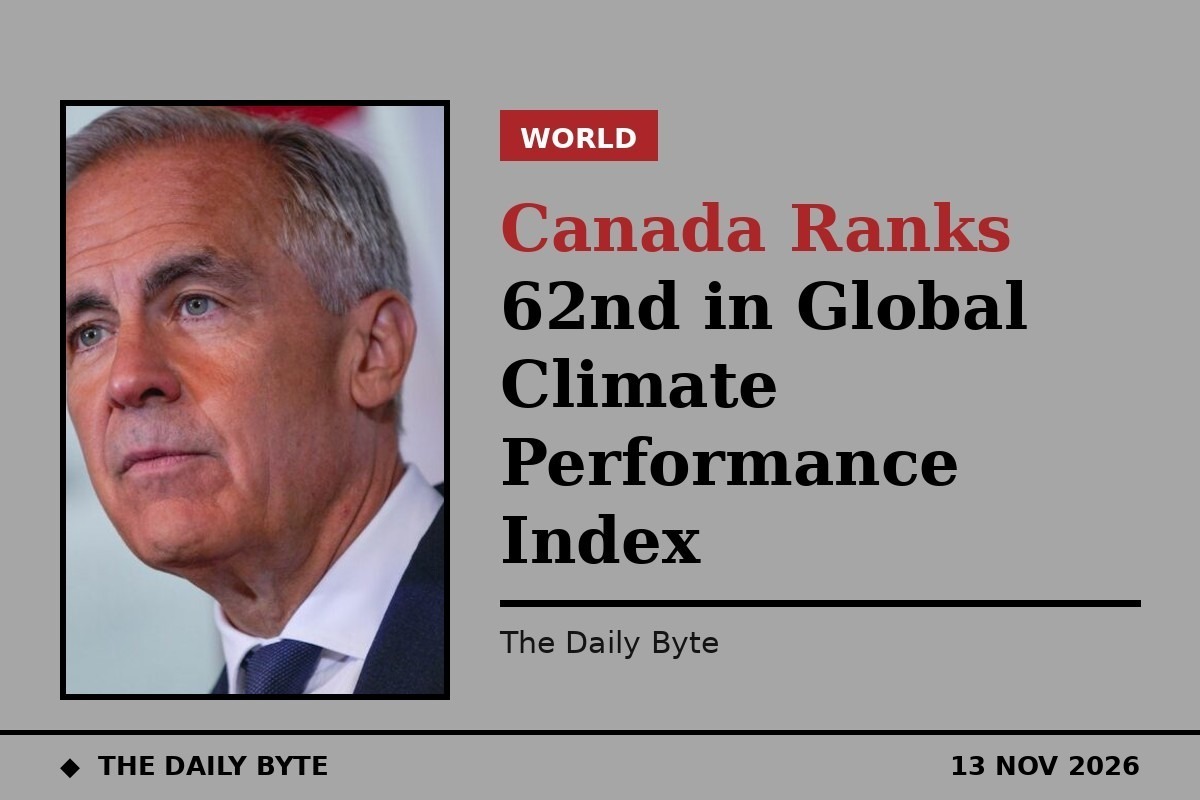
Canada has ranked 62nd out of 64 countries plus the European Union in the Climate Change Performance Index 2027, placing it among the worst performers in the world on climate action.
The annual index, published since 2005 by Germanwatch, the NewClimate Institute and Climate Action Network, was launched on 11 November at the COP31 climate conference in Antalya, Türkiye. It assesses the countries responsible for more than 90 per cent of global greenhouse gas emissions across four categories: emissions, renewable energy, energy use and climate policy.
Canada received a “very low” rating for greenhouse gas emissions, renewable energy and energy use, and a “low” rating for climate policy. Of all the jurisdictions ranked, only Kazakhstan, the United Arab Emirates, Saudi Arabia, Russia, the United States and Iran placed lower. The top three ranks in the index remain empty again this year, because no country performs well enough across all categories to earn an overall “very high” rating.
How other countries ranked
Denmark remains the top-ranked country in fourth place, followed by Lithuania in fifth and Luxembourg in sixth. The United Kingdom, in seventh, is the only G20 country to achieve an overall “high” rating. Among other fossil fuel producers, Norway placed 13th, Nigeria 17th, Brazil 21st and India 28th, while COP31 co-host Australia ranked 54th and China 56th. The United States placed 67th and Iran last at 68th.
Policies weakened, report says
Canada has committed to cutting greenhouse gas emissions by 40 to 45 per cent below 2005 levels by 2030, and by 45 to 50 per cent by 2035, on the way to net zero emissions by 2050. But the index’s country report says the federal government under Prime Minister Mark Carney “has weakened or cancelled most policies in the climate policy framework”, including consumer carbon pricing and the Electric Vehicle Availability Standard, which was intended to phase out petrol-powered vehicles.
“Carney subsequently conceded that Canada would not meet its 2030 target,” the report states, adding that the government “has not presented a comprehensive action plan for emissions reduction beyond 2030”.
The criticism is echoed by other assessments published during COP31. A separate report by Climate Action Tracker, led by Climate Analytics and the NewClimate Institute, gives Canada a “highly insufficient” rating for policies, action and climate finance, with policies that would bring average global warming close to 4°C.
In September, a major report from the environment department projected that average warming will reach 3.5°C to 5°C by 2100 across Canada, and more than 10°C in the Arctic. The Canadian Climate Institute followed up with an analysis showing that the country’s current climate policies put it more than 20 years behind its 2030 target.
Oil expansion at the heart of the problem
The index traces the problem back to fossil fuels. Canada “is among the 10 countries with the largest developed oil and gas reserves, and it currently plans to increase its oil production,” the country report states, adding that Canada has no framework to phase out oil and gas production or set regulatory limits on pollution from the sector. Instead, the government has taken steps to expand oil and gas production, including liquefied natural gas, and develop new crude oil infrastructure, beginning with the proposed Pacific Link pipeline.
Environment and Climate Change Minister Julie Dabrusin, speaking in Antalya, insisted the government remains committed to its goals. “We’re absolutely committed to our Paris commitments,” she said, pointing to work on methane controls, electrification, energy efficiency and oceans.
Her predecessor, former environment minister Catherine McKenna, responded sharply from Antalya. “This statement is absolutely factually untrue,” she wrote. “Canada now has zero chance of meeting its 2030 Paris commitment and has no path to meet net zero by 2050.”


