Canada Supreme Court Hears Firearms Ban Challenge
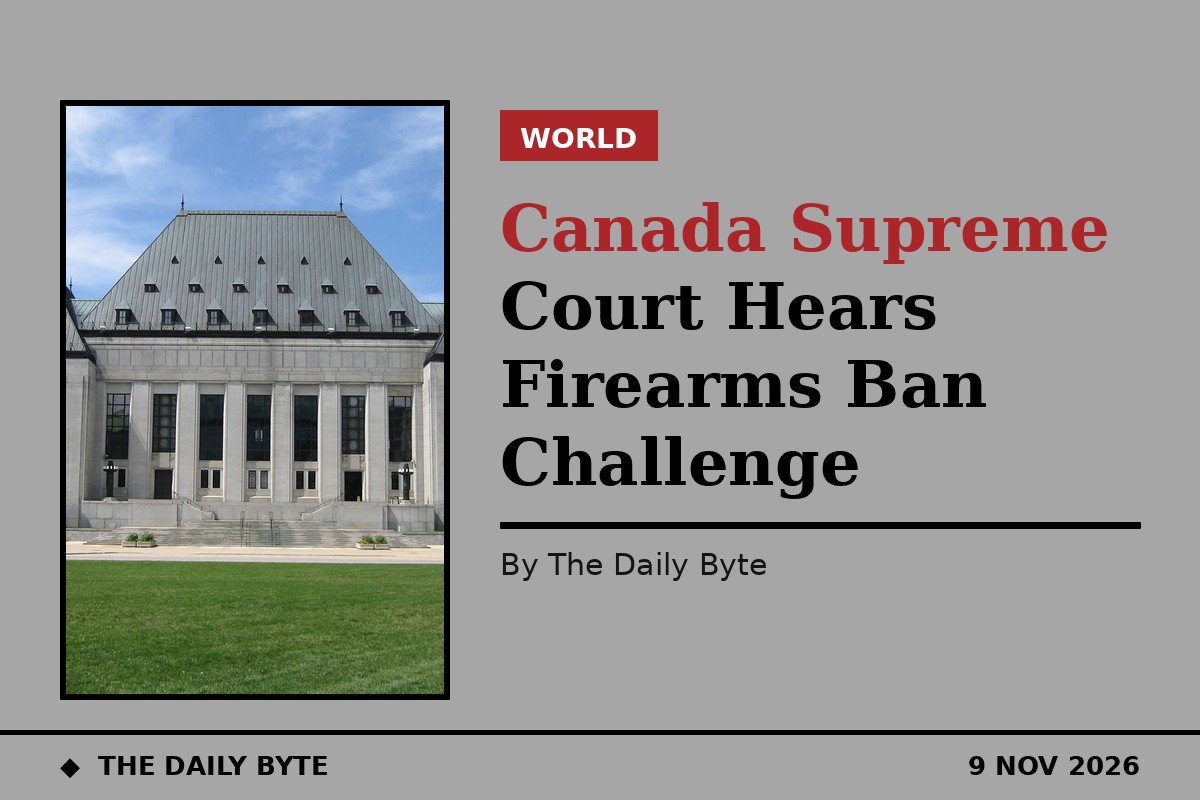
Canada's Supreme Court begins a two-day hearing on Monday into the federal government's 2020 ban on assault-style firearms, in what is being described as the biggest hearing at the country's top court this autumn.
The case, heard on Monday and Tuesday in Ottawa, brings together four appeals challenging the regulations that banned more than 1,500 types of firearms in 2020. The list of banned guns was later extended to more than 2,500 models in late 2024 and early 2025.
At the centre of the case is a legal question about the limits of Ottawa's power. The former Liberal government under Justin Trudeau used cabinet regulations, rather than an act of Parliament, to impose the ban. Trudeau said at the time that assault-style firearms designed for military use had no place in Canada.
The challengers argue that the federal cabinet went beyond what the law allows. The key provision is section 117.15 of the Criminal Code, which says cabinet may not ban a firearm that is reasonable for use in Canada for hunting or sporting purposes. The gun owners and groups bringing the appeals say cabinet weighed public safety instead of asking the question the statute sets out.
The federal government argues that Parliament has long given cabinet broad discretion to prohibit firearms in the interests of public safety, and that the exercise of that power was reasonable and justified by the serious public safety concerns the firearms pose. Its response to the appeals opened by listing deadly mass shootings in Canada and around the world in which assault-style firearms were used, starting with Portapique in Nova Scotia in 2020, the Ecole Polytechnique in Montreal in 1989 and the Islamic Cultural Centre in Quebec City in 2017.
The lower courts have twice ruled in Ottawa's favour. The Federal Court dismissed the challenges in 2023, and the Federal Court of Appeal did the same in April 2025. The Supreme Court agreed in March 2026 to hear the appeals.
The lead case is brought by Christine Generoux, an Ottawa woman in her late 30s who will argue her own case on Monday morning. In her filing she said there was no justification for deeming the guns unreasonable for recreational use, and described sport shooting as destroyed and hunting disrupted. She also argued the issue went deeper than reasonableness, saying it struck at the heart of parliamentary democracy and Canadian identity.
The Canadian Coalition for Firearm Rights, another appellant, argued that the regulations were too vague to fall within cabinet's powers, and said the case concerned the profound disruption of the lives of ordinary, law-abiding Canadians, including farmers, veterans, competitive athletes and Indigenous harvesters.
Three provinces have also intervened against the ban. Alberta, Saskatchewan and Ontario are all opposing the federal government, with Ontario stating plainly that the regulations are unconstitutional. Alberta hired veteran lawyer Guy Pratte to lead its arguments, and its filing said Ottawa had criminalised firearms ownership for more than 100,000 licensed Canadians at the stroke of a pen, without any evidence that those owners posed a threat to public safety.
Ottawa has few allies at the top court. The Canadian Coalition for Gun Control is the only intervener explicitly backing the federal position, arguing that the Criminal Code allows cabinet to pass the regulations and that public safety is their overriding purpose.
An amnesty for owners of the prohibited firearms remains in effect until 90 days after the Supreme Court gives its judgment. Owners can dispose of their guns or permanently deactivate them, and Ottawa is also buying them back. By mid-2026 the federal government had paid businesses 96 million Canadian dollars for about 74,000 guns, an average of 1,300 dollars per weapon.
No ruling is expected during the two days of argument. The court is expected to reserve its decision and release written reasons at a later date, with Public Safety Canada having said in June 2026 that it expected the decision in 2027.


