Chilean mother reunites with sons taken in Pinochet era
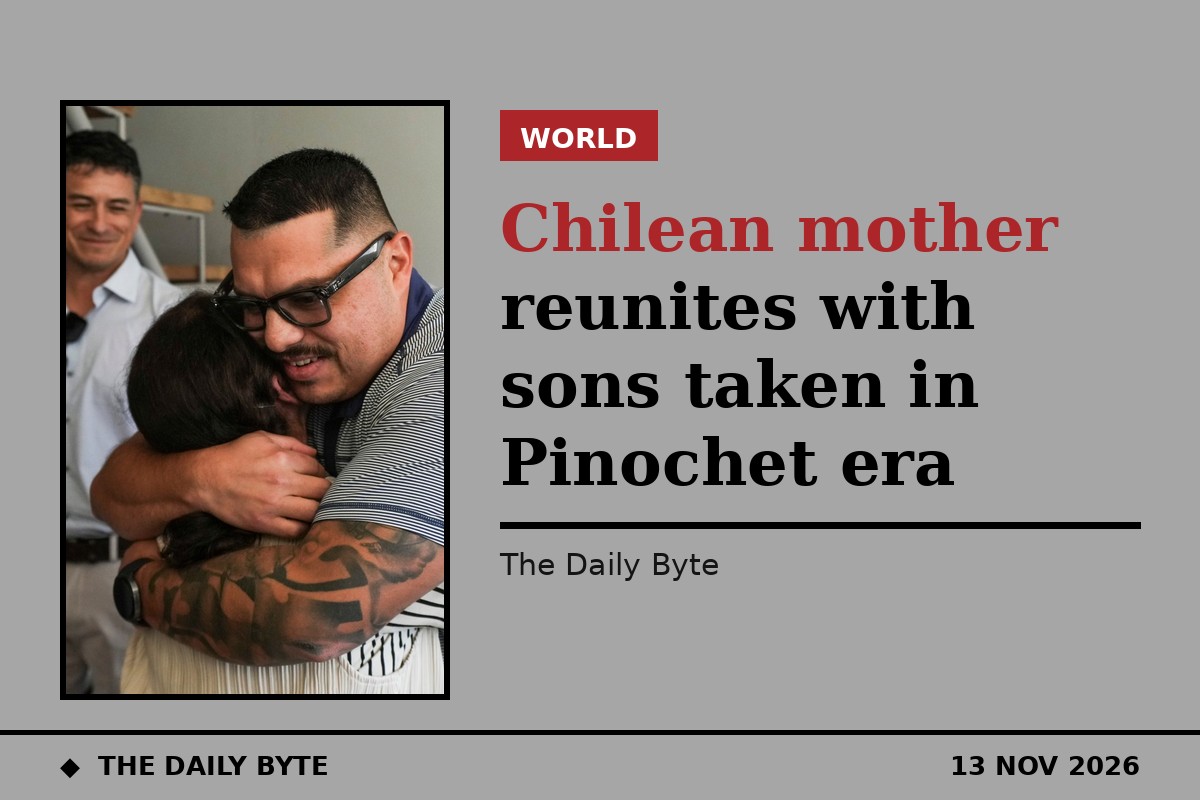
SANTIAGO — Teresita de Jesús Padilla waited 41 years to hold her sons again. On Wednesday 11 November 2026, the 66-year-old embraced Tim Rolnick, 41, and Travis Murdoch, 37, at the offices of the Santiago organisation Nos Buscamos, ending a separation that began when hospital workers took the boys from her as babies in Chile.
“God gave me back my children, whom I thought I had lost forever,” Padilla said moments after the reunion, according to the Associated Press.
Taken as babies
Padilla’s children were taken from her in hospital in two separate episodes. Rolnick was taken first, as a tiny baby. Four years later, her twin sons Travis and Chris were taken the same way and adopted by an American couple. All three brothers grew up in the United States knowing they had been adopted, but unaware of the history behind their origins.
Travis’s twin, Chris, was unable to travel to Santiago because he was severely injured in a car accident in 2013. The brothers’ eldest sibling, Alberto, stayed with his mother in Chile and led the search for his brothers, but died before he could meet them, Reuters reported.
Padilla’s father died when she was four, and her family struggled with poverty. When she became pregnant, she saw the hospital as a refuge that could help her find a better life for her babies. Instead, she said, her children were taken from her twice. “These women took my children away from me under threats, through sheer terror, and I suffered because of it my entire life,” she said.
A DNA test opened the search
Rolnick began searching for answers in 2020, when he took a MyHeritage DNA test to learn about his medical history. He discovered that he had an entire family in Chile who had never stopped thinking of him, including two brothers living just a few hundred miles from his home in Maryland. Distant cousins and organisations that investigate illegal separations soon began contacting him. “And then it was like opening up Pandora’s box,” he said.
As he kept searching, Rolnick learned that he and his brothers had been trafficked to the United States as infants, and that he had another sibling who had remained in Chile. “I always wanted a brother, so I got three!” he said.
The brothers had already built a close bond before the Santiago reunion. Murdoch recalled feeling nervous before meeting Rolnick, and wondering whether his brother would show up. “Then we met and he looked just like me and I was, like, this is super weird, very surreal,” he said. “We started talking and getting to know each other and we clicked pretty quickly.”
A wider scandal
The family’s case is part of one of the darkest chapters of the dictatorship of the late Gen. Augusto Pinochet, which ruled Chile from 1973 to 1990. According to Chilean judicial reports obtained by the Associated Press, approximately 20,000 cases of forced or criminal adoptions took place during the regime’s 17 years in power. Nos Buscamos, the organisation that helped arrange the reunion, estimates that more than 50,000 Chilean families have been affected.
Constanza del Río, the director of Nos Buscamos, told the Associated Press that the most vulnerable women, particularly those from Chile’s poorest regions, were the main targets of a child-trafficking network made up of social workers, doctors, judges and lawyers who arranged for children to be taken out of the country. In the 1970s, Chile was the third-largest exporter of children for illegal adoptions, after China and South Korea, the Associated Press reported.
During the dictatorship, at least 3,095 people were killed or forcibly disappeared, according to government figures, and tens of thousands more were tortured or jailed for political reasons.
Looking to the future
For Padilla and her sons, the reunion was bittersweet after 41 years of pain, but all three said they wanted to rebuild their fragmented family. Rolnick said meeting his biological mother felt familiar at once. “It felt almost like I’ve known Teresita my whole life. I just felt a connection,” he said. “It’s definitely something I will remember for the rest of my life.”
Murdoch said the family should now look forward rather than back. “There’s no reason to look into the past too far and from here we can work toward the future,” he said.


