Chile's Stolen Children: Pinochet Era Explained
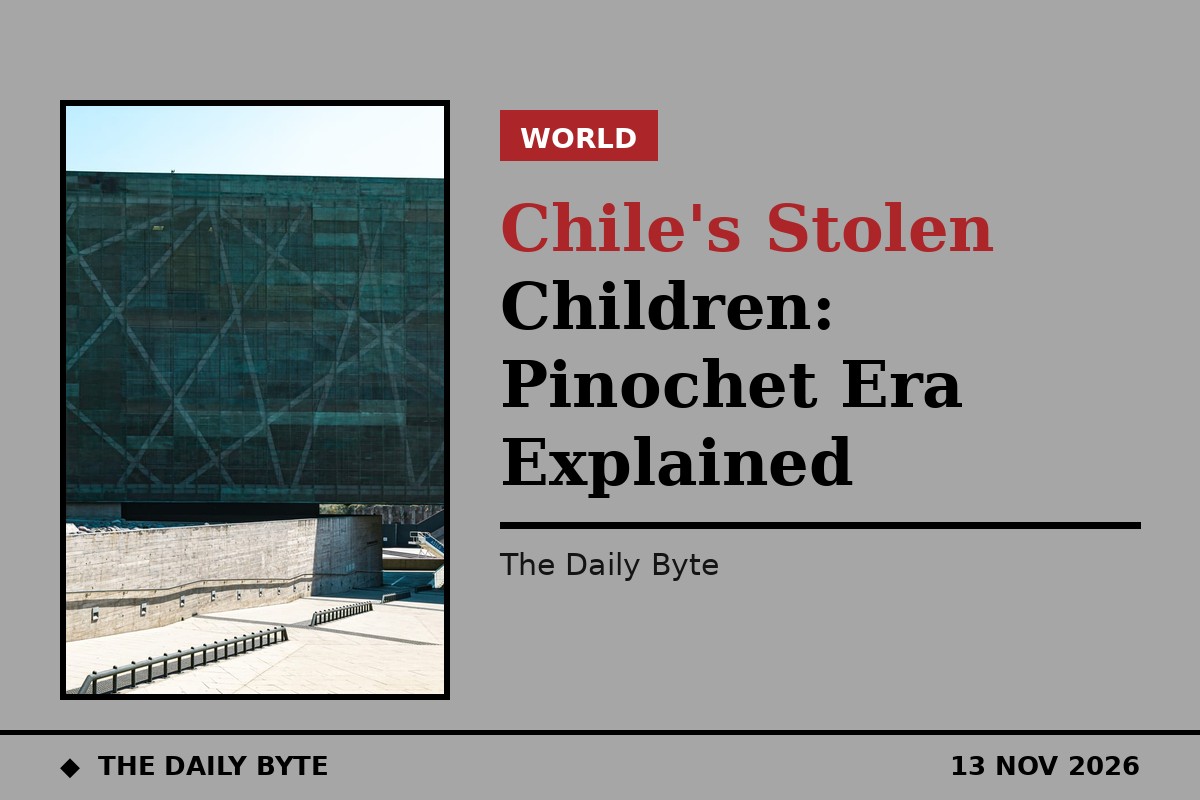
On 11 November 2026, Teresita de Jesus Padilla, a 66-year-old mother from Chile, embraced two of her sons for the first time in 41 years. The boys had been taken from her as babies in hospital and trafficked to the United States. Her reunion in Santiago was not an isolated family story. According to Chilean judicial reports obtained by The Associated Press, approximately 20,000 cases of forced or criminal adoption took place during the 17 years of General Augusto Pinochet's military regime, and the organisation that arranged the reunion, Nos Buscamos, estimates that more than 50,000 Chilean families have been affected. This explainer sets out what happened, how the network worked, how many children were taken, and how families are finding each other now.
What happened in Santiago on 11 November 2026?
Teresita de Jesus Padilla met her sons Tim Rolnick, 41, and Travis Murdoch, 37, at the offices of the non-governmental organisation Nos Buscamos in Santiago, Chile's capital. The Associated Press reported that both men had been taken from their mother while she was still in hospital, in one of the thousands of illegal adoptions under Pinochet's dictatorship. "God gave me back my children, whom I thought I had lost forever," Padilla said moments after the reunion.
Both of Padilla's sons grew up in the United States. They knew they had been adopted, but they were unaware of the history behind their origins. Rolnick began searching for answers in 2020, when he took a MyHeritage DNA test to learn about his medical history. He discovered that he had an entire family in Chile who had never stopped thinking of him, and that he had two brothers living just a few hundred miles from his home in Maryland. "It all started when I was trying to find out about my medical history," he explained. Soon after, distant cousins and organisations that investigate illegal separations began contacting him. "And then it was like opening up Pandora's box," he said.
As he kept searching, Rolnick learned that he and his brothers had been trafficked to the United States as infants, and that he had another sibling who had remained in Chile. Four years after Rolnick was illegally taken from his mother's arms, his brothers, twins Travis and Chris, suffered the same fate and were also adopted by an American couple. "I always wanted a brother, so I got three!" Rolnick said. Chris was severely injured in a car accident in 2013 and was physically unable to make the long journey to Santiago, so he could not attend the reunion. The two brothers who did travel had already built a close bond before meeting their mother. "It felt almost like I've known Teresita my whole life. I just felt a connection," Rolnick said. "It's definitely something I will remember for the rest of my life." Murdoch said there was no reason to look into the past too far, and that from here the family could work towards the future.
Padilla's own account of what happened to her is stark. Her father died when she was four, and her family struggled with poverty. When she became pregnant, she saw the hospital as a refuge that could help her find a better life for her babies. Instead, her children were taken from her twice. "These women took my children away from me under threats, through sheer terror, and I suffered because of it my entire life," she said.
Who was Augusto Pinochet, and how long did he rule?
Augusto Pinochet was the general who led Chile's military dictatorship from 1973 to 1990. On 11 September 1973 he overthrew the democratically elected government of socialist president Salvador Allende in a bloody coup. For the next 17 years his regime cracked down on all opposition. According to government figures cited by The Associated Press, at least 3,095 people were killed or forcibly disappeared during the dictatorship, and tens of thousands more were tortured or jailed for political reasons. The openDemocracy investigation published by the International Women's Media Foundation gives a similar picture, reporting that more than 3,000 people were killed and at least 1,469 forcibly disappeared, with their whereabouts unknown to this day.
The stolen-children scandal ran alongside those better-known crimes. It was not a matter of a few corrupt individuals acting alone. The evidence gathered by Chilean investigators and journalists points to a system that operated inside state institutions, with hospitals, courts and social services involved, and with the regime actively promoting adoption as a matter of policy.
How did the child-trafficking network work?
The pattern described by mothers who spoke to openDemocracy is disturbingly consistent. Women gave birth in hospital and were then told their baby had died. They were not allowed to see or hold the baby, they were denied access to the body, and they were often given no documentation confirming the death. Gladys Munoz, who lost her son Alberto within minutes of his birth, remembers crying for days after she left hospital without her baby. Cipriana Bustos Oyarzun, who was 19 when she gave birth to her second child Pamela in Sotero del Rio Hospital in Puente Alto, one of Santiago's poorer neighbourhoods, heard her baby cry after the caesarean and recalls a doctor telling her it was a "cute little girl". She never saw the baby again. After five days recovering in hospital, a doctor told her the baby had died of "foetal distress". She was not allowed to see or bury her baby, and hospital staff provided no further information. Nearly half a century later, she holds on to the only documentation she was ever given to show she had a baby. "All I got was a piece of paper," she said.
Mercedes Tapia's story follows the same pattern, a decade later. She was 27 and in the same maternity ward in Hospital del Salvador when her son Jacob was born by caesarean on 30 August 1989. Every ultrasound scan during her pregnancy had been normal. But when she was admitted to hospital to give birth, a midwife warned her that her baby would die, a social worker asked if she would allow his body to be used for scientific research, and someone asked her to sign a blank piece of paper. She signed it. She woke up alone after surgery to be told her baby had died. When the family asked for the body to arrange a burial, they were told the child had a deformity too shocking for them to see. Tapia was given Jacob's birth and death certificates, but she has never felt the details made sense. The box next to "Vivo" is crossed out in pen, meaning he was born alive, but a note scribbled next to it reads "Died 30.8.89". Written below, in a different pen, is a note saying that Jacob received a tuberculosis jab, despite being apparently alive for only an hour and a half. The vaccine is normally given to newborns within a few days of birth and up to six months old. Jacob's death certificate states that he died of asphyxia and was buried in the general cemetery. When Tapia's daughter Barbara later went to the cemetery to find her brother's records, there was nothing. When she went to the hospital, she was told Jacob's files had been burned.
The Associated Press reported that the network was made up of social workers, doctors, judges and lawyers who arranged for children to be taken out of the country. The openDemocracy investigation found the same structure: judges, social workers, health professionals and international adoption agencies facilitated the overseas sale of babies and young children. The methods included false declarations of death at birth, document manipulation, the involvement of networks of intermediaries, and even the use of threats. Adoption papers were filled with lies, for example claiming that the mother had been raped and did not want the child, or that both parents had abandoned the baby. The documents were signed off by judges involved in the scheme.
The regime created the conditions that made all of this possible. Hospitals were run by the military, mayors were no longer elected and were put in place by the military, and even neighbourhood councils were controlled by the regime. As the journalist Ana Maria Olivares, who first noticed a pattern of irregular adoptions between Chile and Sweden in the early 2000s, put it: "The hospitals were run by the military; the mayors were no longer elected and were also put in place by the military, even the neighbourhood councils. It is very difficult to go to fight for anything. That's why they always remained silent." The climate of fear forced many mothers to stay quiet. Those who lost children were too scared to complain to hospitals or the judiciary, which were state institutions controlled by the military regime. "We suffered terror, there was nothing we could do. The psychological fear stays with you. It was like we were all in a prison," Munoz said.
Policy also played a part. In 1978 Pinochet introduced the National Childhood Plan, which sought to enshrine the "traditional" family but focused heavily on engineering it through forced adoptions. According to the research of Karen Alfaro, a leading researcher into Chile's forced adoptions scandal, the plan set out to "significantly increase the number of adoptions in Chile, as a way to provide homes for children", and to "create a movement of public opinion favourable to adoption, inform and motivate adoption and speed up processes". Pinochet's wife, Lucia Hiriart, was appointed head of the organisations and government agencies related to children and family policies in Chile. Alfaro says the whole system made it possible to capture young mothers or girls at an early age in order to follow them and force them to give their children up for adoption, or to take the child once they delivered in hospital.
Why were poor mothers targeted?
Constanza del Rio, the director of Nos Buscamos, told The Associated Press that the most vulnerable women, particularly those from Chile's poorest regions, were the main targets of the network. The mothers who spoke to openDemocracy fit that profile: often young, many of them living on the poorer outskirts of Santiago, and in rural areas across Chile, especially Indigenous communities such as the Mapuche, who have also reported many of their children being stolen. Many of the mothers report that it was their second child who was taken, and the women now believe the perpetrators thought they would not "suffer as much" if they already had one child at home.
Alfaro argues that the targeting was deliberate and ideological. She says the Pinochet dictatorship "sought to control the birth rate, especially in the case of rural women, it was a way of controlling the 'quality' of the country's population". She also notes that poorer women were targeted because of assumed ideology: through the 1960s and the rise of Salvador Allende's Popular Unity coalition, "poor women were [seen as] protagonists during all the mobilisation processes; they were liberal, they were sexually free. So controlling their bodies was a goal."
How many children were taken?
The honest answer is that nobody knows the exact number, and that is part of the scandal. According to Chilean judicial reports obtained by The Associated Press, approximately 20,000 cases of forced or criminal adoption took place during the 17 years of Pinochet's military regime. Nos Buscamos estimates that more than 50,000 Chilean families have been affected. "We still haven't been able to identify the actual number of children who were taken out of Chile," del Rio told the Associated Press.
Chilean investigators have been looking into the circumstances of around 8,000 overseas adoptions between 1970 and 1999, as part of a criminal inquiry opened by Judge Mario Carroza of the Court of Appeals in 2018. Subsequent investigations by the Chilean legislature and international non-governmental organisations put the number of illegal adoptions closer to 20,000. In the 1970s, Chile was the third-largest exporter of children for illegal adoptions, after China and South Korea, the Associated Press reported. Alfaro's research records cases of foreign foster parents paying between $6,500 and $150,000 to adopt a child.
The scale was possible because the law offered almost no protection. International adoptions of Chilean children had begun decades before the 1973 coup, but the regime actively promoted them, including those that were forced and illegal. A lack of regulation of international adoption processes made it possible for thousands of children to leave Chile with little scrutiny, to be adopted by families across Europe and North America. Chile's 1965 law introduced closed adoptions, which established a clean break from biological families, so adoptees were unable to access information about their origins. Chile enacted a law formalising the procedure for overseas adoptions as late as 1988, but it did not regulate the evaluation and selection of adoptive families. The country signed and ratified the Hague Convention on intercountry adoption, which explicitly seeks to protect the "best interests" of children and to "prevent the abduction, the sale of, or traffic in children", only in 1999, nine years after the dictatorship ended.
How was the scandal discovered?
For decades, the mothers' stories were dismissed or never heard. The first cases came to light in 2014, after an investigation by the Chilean outlet CIPER into cases involving a priest and a doctor. After that, hundreds of adoptees raised abroad began to trace their roots back to Chile using DNA ancestry tests and with the help of Chilean groups such as Connecting Roots, Hijos y Madres del Silencio (Children and Mothers of Silence) and Nos Buscamos, and European organisations such as Chilean Adoptees Worldwide. Collectively, they have facilitated more than 700 reunifications, according to the openDemocracy investigation.
DNA testing has been the breakthrough. Adoptees submit their DNA to sites such as MyHeritage and hope their child, or their birth family, is searching too. For mothers, the search is even harder. Documentation is scarce, they often do not remember the names of hospital staff from all those years ago, and they are obstructed at every turn by a culture of silence and denial. Many adoptees have been found in the United States, Sweden, the Netherlands, Italy, Germany and other European countries. So far, only the Netherlands and Sweden have launched official investigations into their role in inter-country adoptions, the investigation found.
What is being done now?
The criminal inquiry opened by Judge Carroza in 2018 remains the main judicial route. More than 600 cases are currently under investigation by Chile's justice ministry, out of the 8,000 suspicious overseas adoptions initially included in the inquiry. Neither the ministry nor the judge who replaced Carroza, Jaime Balmaceda, responded to openDemocracy's requests for comment. Earlier this year, Bustos Oyarzun, who lost her newborn daughter Pamela nearly half a century ago, filed an official police complaint.
For the families, the work continues through the volunteer organisations. They investigate severed families, help adoptees trace birth certificates and family names, and support mothers through the long process of searching. For Padilla and her sons, the reunion in Santiago was bittersweet after 41 years of pain, but all three said they wanted to rebuild a fragmented family, create new memories and write the next chapters of a future that is only beginning. As Murdoch put it: "There's no reason to look into the past too far and from here we can work toward the future."
Frequently asked questions
How many Chilean children were taken during the Pinochet era? According to Chilean judicial reports obtained by The Associated Press, approximately 20,000 cases of forced or criminal adoption took place during the regime's 17 years in power. Nos Buscamos, the organisation that helped arrange the Padilla reunion, estimates that more than 50,000 Chilean families have been affected. The exact number has never been established.
Where did the children go? Many were adopted by families in the United States, Sweden, the Netherlands, Italy, Germany and other European countries. In the 1970s, Chile was the third-largest exporter of children for illegal adoptions, after China and South Korea.
How did mothers find out the truth? Most did not know for decades. The scandal began to come to light in 2014 after an investigation by the Chilean outlet CIPER. Since then, DNA ancestry tests and the work of groups such as Nos Buscamos, Hijos y Madres del Silencio and Connecting Roots have helped reunite more than 700 people with their birth families.
Can families still search for missing children today? Yes. Adoptees and mothers can submit DNA to ancestry sites, contact the Chilean organisations that investigate forced adoptions, and check records with the Chilean authorities. More than 600 cases are currently under investigation by Chile's justice ministry. The search is slow because documentation is scarce and many records were destroyed or never existed.
What happened to Padilla's third son? Padilla's twin sons are Travis and Chris Murdoch. Chris was severely injured in a car accident in 2013 and was physically unable to make the long journey to Santiago, so he could not attend the reunion on 11 November 2026.