China's Ceres-2 Rocket Puts Four Satellites Into Orbit
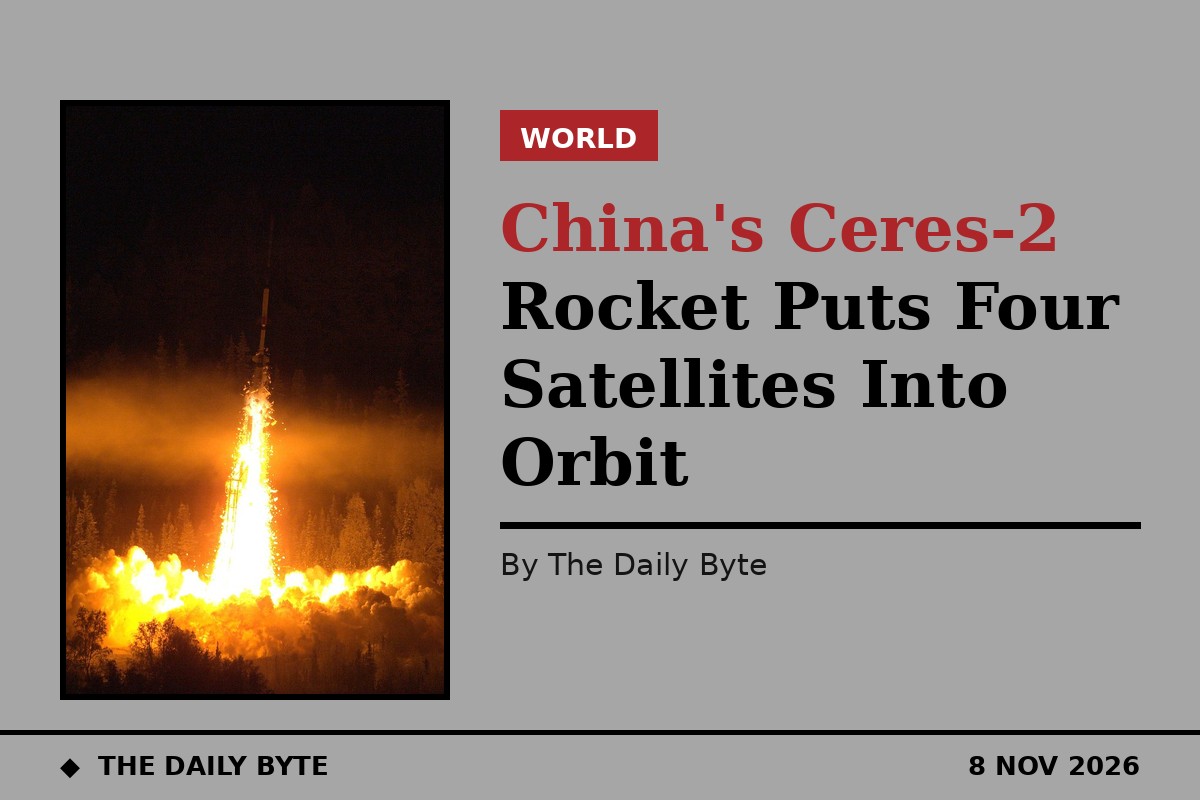
Chinese private rocket maker Galactic Energy has successfully flown its Ceres-2 rocket into orbit for the first time, placing four satellites in space on Saturday morning after the vehicle's debut flight failed in January.
The company said in a news release that the Ceres-2 Y3 carrier rocket lifted off at 7:37 a.m. Beijing time from the Jiuquan Satellite Launch Center in northwest China on 7 November, and then deployed four satellites in a sun-synchronous orbit at an altitude of 535 kilometres.
The four satellites will be used for operations such as collecting meteorological data and demonstrating new technologies, the company said. China Daily, which reported the flight, called it successful in its headline.
The flight was the second for Ceres-2. The first mission took place in January at the same Jiuquan spaceport, aiming to deploy six commercial satellites and two pieces of experimental equipment, but it failed because of technical malfunctions. That makes Saturday's flight the first time a Ceres-2 rocket is reported to have reached orbit.
According to Galactic Energy, Ceres-2 has three solid-propellant core stages and a liquid-fuelled upper stage and weighs 100 tons. The company says it is capable of carrying satellites with an overall weight of 1.6 tons to a low-Earth orbit at an altitude of 500 kilometres, or 1.3 tons of payload to a sun-synchronous orbit at the same altitude. Those capacity figures are the company's own claims.
A single reported success after a failed debut shows the rocket can reach orbit, by the company's account, but it does not on its own show how reliably Ceres-2 will fly in regular service. Independent tracking of the flight's orbital details had not been published at the time of reporting.
Galactic Energy, based in Beijing, has developed three types of rockets, Ceres-1, Ceres-2 and Pallas-1, and has carried out 27 missions, transporting a total of 94 commercial satellites into space, according to China Daily.
The successful flight is a recovery for the Ceres-2 programme after its debut ended in failure. Galactic Energy describes the rocket as a new model of solid-propellant carrier rocket, and the company has now flown 27 missions in total across its three rocket types. Private launch firms in China are flying small-satellite missions alongside the state programme, offering rideshare flights for payloads used in weather monitoring, Earth observation and technology demonstrations.
The launch adds to a busy year for China's commercial space sector, with private firms now flying alongside the country's state-run programme and competing to offer rideshare launches for small satellites used in weather monitoring, Earth observation and scientific research.


