China moves to slow yuan rally with reserve hike
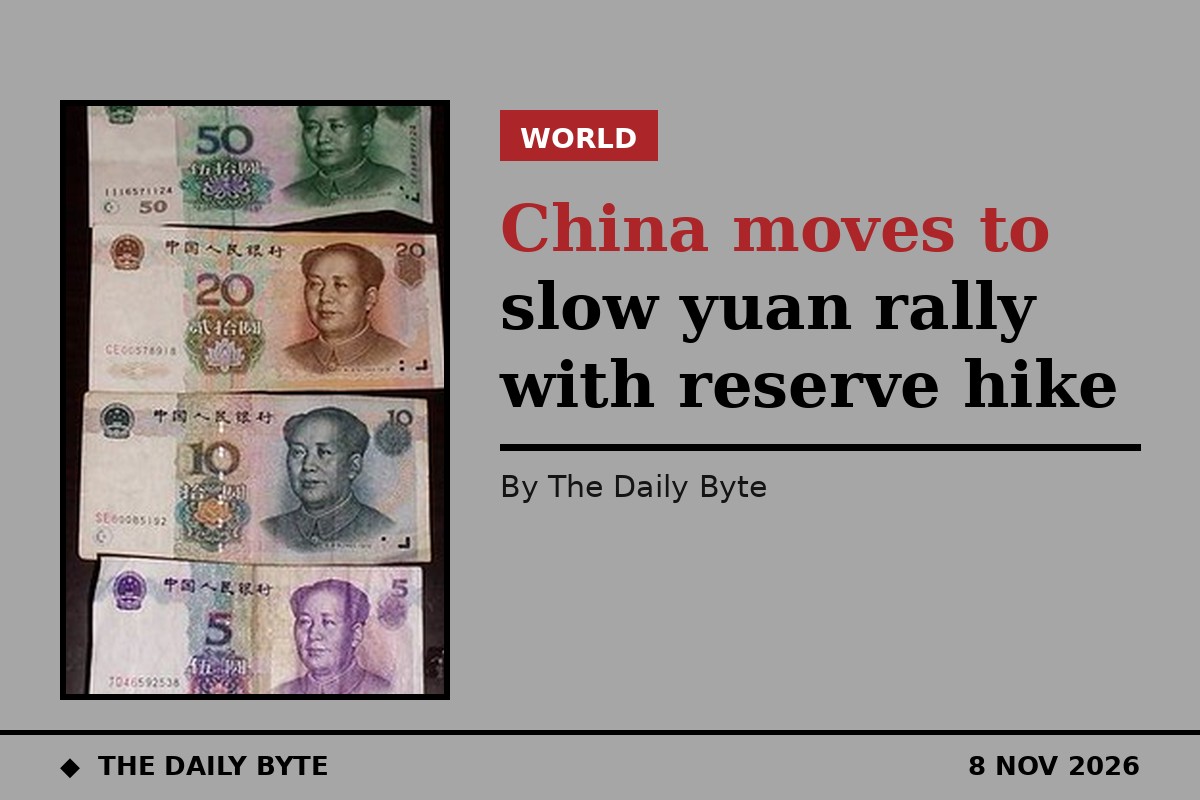
China's central bank has moved to slow the yuan's rapid rise, announcing that it will raise the foreign exchange reserve requirement ratio for financial institutions by two percentage points, from 4% to 6%, with effect from 15 November 2026. The People's Bank of China (PBOC) said the decision was aimed at strengthening the management of foreign exchange liquidity in financial institutions. It is the first increase in the ratio in nearly five years.
The foreign exchange reserve requirement ratio is the share of foreign currency deposits that financial institutions must hold at the central bank. Raising it tightens US dollar liquidity in the domestic banking system and eases upward pressure on the renminbi, or yuan. A Reuters calculation based on official foreign exchange deposit data put the extra amount withdrawn from the financial system at about $24 billion, while Ming Ming, chief economist at CITIC Securities, estimated the move would freeze about $20 billion to $25 billion of foreign exchange liquidity at bank level.
The yuan weakened after the announcement. The onshore yuan fell as much as 0.37% against the dollar to 6.6728 per dollar, its weakest level since 23 October, and looked set for its biggest one-day drop since 15 May. It closed at 6.6765 against the dollar, weakening by 307 pips from the previous trading day, according to data from the China Foreign Exchange Trade System, and the offshore yuan followed the same trend. Separately, the PBOC lowered its daily midpoint rate for a second day in a row, to 6.7150 per dollar, 661 pips weaker than a Reuters estimate, its largest weak-side deviation since 10 September.
The move comes after a sustained run of strength in the Chinese currency. The yuan has gained more than 5% against the dollar so far this year, reaching its strongest level since 2022 and becoming one of Asia's best-performing currencies. Xinhua reported that the yuan appreciated by a cumulative 4.2% against the US dollar in the first nine months of the year, with the pace accelerating since October: the onshore rate strengthened for 14 consecutive trading days from 14 October. Reuters reported that the strength has been underpinned by robust exports, big trade surpluses and heavy corporate conversion of foreign currency into yuan.
Analysts said the central bank was signalling concern about the speed of the appreciation rather than trying to reverse it outright. Marco Sun, chief financial market analyst at MUFG (China), said the PBOC was responding to strong market-driven yuan appreciation and, by absorbing part of the available US dollar liquidity in the banking system, was attempting to reduce the momentum behind the gains and prevent the market from developing excessive one-way expectations. Zhaopeng Xing, senior China strategist at ANZ, said the move was likely to carry greater symbolic significance for the market, adding that heavier corporate foreign exchange settlement into yuan had created an imbalance of excess supply over demand that the increase would not be enough to ease.
Wen Bin, chief economist at China Minsheng Bank, said the increase would help promote a supply-demand balance in the foreign exchange market and curb a self-fulfilling cycle in which expectations of yuan appreciation drive further gains. Zhiwei Zhang, chief economist at Pinpoint Asset Management, said the central bank had sent a clear message that it was concerned about the fast appreciation. The step reverses the PBOC's decision in September 2023 to lower the ratio, a move made then to stem the yuan's rapid losses and capital outflows. The ratio had been raised twice in 2021 to 9%, then lowered three times between 2022 and 2023 to the current 4%. The PBOC said in October that it does not preset a target level for the exchange rate, but will introduce market-based measures if short-term fluctuations turn sharp and the market shows herd behaviour. Deputy Governor Zou Lan reiterated at a financial forum in Hong Kong on 3 November that China has promoted high-level opening-up and insisted that the market play a decisive role in forming the exchange rate. Market participants do not expect the move to reverse the yuan's upward trend.


