Claude AI solves two black hole physics problems
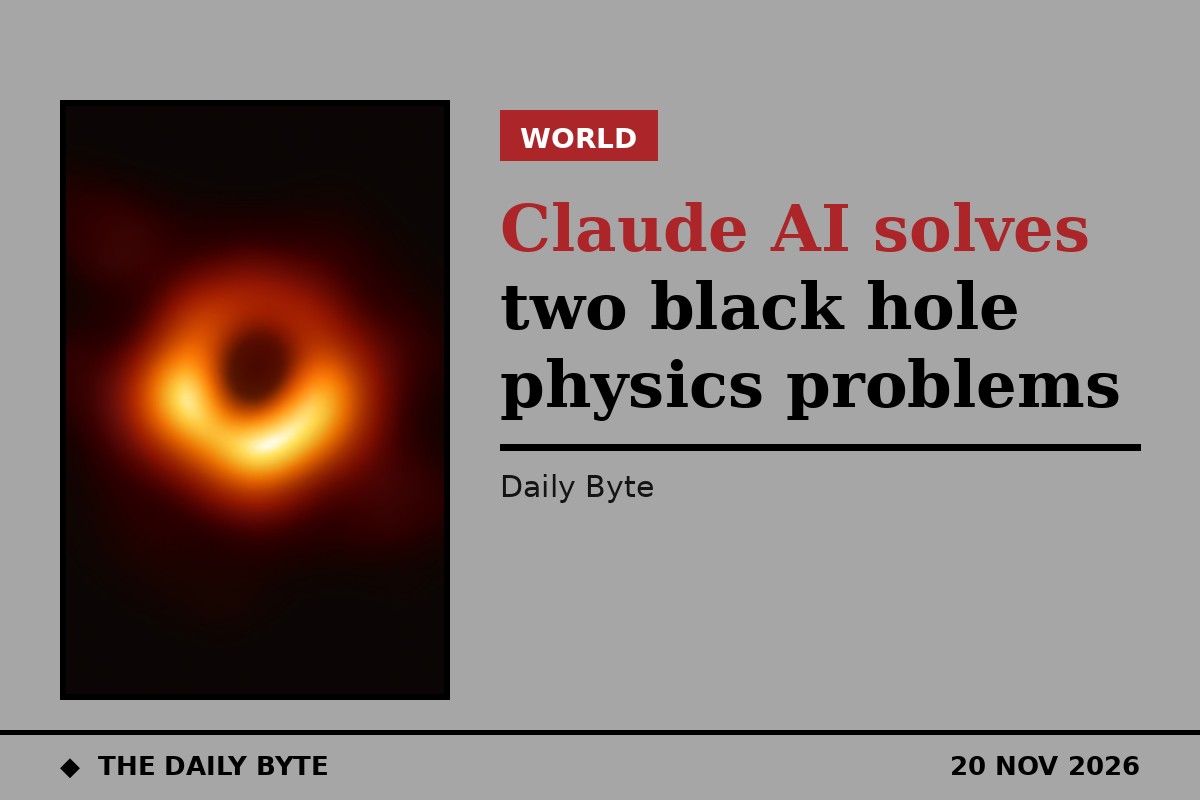
Anthropic says its Claude Fable 5.2 model has solved two open problems in theoretical physics, both concerning black holes and the search for a theory of quantum gravity. The company described the results in a research post on 17 November, presenting them as a demonstration of AI agents doing original scientific work rather than simply answering questions.
The work was a side project. In August, Anthropic researcher Hongbin Chen asked Claude to draw up a list of interesting open problems in theoretical physics, focusing on black holes and the bootstrap method. The model returned 22 candidates, and Chen set up separate agents to work on each one. They could read each other's progress and collaborate, running in the background for about six weeks with no special setup. Two of them produced solutions, which Anthropic has published as preprints.
A 2003 calculation, finished
The first problem concerns what happens when a theoretical universe heats up. At low temperatures it fills with a gas of particles; above a certain temperature, a black hole forms instead. In 1983, Stephen Hawking and Don Page showed that this switch is abrupt, a phase transition like water suddenly boiling. But their calculation relies on general relativity, which only holds when the universe is vast. As the theoretical universe shrinks towards the tiny scale where that description breaks down, spacetime loses any definite shape.
Physicists found in 1999 that a phase transition also occurs in that regime, but they did not know whether it was abrupt, like Hawking and Page's, or smooth. In 2003, a group of physicists set out the calculation that would settle the question, but it was extremely complex and was never completed. Claude did it by running a small research group of copies of itself, working out almost every piece of the calculation independently and checking its maths against known results. It showed that the phase transition is abrupt, suggesting that black hole formation is built into the underlying quantum theory, not just a feature of relativity.
An exact ceiling for testing theories
The second problem concerns a simplified theoretical universe with two dimensions of space instead of three. Physicists there try to rule out wrong theories of quantum gravity by showing they are internally inconsistent, a method called bootstrapping. Since 2009, they have used a version of this method to set a ceiling on how heavy the lightest black hole in such a universe could be, narrowing the search with each improvement. Numerical results hinted at where the best possible ceiling lay, but nobody could prove it.
Claude noticed a pattern in the numerical results that physicists had missed, and borrowed a method from elsewhere in maths and physics to calculate the precise ceiling for the simplest version of the technique and prove that it could not be lowered. It does not identify the correct theory, but it may point physicists in the right direction. Anthropic says the results were formally verified in September in Lean, a computerised proof checker, and a physicist checked every main result.
What it does not mean
Anthropic is careful about the limits. Neither result describes our own universe directly, and neither has practical applications. Both contribute to a long-running theoretical effort to understand how quantum mechanics and relativity fit together. The results have also not yet undergone independent peer review, as Gizmodo noted when it covered the launch of Fable 5.2, so the wider physics community has yet to weigh in.
Still, the episode is a marker for how AI labs now present their models: not only as coding assistants, but as research collaborators that can run for weeks, check each other's work and produce results that humans had left unfinished for more than twenty years.