Devin Gets a Cloud Mac to Build Apple Apps
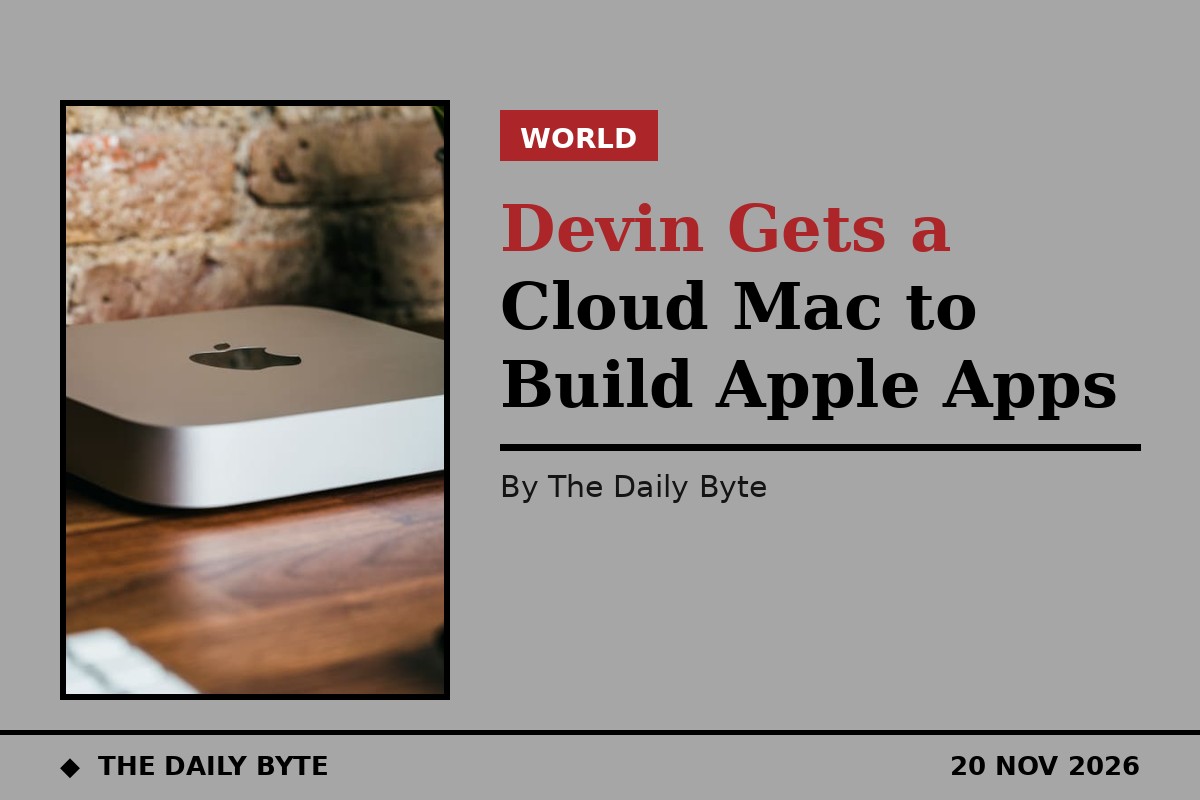
Cognition's AI software engineer, Devin, can now build and test Apple apps on its own Mac in the cloud, after the company moved its macOS work onto Amazon's EC2 Mac service, according to a technical account published by Amazon Web Services on 19 November.
Devin is an autonomous coding agent: it takes a software task, writes code, runs tests and iterates on the result. Until now, its cloud sessions ran on Linux and Windows. It could write Swift code for Apple platforms, but it needed a customer's own build system or Mac fleet to compile and test an iPhone or Mac app. That gap has now closed.
A fresh Mac for every session
Cognition launched macOS support for Devin on 15 September 2026, and says nearly 1,000 organisations were running Devin on macOS within six weeks. Behind that rollout is a fleet of Amazon EC2 Mac hosts spread across six AWS regions, each a physical Mac mini or Mac Studio attached to Amazon's Nitro system.
Each Devin session gets a fresh macOS virtual machine, started in under a minute. A manager built by Cognition uses Apple's Virtualization framework to run the guest machines from images it prepares and maintains, pre-loading permissions, developer tools, Xcode and a warmed-up iOS Simulator before the agent starts work.
That speed matters because Mac capacity is tightly rationed. Each physical host can run only two isolated macOS virtual machines at a time, reflecting the limit in Apple's software licence agreement, and each host carries a 24-hour minimum allocation. If every task held a Mac until it finished, expensive hardware would sit idle between jobs.
Snapshot trick stretches scarce hardware
Cognition's answer is to separate the life of a session from the life of a host. When a Devin session goes idle, its virtual machine can be shut down and its disk saved as a snapshot. The session can later resume from that saved state in seconds, while the host is freed for another job.
Amazon says about 90 per cent of sessions release their Mac when idle and come back from snapshots, while a brand-new virtual machine takes under a minute to start. In regions where Cognition has not pre-booked capacity, an auto-scaling group allocates and releases dedicated hosts as demand rises and falls.
Verification still combines structured checks with visual ones: the agent can run the app in the simulator and inspect what appears on screen, rather than relying on build logs alone. That is the practical payoff of giving an agent its own Mac — it can see what it built, not just compile it.
Why agents need real hardware
The setup is a small case study in a larger shift. As AI agents take on more of the software lifecycle, they need the same environments human developers use, including the hardware that only runs on one company's machines. Renting Macs by the hour through a cloud provider avoids buying, racking and maintaining physical machines, but the licensing cap of two virtual machines per host means the economics depend on clever scheduling.
For Cognition, the bet is that an agent that can build, run and test an app end to end is far more useful than one that only writes code and waits for a human to check it. The first six weeks suggest customers agree: almost a thousand organisations put Devin on macOS in that window, and the cloud Mac fleet is now part of how the agent works.