CBA First-Quarter Cash Profit Rises 8% to $2.8 Billion
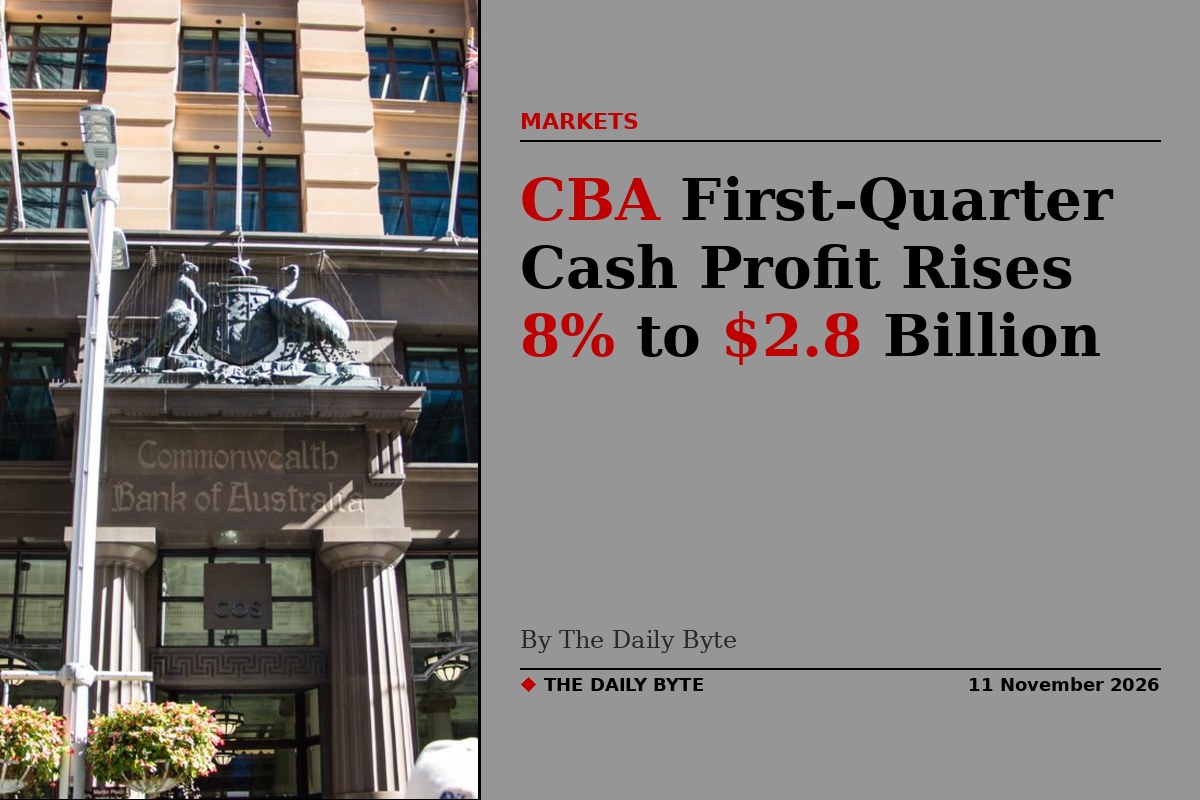
Commonwealth Bank of Australia (CBA) has reported an unaudited cash profit of approximately A$2.8 billion (about US$1.92 billion) for the three months ended 30 September 2026, an increase of 8% on the same period a year earlier. Australia's largest bank announced the first-quarter trading update on Wednesday, 11 November 2026, reporting a rise from A$2.6 billion a year ago, although profit was flat against the average quarter in the second half of the 2026 financial year. CBA shares were down around 1% in Wednesday trading after the update.
The result shows a bank still growing its loan book in a difficult environment for borrowers. Operating income rose 3% in the quarter, supported by continued growth in lending and deposits, while the underlying net interest margin was broadly stable. CBA said the outcome came despite elevated inflation and rising interest rates squeezing households and businesses, after the Reserve Bank of Australia raised interest rates five times this year.
What drove the higher profit
Lending growth did much of the work. Business lending increased 13.6% over the 12 months to September, growing about 1.3 times faster than the broader market, while home lending grew 6.6% over the year and household deposits rose 7.7%. Customer deposits account for 79% of the bank's total funding. The bank's cash profit for the quarter matched its statutory profit for the same period.
Costs rose in step with income. Operating expenses increased 3%, which management attributed mainly to rising labour costs and IT vendor inflation, along with higher cloud-computing volumes and software licensing. That balance between income and cost growth left earnings flat against the second-half quarterly average, even as the year-on-year comparison showed an 8% gain.
Arrears rise as borrowers feel the pressure
The part of the update that drew the most attention was the deterioration in mortgage arrears. CBA said home loans more than 90 days overdue rose by seven basis points during the quarter to 0.80%. Management linked the increase to cost-of-living pressures from higher inflation and interest rates, alongside slower resolution of some overdue loans.
The bank recorded a loan impairment expense of A$300 million in the quarter, up from the A$234 million quarterly average during the second half of FY26, and collective provisions rose by A$105 million. CBA said its overall credit quality remains sound. Chief Executive Matt Comyn said: "While economic growth is slowing, the Australian economy remains resilient, supported by low unemployment and a strong public infrastructure and private investment pipeline."
Capital position stays strong
CBA's common equity tier 1 (CET1) ratio, a key measure of a lender's ability to withstand financial shocks, improved by 36 basis points to 11.5% before accounting for the payout of dividends to shareholders. The ratio sits comfortably above regulatory requirements, giving the bank a cushion if credit conditions worsen.
The update leaves investors watching two things in the months ahead: whether home loan arrears keep climbing as higher rates work through household budgets, and whether CBA can keep growing its lending without a further rise in impairment costs. For now, the bank has started its 2027 financial year with profit growth intact and its balance sheet in solid shape.
Sources: Reuters and Morningstar / Dow Jones Newswires. This article is for information only and is not investment advice.