Congo court sentences 66 soldiers to death in Walikale
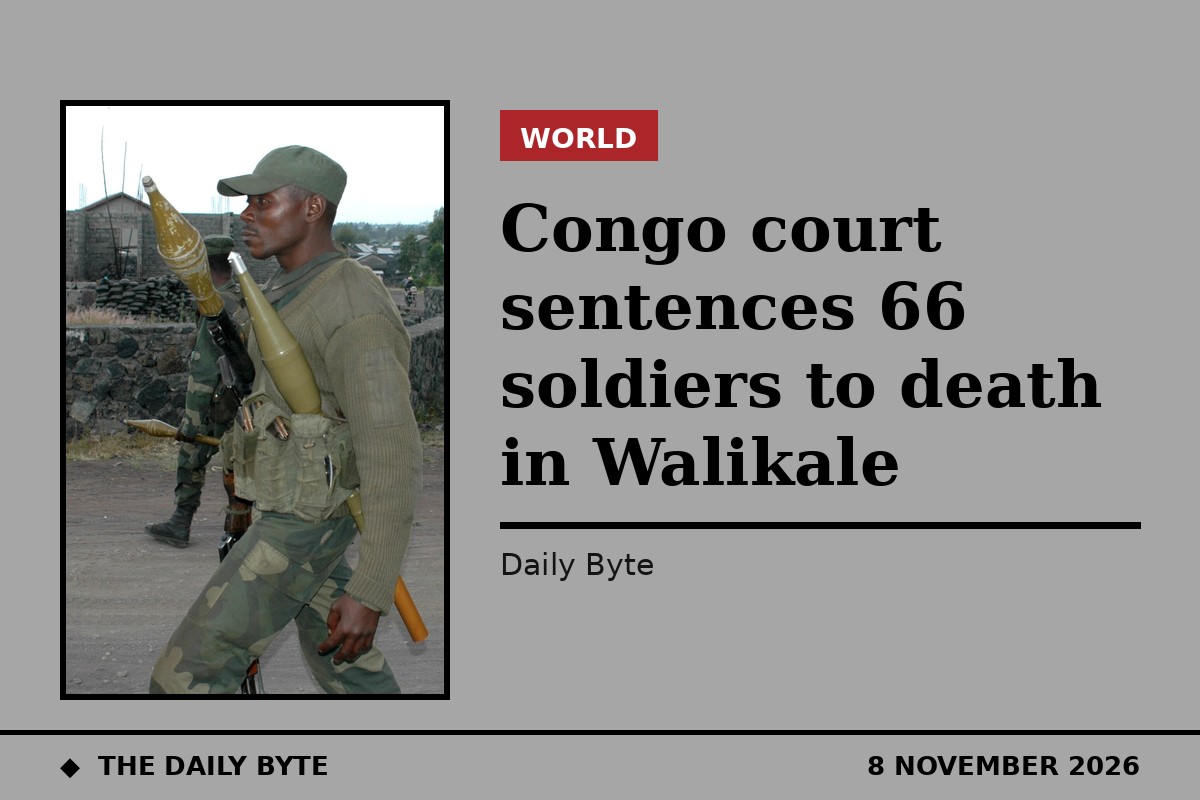
A military court in the Democratic Republic of Congo has sentenced 66 soldiers to death for cowardice, military revolt and refusing orders, in one of the largest mass death sentences handed to the country's own troops. The Goma garrison military court, sitting in Walikale-Centre in North Kivu province, delivered the verdict on the night of Friday 6 November after a trial lasting 12 days, the Congolese press agency ACP reported.
All of the condemned soldiers belonged to the 3415th regiment of the Armed Forces of the Democratic Republic of Congo (FARDC). They were convicted of cowardice in the face of the enemy, military revolt and refusal to obey the orders of their superiors, with the court also hearing charges including the dissipation of war munitions. The trial was held in Walikale so the accused could be tried where the case arose, rather than in Goma.
The case began with the arrest of 54 soldiers of the regiment on 20 October in Ngora, following shooting incidents in Ntoto, in the Waloa-Loanda area of Walikale territory. Those incidents, on 16 and 20 October, left three people dead, two soldiers and one civilian. A further 16 soldiers were later added to the case, bringing the number of defendants to 71. The trial opened on 26 October and was scheduled to last 10 days before being extended by two.
Not every defendant received the death penalty. One soldier, a sergeant, was given 10 years of penal servitude after the court accepted mitigating circumstances in his case. Four others were acquitted, including the regiment's intelligence captain. Prosecutors had sought the death penalty for 70 of the 71 defendants, but the court exercised discretion in the remaining cases.
Major Dieudonné Kasereka, communications officer for the 34th military region, confirmed the details of the arrests and the proceedings. Military authorities have presented the trial as part of a drive to reinforce discipline within the armed forces while Congolese troops continue operations against armed groups in the east of the country, where the army has faced sustained criticism over battlefield conduct and command failures.
The sentences follow the Congolese government's decision to lift a moratorium on the death penalty that had stood since 2003, a move aimed at soldiers accused of treason and serious military offences. A death sentence is a court decision and is distinct from its carrying out; the condemned soldiers' cases now move to the next stage of the military justice process. The verdict underlines how far the authorities are prepared to go to enforce discipline in an army still fighting a war in North Kivu.