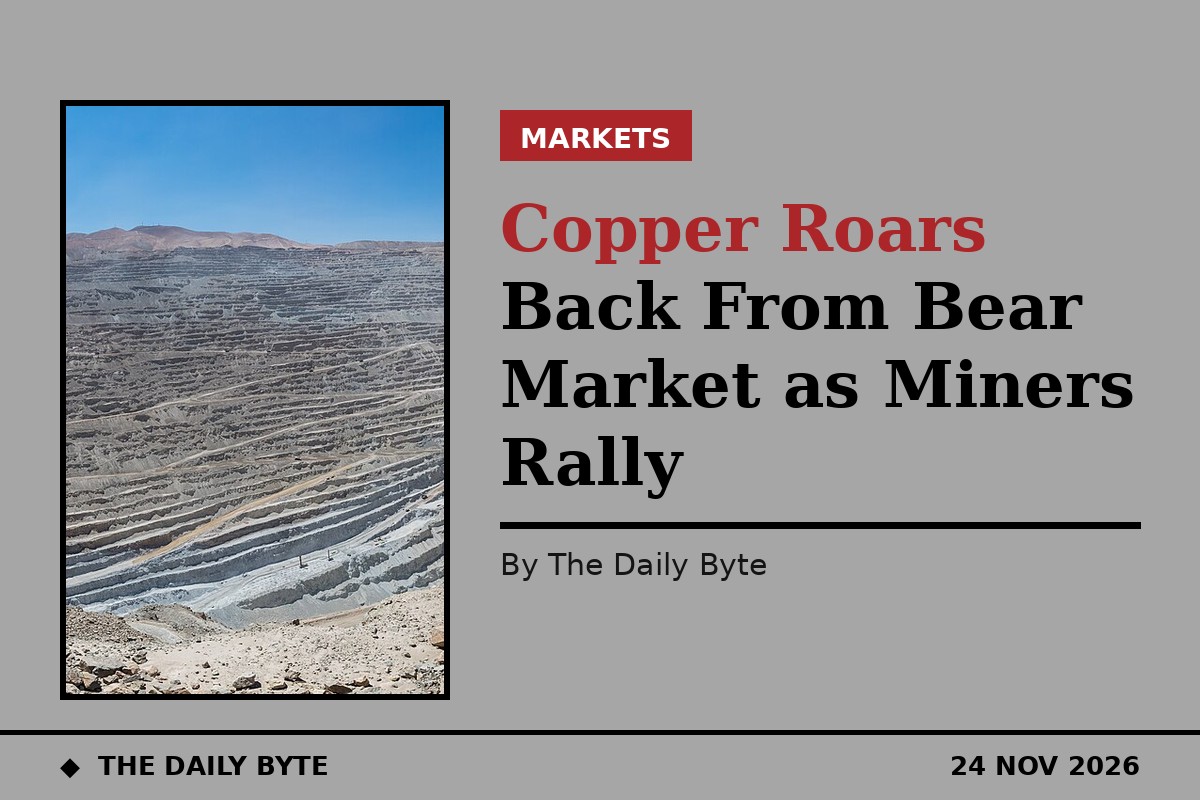
Copper Roars Back From Bear Market as Miners Rally
Copper staged one of its biggest rallies of the year on Monday, 23 November, bouncing out of the bear market it entered on Friday after Nvidia's board reinstated Jensen Huang as chief executive and set off a rush back into the artificial intelligence trades that have dragged the metal lower all month.
Comex copper for December delivery jumped as much as 5.5% to $5.787 a pound in early New York trading, and was changing hands at $5.762 — about $12,703 a tonne — up 5% on the day, according to MINING.COM. The move carried copper back above $5.63, the level at which it ended 2025, leaving it about 2% higher for the year despite the month's rout.
A rough morning in London
London had a rougher morning before the Huang news broke. Three-month copper on the London Metal Exchange opened higher, then fell as much as 1.7% to $11,948 a tonne — its lowest since 24 March and within $50 of a bear market of its own, measured from the September peak of $14,875. It later recovered to about $12,235.50, up 0.62% on the day, Reuters reported.
The scale of the preceding fall explains the force of the rebound. Copper lost 9% last week, its third-biggest weekly slump this decade and its heaviest weekly loss in more than 19 months. New York futures fell as low as $5.4405 a pound on Friday, roughly 20% below the record $6.8885 reached earlier in the year. Even after Monday's rally, the metal remained about 18% below its September peak.
Miners add $25 billion
Mining shares surged with the metal. Freeport-McMoRan jumped 8%, lifting its market value to $71 billion from $66 billion at Friday's close, though the stock was still 16% lower than a week earlier. Southern Copper gained 6% to $121 billion, BHP rose 5% to $182 billion, Teck Resources added about 7% to $25 billion and Rio Tinto climbed 3% to $130 billion. Together, the five New York-listed heavyweights added more than $25 billion in the first minutes of trading.
In London, Antofagasta climbed 6%, Anglo American rose more than 5% and Glencore gained almost 4%. The bounce recovered only a fraction of the damage: the eleven largest copper-exposed miners lost a combined $127 billion in market value last week.
Why copper fell so far
Copper soared to a record near $15,000 a tonne in September on booming demand from data centres. But prices plunged this month as doubts grew about AI spending, traders bet on further US interest-rate rises, and the dollar strengthened. The metal's slide accelerated as investors questioned whether the AI build-out could sustain the demand forecasts behind the rally.
Physical supply, however, remains tight. The Yangshan premium — the extra fee Chinese buyers pay to import copper — hit a record $500 a tonne on Thursday, 19 November, before easing to $495 on Friday. Orders to withdraw 11,225 tonnes of copper from LME warehouses in Asia were placed on Friday, and all of it is expected to go to China, Reuters reported.
What to watch
Analysts cautioned that one strong day does not repair the technical damage. Copper is still down by double digits in November, and the rebound was driven in large part by the same AI sentiment that has whipsawed the metal for weeks. The next test will be whether buyers hold the gains in the coming sessions, and whether physical demand from China stays strong enough to support prices above $12,000 a tonne.
For now, Monday delivered relief to miners and metal traders alike — and a reminder of how tightly copper's fortunes are tied to the AI trade. MINING.COM reported the rally in full, and Reuters covered the London market's recovery.