Oil Falls as Trump Gives Iran Talks More Time
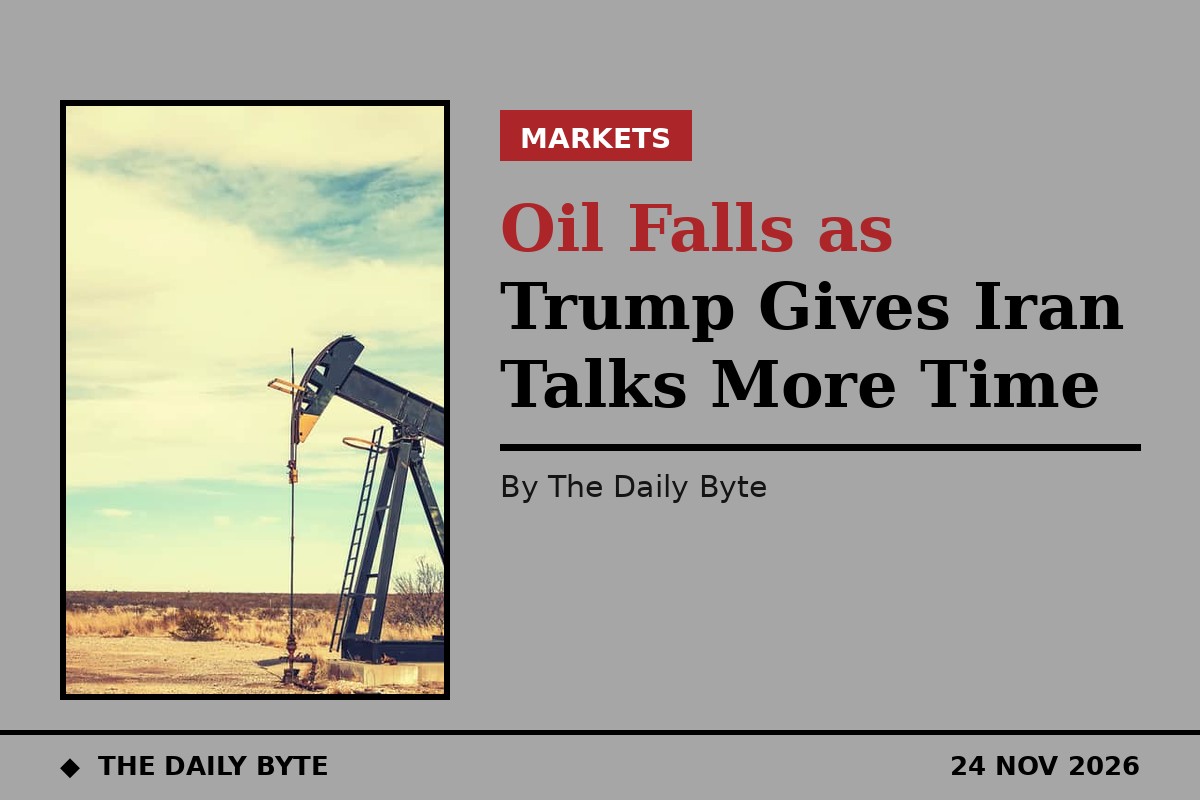
Oil prices fell sharply on Monday, 23 November, as signs that Washington is giving diplomacy with Iran more time took the urgency out of a market that had spent the weekend braced for escalation. West Texas Intermediate, the US benchmark, dropped 4.5 percent to settle at 80.17 dollars a barrel in New York, its first close near 80 dollars since August. Brent, the global benchmark, fell 3.5 percent to settle at 89.37 dollars a barrel.
The trigger was President Donald Trump, who appeared to give talks with Tehran more time while telling Fox News that US strikes could resume after the New Year if negotiations fail. The comments effectively extended the timeline he had set out before the US midterm elections, and traders who had bought oil as insurance against a weekend escalation moved quickly to unwind those positions once the weekend passed without a major new attack.
That pattern has become familiar in this conflict. Rebecca Babin, a senior energy trader at CIBC Private Wealth Group, told Bloomberg that each weekend that passes without meaningful escalation leaves Monday vulnerable to selling, because geopolitical anxiety tends to build during the week and then fade when the weekend passes without a material disruption. Hostilities have not stopped: over the weekend Iran again attacked Bahrain, which hosts US forces, and Yemen's Houthi movement claimed a direct hit on a Saudi Arabian refinery at Rabigh, a claim Saudi authorities had not confirmed by Monday morning.
What kept prices down was supply. Crude shipments appear to be flowing out of the Persian Gulf despite attacks on tankers near the Strait of Hormuz, and Reuters attributed part of Monday's fall to increased Middle East flows and the restart of Libya's Sharara pipeline. Analysts are increasingly convinced that the market is heading into surplus: the International Energy Agency has forecast a surplus of roughly two million barrels a day this quarter, Bernstein analysts predicted the global market would flip back to surplus over the next three years as supply growth outpaces demand, and Goldman Sachs has also flagged the risk of a glut next year.
The scale of the slide is now striking. Brent has dropped by about a fifth this month after Trump held off on renewed strikes following midterm elections in which his Republican Party suffered steep losses. Brent had already fallen 3.4 percent last week, and West Texas Intermediate 5 percent, extending a run of weekly declines to a third straight week. Even so, the market has not fully let go of its war premium: tensions have gradually heightened, and the unresolved US-Iran conflict kept a floor under prices through the session.
There was also a silver lining for consumers. Refined fuel prices have eased, which had rallied even harder than crude as the Iran war throttled fuel exports while Ukrainian strikes hobbled Russian refineries. Ole Sloth Hansen, head of commodity strategy at Saxo Bank, said the easing in diesel prices could help alleviate inflation pressures and, in turn, reduce concerns about further interest rate hikes, provided the standoff with Iran does not trigger another supply disruption.
Traders will now watch whether diplomacy makes real progress. Vice President JD Vance has met Qatar's prime minister to discuss negotiations with Iran, with the Gulf state acting as a mediator in the near nine-month conflict. Among the unresolved issues, Iran is demanding that the US end its naval blockade, and its state-backed media have suggested the government will try to get more ships through the line. Trump warned in his Fox interview that any such vessels attempting to test the US position would end up at the bottom of the sea. For now, the market's message is clear: as long as crude keeps flowing and talks keep going, the price of oil keeps falling.