CoreWeave Database Brings Managed PostgreSQL to AI Cloud
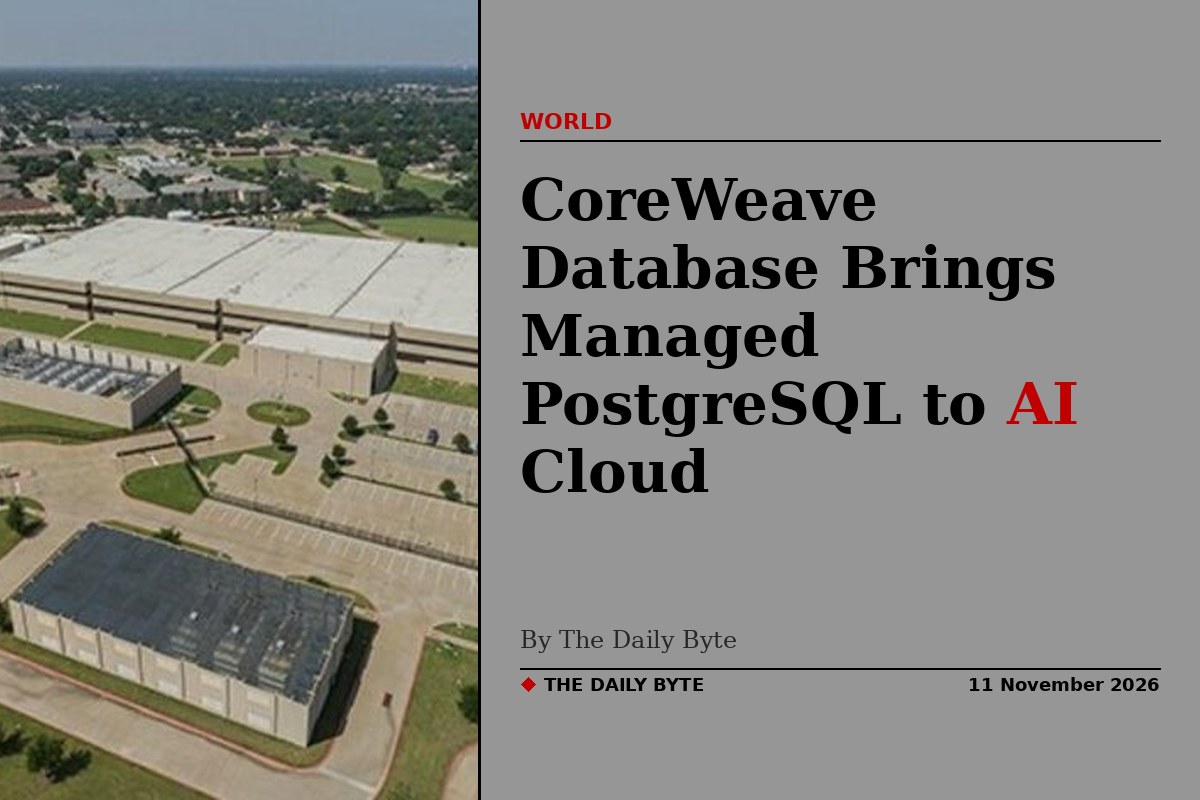
CoreWeave has launched a managed database service for production AI applications, putting the database in the same cluster as the computing that depends on it. Announced on 11 November 2026, CoreWeave Database is a managed PostgreSQL service that runs inside customers' CoreWeave Kubernetes Service clusters, alongside their training and inference workloads, and is generally available from today.
The launch extends CoreWeave beyond the GPU infrastructure it is known for and into the software services that production AI depends on. Until now, teams building on CoreWeave either ran PostgreSQL themselves or kept it in another cloud, adding a network hop, an egress path and a second environment to secure. CoreWeave says that distance matters more as AI moves into production, because agents read and write state between tool calls, training jobs log experiment data and retrieval systems query embeddings at every step.
What CoreWeave Database includes
The service is fully compatible with PostgreSQL, so teams can move an existing database from another cloud or a self-managed deployment using native Postgres tools. Databases run on CPU nodes inside the customer's own cluster and applications connect through an in-cluster Kubernetes service, with no cross-cloud link or egress path to manage.
Each database runs a primary instance with read replicas spread across hosts, with automatic failover, and stores live data on CoreWeave Distributed File Storage. Every database is backed up continuously by default, with point-in-time recovery, scheduled and on-demand backups, and full restores to a new cluster for validation. Databases stay private to their cluster, data is encrypted at rest and in transit, and CoreWeave manages TLS certificates and security patches, while customers control access through native PostgreSQL roles, Kubernetes network policies and audit logging.
Built for AI workloads
CoreWeave Database also supports pgvector, so teams can store embeddings and run vector search for retrieval-augmented generation and semantic retrieval in the same database as their application data, with no separate vector store to run. CoreWeave operates replication, failover, patching and backups, while customers keep ownership of their data, schemas, queries and database users.
The service is built on CloudNativePG, the open-source Kubernetes operator for PostgreSQL, which handles primary and replica management and failover. CoreWeave adds the managed service around it, including its console and Kubernetes workflows, distributed file storage, managed backups, monitoring and ongoing operations. The company says it also contributes upstream to the PostgreSQL ecosystem, including work on the Barman backup and recovery tool and on pgexporter, a Prometheus exporter for PostgreSQL metrics.
Early customer and why it matters
One early user is Advaita Bio, which moved its biomedical literature database from another cloud. "Migrating our biomedical literature database from another cloud to CoreWeave Database was straightforward, and the CoreWeave team helped us get to production quickly," said Mike Mattacola, the company's chief executive. "Our managed PostgreSQL now runs alongside the applications that depend on it, and we're confident our data is encrypted, private, and backed up."
CoreWeave's product chief, Corey Sanders, said the launch reflects how production AI actually runs. "AI in production runs on more than GPUs. It runs on the application state, metadata, and embeddings that agents and training pipelines touch on every step," Sanders said. "CoreWeave Database puts that data in the same cluster as the compute that depends on it, operated by CoreWeave so teams can spend their time on models instead of database operations."
Teams manage the service through the CoreWeave Cloud Console, kubectl, GitOps tools such as Argo CD or Flux, or custom controllers built against the Kubernetes API. The launch comes as CoreWeave, which describes itself as the essential cloud for AI, pushes further into the full production stack rather than compute alone. For more detail, see the CoreWeave announcement and the Unite.AI report.