Coroner warns over baby ambulance delays
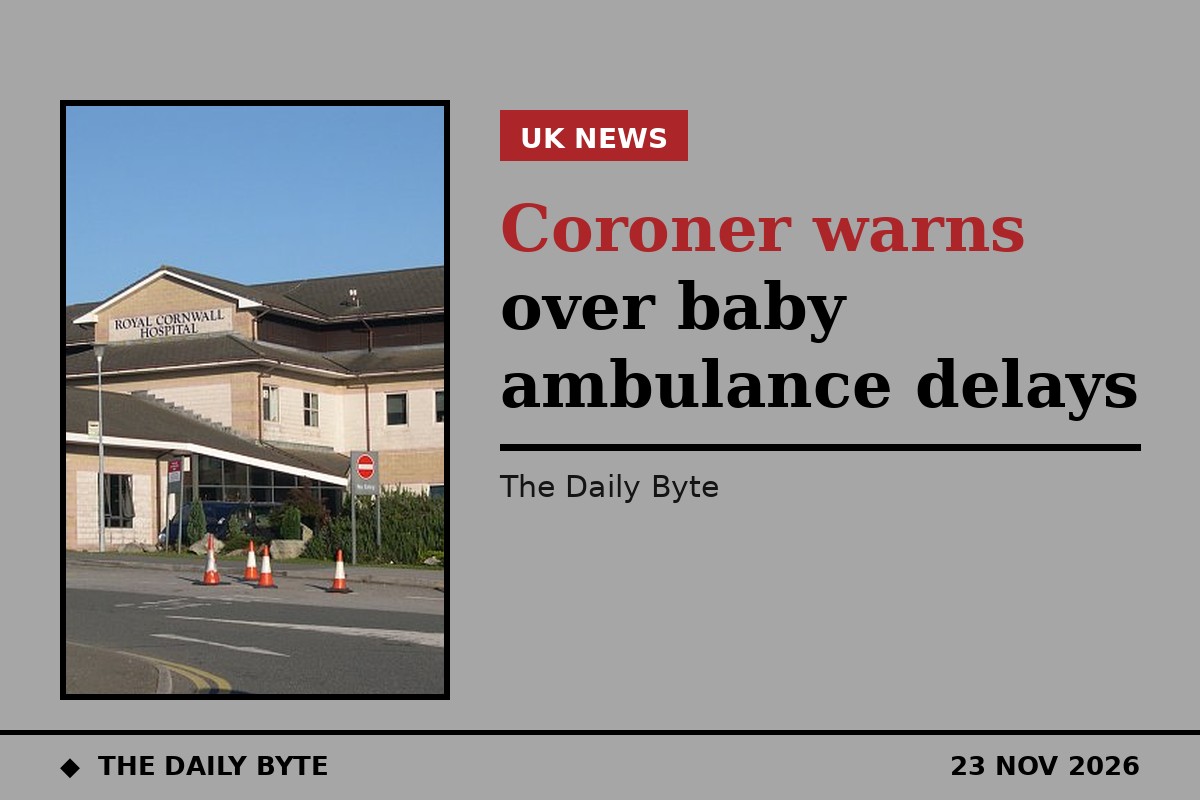
A coroner has warned that babies under three months old have no route to the fastest ambulance response in England, after a baby boy died in Cornwall when an ambulance that should have arrived within 18 minutes was never sent. Senior Cornwall coroner Andrew Cox issued a Prevention of Future Deaths report after the inquest into the death of Ezrah Pollard, who died aged 18 days in March 2022.
Ezrah was born at the Royal Cornwall Hospital in Truro on 7 March 2022. On 23 March, when he was 16 days old, he became unwell: he was grizzly, not feeding, had a foul nappy and then developed a fever. His parents called 111 at about 8.25pm. The call was transferred to the South Western Ambulance Service Trust (SWAST), which reached a Category 2 disposition, meaning an ambulance should have arrived within 18 minutes.
Ambulance never dispatched
At 9.30pm, more than an hour later, the ambulance was chased up — but it had not been dispatched because of operational pressures. At the time, ambulances were taking four hours on average to respond to cases in the same category, the inquest heard. Ezrah's parents took him to the Royal Cornwall Hospital themselves, where staff recognised that he was profoundly ill. He was transferred to Bristol Royal Hospital the next day, where a CT scan revealed a devastating brain injury. He died on 25 March 2022.
The coroner recorded the cause of death as Group B Streptococcal sepsis and meningitis, and concluded that Ezrah died from natural causes. The inquest concluded on 8 September 2026, and the coroner's report, dated 9 September 2026, was sent to NHS England, SWAST, the 111 service and the Royal Cornwall Hospital.
What the coroner found
Cox said there was currently no pathway for an infant up to the age of three months to have a Category 1 ambulance disposition — the fastest response — even though Ezrah had shown red-flag markers including fever, grunting, breathlessness, a "deathly colour" and drowsiness. An expert told the inquest that the particular vulnerability of babies under three months, whose immune systems are not yet developed, appeared not to be recognised in the current ambulance pathways.
The coroner also found that neither the 111 service nor the ambulance trust could tell Ezrah's parents how long the ambulance would take, and that the scripts followed by telephone dispatchers did not require them to advise parents to take a child to hospital immediately. His report said: "Ezrah required immediate antibiotics, yet their administration was avoidably delayed." His parents also had to repeat details of his condition to the ambulance service and again in hospital, because staff there were not aware of the earlier history, which the coroner said may have delayed treatment.
What the services said
Responding to the report, SWAST said its emergency medical dispatchers did not have enough training or expertise to identify a patient with Group B Streptococcus or definitely identify sepsis, and were not expected to diagnose from symptoms described. It said it took ambulance delays very seriously and significant work had been done with partners to improve response times, but it did not give people estimated arrival times. BBC News reported the coroner's concerns on 22 November 2026.
The Royal Cornwall Hospitals Trust said there were no extra systems available that would help share information more effectively than those already in place, and that all patients must undergo a formal triage assessment. Kernow Health CIC, which operates the 111 service in Cornwall, said it was unaware of a restriction on requesting a Category 1 ambulance, and that it was not currently usual practice to advise callers on waiting times.
Frequently asked questions
Who was Ezrah Pollard? A baby boy born at the Royal Cornwall Hospital on 7 March 2022, who died aged 18 days on 25 March 2022 from Group B Streptococcal sepsis and meningitis.
What did the coroner warn about? That there is no pathway for infants up to three months old to receive a Category 1 ambulance response, and that parents are not told how long an ambulance will take or advised to take a child to hospital immediately.
How long did the ambulance take? It was never dispatched. A Category 2 response should have arrived within 18 minutes, but after more than an hour the ambulance had still not been sent, and Ezrah's parents drove him to hospital themselves.
Who received the coroner's report? NHS England, the South Western Ambulance Service Trust, the 111 service and the Royal Cornwall Hospital. The report was made under the Coroners and Justice Act 2009.