UK recognises Rohingya genocide and sanctions Myanmar
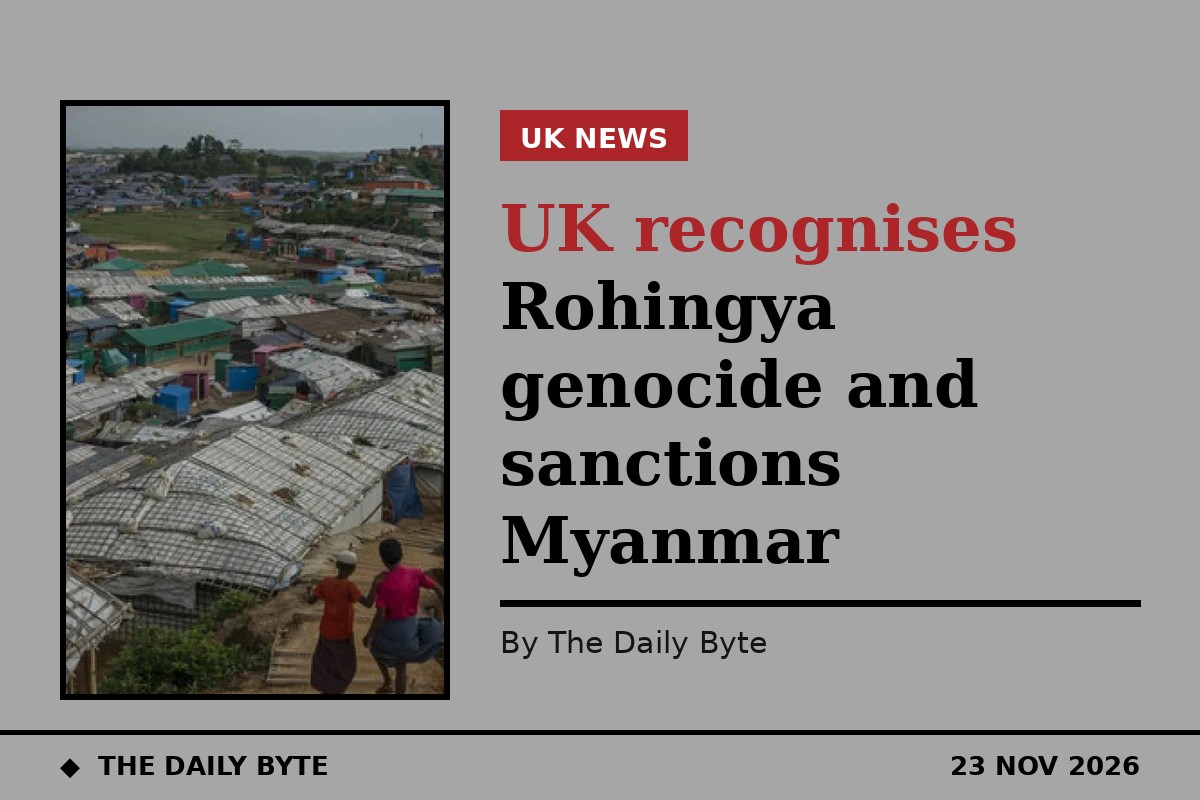
The United Kingdom has formally recognised the genocide committed against the Rohingya people, Foreign Secretary Ed Miliband told Parliament on Monday, 23 November 2026, announcing a package of sanctions, planned aviation-fuel legislation and new humanitarian funding in response to the Myanmar military's continuing violence. The recognition follows the International Court of Justice's landmark judgment on 19 November, in which the court found that Myanmar had violated its obligations under the Genocide Convention over its treatment of the Rohingya.
"The horrific violence and persecution inflicted on the Rohingya cannot go unanswered," Miliband told MPs. "Following the landmark judgment by the International Court of Justice, the UK formally recognises the genocide committed against the Rohingya and is taking decisive action." The measures are designed to turn the court's ruling into practical pressure on the military authorities, where civilians still face deadly airstrikes and restrictions on food and medicine.
Five senior officers sanctioned
The new sanctions target five senior Myanmar military officers, imposing asset freezes, travel bans and director disqualifications. The government said the five were sanctioned on the basis of reasonable grounds to suspect their involvement in the repression of civilians and other serious human rights abuses.
They are Brigadier General Myo Htut Hlaing, deputy commander of the Northwestern Regional Command, sanctioned over the treatment of prisoners detained in Chin State; Major General Myo Min Tun, the Eastern Military Commander for Shan and Kayah; Major General Myat Thet Oo, a former Northern Command chief in Kachin who later served as ambassador to Laos; Major General Kyaw Soe, the Western Command chief in Rakhine since June 2026, linked to airstrikes on civilians and medical sites; and Major General Kyaw Swar Oo, his predecessor, linked to an airstrike on Mrauk-U General Hospital in which 33 civilians were killed, including a baby.
The UK has imposed 19 rounds of sanctions since the 2021 military coup, designating 42 individuals and 39 entities, according to the Foreign, Commonwealth and Development Office.
Plans to cut off aviation fuel
Alongside the sanctions on individuals, the government said it intended to introduce legislation targeting the export and supply of aviation fuel to Myanmar. The move is aimed at the military's continued airstrikes against civilians, which the government says have killed and injured people across the country and destroyed hospitals and other civilian infrastructure.
No date has been given for the legislation, which the government said would be introduced in the coming months.
Aid and justice funding for survivors
The package also includes fresh money for people affected by the violence. An additional £5 million will support Rohingya and other communities in Rakhine State with essential services for about 350,000 people where humanitarian need is most acute. A further £3 million will go towards accountability and justice for survivors, including collecting and preserving evidence, documenting violations and supporting survivors pursuing justice.
The government said it was also doubling its support for the United Nations' International Investigative Mechanism for Myanmar, whose evidence helped support the court's judgment. Britain has provided £447 million in humanitarian assistance to Rohingya refugees in Bangladesh since 2017, according to reporting of the announcement.
A coordinated international response
Britain is pressing other countries to act too. The UK led a joint statement on Monday with Belgium, Canada, Cyprus, the Czech Republic, Estonia, Iceland, Latvia, Luxembourg, New Zealand, Portugal, Spain and The Gambia, calling on Myanmar to comply fully with the ruling, and has called an urgent UN Security Council session this week, with a further council meeting in two weeks.
The diplomatic pressure has been building since the judgment. Last week the UK summoned Myanmar's Chargé d'affaires and expelled the Myanmar Defence Attaché from Britain. "There can be no impunity for these atrocities and the gravest violations of international law," Miliband said. "We will stand with the Rohingya and remain committed to supporting a stable future for the people of Myanmar."
What the recognition means
With the announcement, the UK now officially acknowledges six instances where genocide has occurred: the Holocaust, Myanmar, Rwanda, Srebrenica, acts of genocide in Cambodia and acts of genocide against the Yazidi people. The Gambia brought the case against Myanmar in November 2019, alleging violations of the Genocide Convention over the military's 2017 clearance operations in Rakhine State, which involved mass killings, sexual violence and forced displacement.
The Burma Campaign UK, which has long pressed for stronger action, welcomed the announcement as the first UK sanctions against the Burmese military in more than two years. Its director, Mark Farmaner, said: "Ed Miliband is taking practical action which will pressure the Burmese military and help save lives." The group added, however, that sanctions on individuals were largely symbolic, and that action against the sectors supplying money, arms and equipment to the military would matter more.