Costa Reassures Merz Over EU Budget Ukraine Row
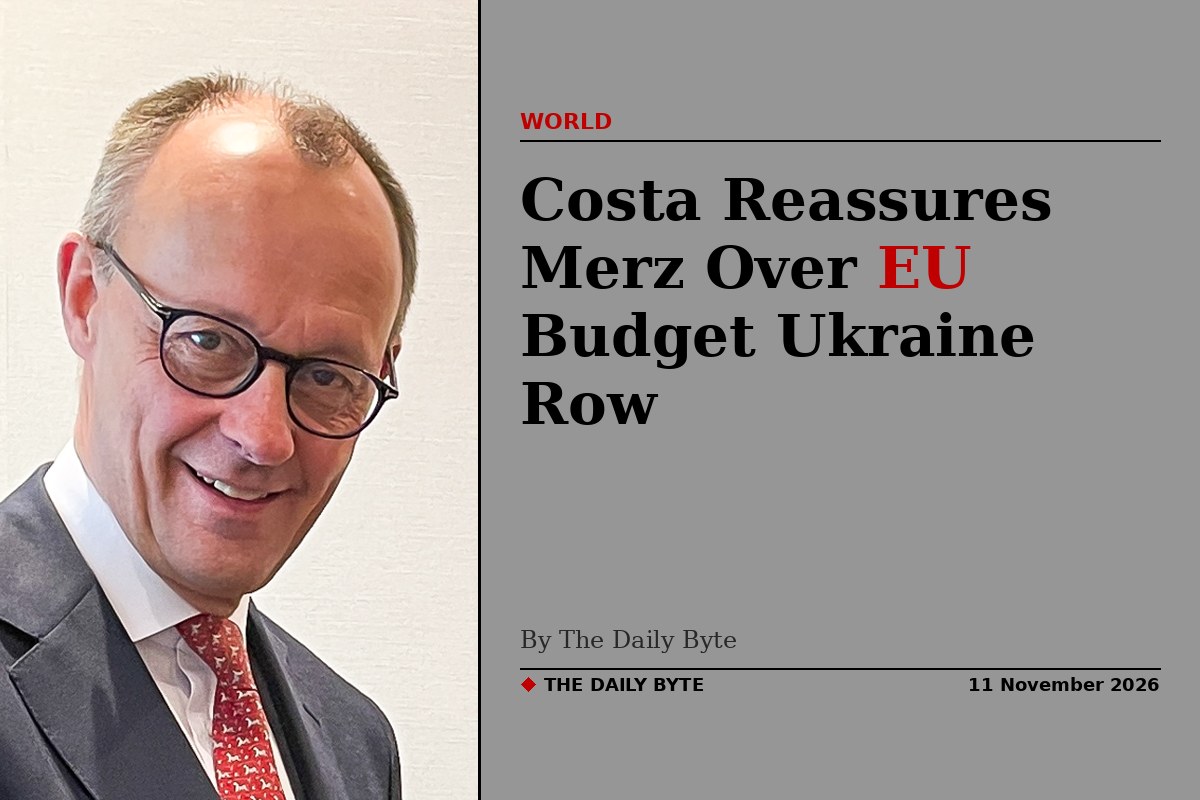
European Council President António Costa has moved to calm a growing row with German Chancellor Friedrich Merz over funding for Ukraine, promising a broad discussion of the issue when European Union leaders meet in Dublin this week. The dispute centres on whether every EU member state must help pay for Kyiv's war effort before Germany will approve the bloc's next long-term budget.
Merz wrote to Costa on Monday, 9 November, warning that Berlin would not approve the EU's multiannual budget for 2028 to 2034 unless all member states took part in financing Ukraine. "Supporting Ukraine is a matter of our indivisible European security, and so must be the burden sharing for that support," he wrote.
Costa offers Dublin debate, decision later in November
Costa replied that the discussion would take place at a special summit in Brussels at the end of the month, once the European Commission has presented proposals to cover Ukraine's financing gap. In a letter seen by Euronews, he added that he would still make time for the issue in Dublin. "In light of ongoing developments, I will make time for a broad discussion on Ukraine at the upcoming informal European Council in Dublin," Costa wrote.
The informal European Council meets on Friday, 13 November, immediately after the European Political Community summit in Dublin on Thursday, 12 November. A dedicated summit on the next EU budget is scheduled for 26 and 27 November,
A €70 billion gap for Ukraine in 2027
Ukraine faces a projected budget shortfall of about €70 billion next year. The EU has pledged to cover roughly €45 billion of that amount, with the remainder expected from international partners including Britain and Canada. The EU agreed last year to lend Kyiv €90 billion, a sum intended to cover two-thirds of its military and civilian costs for 2026 and 2027.
Germany has taken the lead in securing the remaining money for Ukraine's 2027 budget, but Berlin says the burden is spread unevenly and carried mostly by only a few member states. Germany is the EU's largest net contributor and, according to the Kiel Institute, has provided the largest bilateral aid package to Ukraine in Europe, worth €31 billion.
Four countries push back against Merz
Four member states — Hungary, Slovakia, the Czech Republic and Bulgaria — have asked to be exempted from the next Ukraine funding mechanism. All four are major recipients of EU cohesion funds, and Merz has argued that countries cannot call for European solidarity on regional funding while refusing to help finance Ukraine.
Slovak Prime Minister Robert Fico accused Merz of blackmail at a press conference in Bratislava on Tuesday, 10 November, alongside his Czech counterpart Andrej Babiš. "What the chancellor is doing is typical blackmail, and I will not give in," Fico said. Babiš said he did not understand why Merz had taken the position
Hungarian Prime Minister Péter Magyar, visiting Berlin on Tuesday, 11 November, took a softer line, arguing that it was "not a good idea to link the European budget — which, after all, concerns the European Union — to any other question."
Why the timing matters
Funding for Ukraine in 2027 must be secured by the end of the year, the deadline for the International Monetary Fund to release its own contribution. EU leaders are still awaiting proposals from the European Commission detailing the options for funding the €45 billion Ukraine will need in the second half of 2027. Valdis Dombrovskis, the commissioner in charge of the economy, said the Commission was working on the options and would present them to member states at a later date.
Some diplomats have questioned Merz's timing, noting that the row erupted just as the United States, Ukraine and Russia were holding trilateral peace talks in Abu Dhabi on 10 and 11 November. Others in Brussels describe the letter as more of a warning than a serious threat. Le Monde and EuropeSays reported the developments.
Frequently asked questions
What did Friedrich Merz demand? He told European Council President António Costa that all EU member states sharing the cost of Ukraine's funding was an essential precondition for Germany approving the EU's 2028-2034 budget.
When will EU leaders discuss Ukraine funding? Costa has promised a broad discussion at the informal European Council in Dublin on 13 November, with a decision expected at a special budget summit on 26 and 27 November.
How much money does Ukraine need? Kyiv faces a projected €70 billion budget shortfall in 2027, of which the EU has pledged to cover about €45 billion.