CVE-2026-134069: AWS SSM Agent Shared Key Flaw
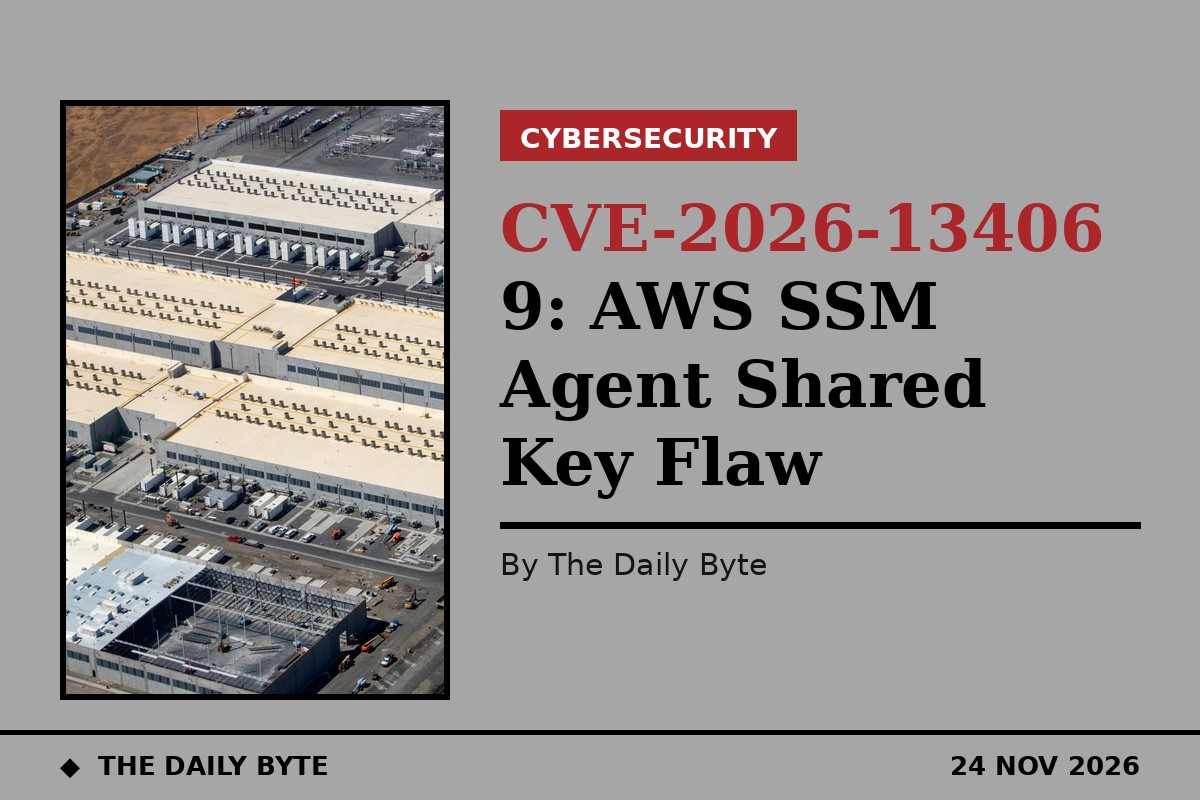
Amazon has disclosed a flaw in its Systems Manager agent that left Windows cloud instances sharing a single registration key, allowing a local user without administrator rights to obtain the instance's cloud credentials. The issue, tracked as CVE-2026-134069, was published in AWS security bulletin 2026-197-AWS on 23 November 2026.
Amazon SSM Agent is the software that runs on EC2 instances so they can be managed through AWS Systems Manager, the service administrators use for patching, configuration and remote commands. According to the bulletin, the flaw affects Amazon SSM Agent on AWS-provided Windows Server machine images released before 9 September 2026. Instances launched from the same image shared one instance registration key, and on instances managed through Default Host Management Configuration, a local user without administrative privileges might be able to use that key to obtain the instance's Default Host Management Configuration role credentials.
Those credentials matter because they are the identity the instance uses when it talks to AWS services on the owner's behalf. A local user who obtains them could act with the permissions attached to that role, which may reach well beyond the single machine. The attack needs local access to the instance, so it is not remotely exploitable from the internet, but any shared or multi-user Windows server, or any workload that runs untrusted code alongside other users, is exposed.
Patching the agent is not enough
The detail that makes this flaw awkward is that updating the agent does not fix it. Affected versions are SSM Agent below 3.3.5226.0, but Amazon says instances launched from the affected images remain affected after an in-place agent upgrade, because the shared registration key stays in place. Upgrading the software on a running instance therefore does not remove the problem.
The fix is to launch new instances from AWS Windows Server images released on or after 9 September 2026, which include SSM Agent 3.3.5226.0 or later. That means affected workloads need to be rebuilt on fresh images rather than patched where they stand, and the old instances retired. Administrators should check which of their Windows instances were launched from images dated before 9 September 2026, confirm whether they use Default Host Management Configuration, and plan replacements for the ones that do.
Check for credential exposure
Because the weakness involves credentials that may have been within reach of local users, it is worth reviewing what the affected role could access and whether anything unusual happened with it. AWS has not reported exploitation of the flaw, and the bulletin describes the credential access as something a local user might be able to obtain, rather than something observed in attacks. Even so, rotating or scoping down the role's permissions while replacements are planned is a sensible precaution.
Amazon published a second bulletin the same day, for an out-of-bounds write in padded block cipher decryption in AWS-LC, tracked as CVE-2026-134056, which can crash applications or corrupt memory. The SSM Agent issue is the more consequential of the two, because it touches the credentials that tie a cloud instance to its owner's account. The full detail is in Amazon's security bulletin 2026-197-AWS, and the vulnerability is also listed by CVE trackers with the same affected versions and fix.