CVE-2026-80466: WAGO Flaw Gives Root on Controllers
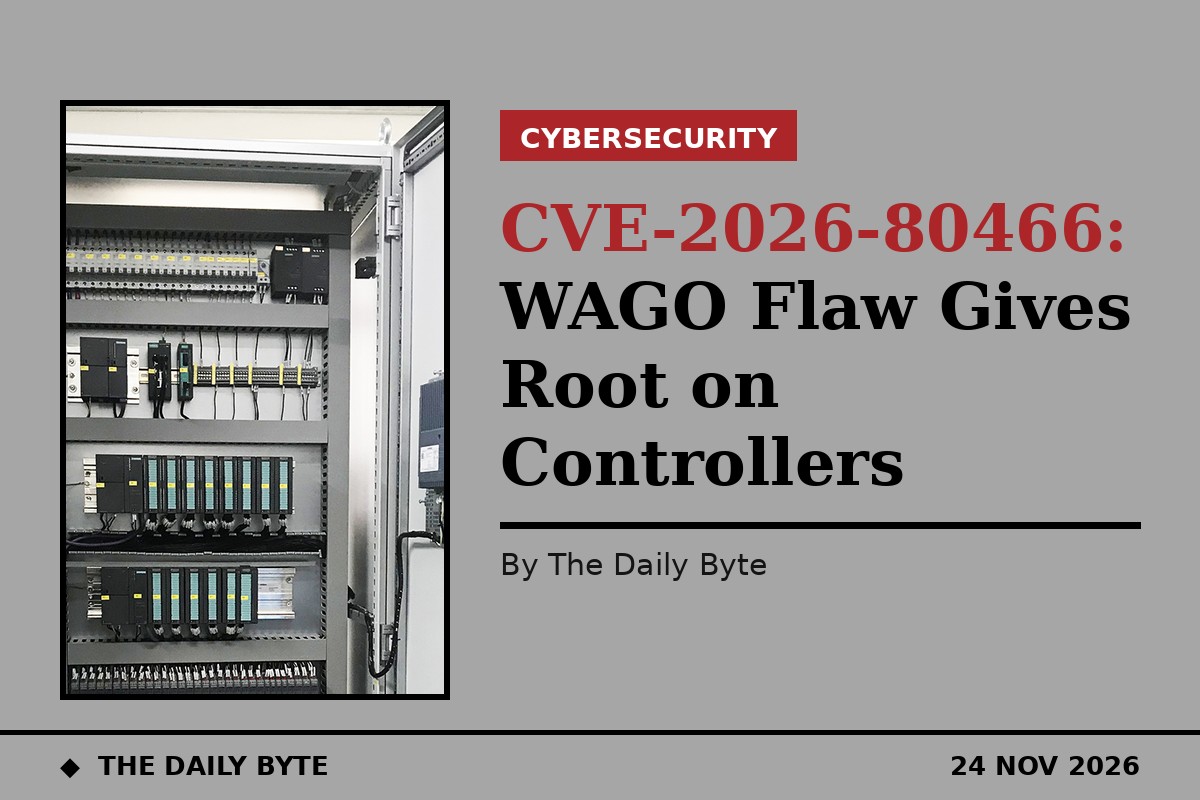
WAGO has fixed two security flaws in the web management interface of its industrial controllers, including one that lets a low-privileged user run commands with root privileges. The German automation vendor disclosed the issues on 23 November 2026 in an advisory from CERT@VDE, and says owners should update to firmware version 4.10.0.
The more serious of the two is tracked as CVE-2026-80466. It sits in the routing configuration page of the web-based management interface, known as WBM, which administrators use to set up the controllers. Because the page does not check routing values properly, an attacker who can log in with a low-privileged account can slip shell commands into those values. The values are saved into a configuration file, and a helper script running with root privileges later reads that file and runs what it finds. The result is command execution as root on the controller, without needing an administrator account.
The flaw carries a CVSS score of 8.8, which rates it as high severity. It affects the CC100, PFC100 G2, PFC200 G2, TP600, Edge Controller and WP400 ranges running WAGO OS Linux below version 4.10.0, including custom firmware builds below version 4.10.0 (70). The advisory was coordinated by CERT@VDE and the flaw was reported by researcher Ievgen Bondarenko. The advisory does not report any known exploitation.
Second flaw weakens PROFIBUS protections
The same advisory covers a second vulnerability, CVE-2026-88850, in the way the management interface enforces permissions for PROFIBUS settings. PROFIBUS is a fieldbus protocol widely used to connect controllers with sensors, drives and other field devices on a factory floor. The advisory says a low-privileged remote attacker can abuse an exposed configuration function to change PROFIBUS parameters that are supposed to be protected, including device addressing and SSA settings. That breaks the privilege boundaries the interface is meant to enforce and could let an attacker alter how field devices are addressed on the network.
Both flaws need an attacker to reach the management interface and hold a low-privileged account, so they are not the kind of bug an outsider can exploit with no access at all. But controllers of this type often sit at the heart of a production line or a building system, and a low-privileged account can belong to an operator, a contractor or a compromised workstation. Once an attacker has root on the controller itself, they can change its behaviour, interfere with connected equipment or use it as a foothold into the wider operational network.
What owners should do
WAGO's fix is firmware version 4.10.0 (FW32) or higher. Owners running custom firmware should contact WAGO support for the latest custom build. As with any controller update, the new firmware should be tested on a spare unit or during a planned maintenance window before it is rolled out to production hardware, because a failed update can take a controller offline.
Until the update is installed, the usual precautions apply: keep controller management interfaces off the public internet, restrict access to trusted networks and accounts, and review who holds low-privileged accounts on each device. The disclosure is a reminder that the web interfaces on industrial hardware deserve the same attention as the control logic itself. A flaw in a settings page can matter just as much as a flaw in the protocol stack, and in this case the settings page was the route to full control of the device. Further detail is in the CERT@VDE advisory VDE-2026-096, and the vulnerability record is listed by CVE databases with the same CVSS score.