Why Do We Have Different Blood Types?
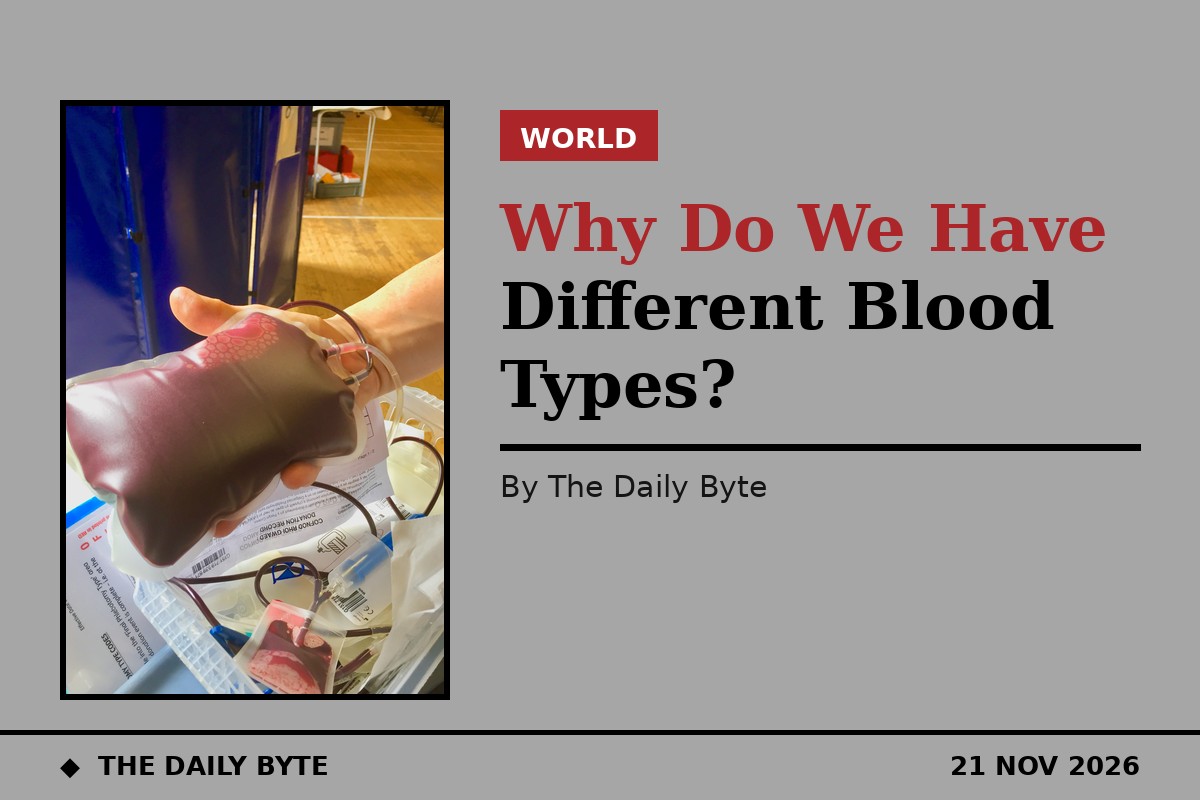
We have different blood types because the red blood cells of different people carry different sugar molecules, called antigens, on their surfaces, and those molecules are inherited from our parents. The ABO system sorts blood into four groups, A, B, AB and O, according to which antigens are present, and the RhD system adds a positive or negative label according to whether a further antigen, called D, is present. Together the two systems produce the eight blood types used in hospitals, and your type is fixed by the genes you inherit.
The deeper question is why the variation exists at all, given that a mismatched transfusion can be dangerous. The short answer is that nobody knows for certain, but the leading explanation is that the variation is very old and has been maintained by evolution because different types protect against different infectious diseases. The ABO variation is shared with other primates and is at least twenty million years old, which is a long time for a trait to survive unless something is actively keeping it alive.
What exactly is a blood type?
A blood type is a description of the molecules sitting on the surface of your red blood cells. Those molecules are called antigens, and they act like identity badges. The immune system uses them to tell the body's own cells apart from foreign ones, and it produces antibodies against any antigen it does not recognise. That is the whole basis of blood typing, and it is why matching matters so much in transfusion.
In the ABO system there are two antigens that matter, A and B. If your red cells carry the A antigen, your blood group is A, and your plasma carries anti-B antibodies, ready to attack B cells. If your cells carry the B antigen, your group is B, with anti-A antibodies. If they carry both, your group is AB, and your plasma carries neither antibody. If they carry neither, your group is O, and your plasma carries both anti-A and anti-B antibodies. The pattern is tidy and exact, and it is the reason a transfusion of the wrong type can trigger a dangerous reaction: the recipient's antibodies attack the donor's red cells and destroy them.
The antigens themselves are sugars. They are built by enzymes coded in your DNA. The A gene produces an enzyme that attaches the A sugar, the B gene produces one that attaches the B sugar, and the O gene is effectively a broken version that produces no working enzyme, so the base structure is left unmodified. You inherit one copy of the ABO gene from each parent, which is why your blood type depends on what your parents carry, and why two parents with group O can only have children with group O.
The eight blood types and how common they are
The RhD system adds a second layer. If your red cells carry the D antigen you are RhD positive, and if they do not you are RhD negative. About eighty-five per cent of people in the UK are RhD positive, and the NHS notes that almost half of the UK population, around forty-eight per cent, has blood group O. Combining the four ABO groups with the two RhD possibilities gives eight types in total, and their shares among blood donors are recorded by NHS Blood and Transplant.
| Blood type | Antigens on red cells | Antibodies in plasma | Share of UK donors |
|---|---|---|---|
| O positive | RhD only | Anti-A and anti-B | 36% |
| O negative | None | Anti-A and anti-B | 14% |
| A positive | A and RhD | Anti-B | 28% |
| A negative | A only | Anti-B | 8% |
| B positive | B and RhD | Anti-A | 8% |
| B negative | B only | Anti-A | 3% |
| AB positive | A, B and RhD | None | 2% |
| AB negative | A and B only | None | 1% |
The figures are shares of NHS Blood and Transplant donors as of February 2026, and donors are a self-selecting group, so they are not an exact census of the whole population. Even so, the pattern is clear. O positive is the most common type, at roughly a third of donors, and A positive is second at just over a quarter. AB negative is the rarest of the eight, at about one per cent of donors, followed by B negative at about three per cent and AB positive at about two per cent.
Why matching matters so much
Matching matters because the immune system cannot tell a donated red cell from an invading microbe. Give a person with group A the blood of a group B donor, and the anti-B antibodies in the recipient's plasma will attack the donor cells, causing them to clump together and break apart. The reaction can be severe and, before blood typing existed, it was often fatal. That is why hospitals test a patient's blood group before every transfusion and cross-match the donor blood against it.
Two types have special roles. O negative is the universal red-cell donor, because its red cells carry no A, B or RhD antigens for a recipient's antibodies to attack. That makes it the type used in emergencies, when there is no time to test the patient, and it is why hospitals are always short of it: only about eight per cent of the population has O negative blood, yet it accounts for a much larger share of hospital demand. AB positive is the universal recipient for red cells, because its plasma carries no anti-A or anti-B antibodies, so it can accept red cells of any ABO type. The advantage is real but narrow, since only about two per cent of people have AB positive blood.
Blood group also matters in pregnancy. If an RhD negative mother carries an RhD positive baby, her immune system can develop antibodies against the baby's blood, which can cause problems in that pregnancy and in later ones. Hospitals manage this with careful testing and preventive treatment, and it is one of the reasons blood group is checked early in antenatal care.
Who discovered the blood types?
Before 1900, blood transfusion was a gamble. Doctors knew that mixing blood from two people could cause the red cells to clump together, but nobody knew why, and transfusions sometimes killed the patient they were meant to save. The answer came from Karl Landsteiner, an Austrian immunologist working in Vienna. In 1900 he began testing the blood of the scientists in his laboratory, including his own, mixing one person's red cells with another's serum and watching what happened. Some combinations clumped and some did not, and Landsteiner realised that the clumping was an immune reaction: the recipient's blood was producing antibodies against antigens on the donor's cells that it did not recognise.
On that basis Landsteiner divided human blood into three groups, now known as A, B and O, publishing his discovery in 1901. A fourth group, AB, was identified soon afterwards. In 1940, working with Alexander Wiener, he discovered the Rhesus system as well. For the ABO discovery he received the Nobel Prize in Physiology or Medicine in 1930. His work removed most of the risk from transfusion, turned it into a routine medical procedure, and gave police a new tool as well, since dried blood could now be typed at a crime scene.
So why do different types exist at all?
This is the question with no settled answer, and the honest version is worth stating plainly. Scientists do not know exactly why humans have several blood types rather than one. What they do know is that the variation is ancient. The A and B variants trace back to a single ancestral gene that already had both forms at least twenty million years ago, long before humans split from other primates, and versions of the ABO system are found in chimpanzees, gorillas and Old World monkeys. When a genetic trait survives that long across many species, evolutionary biologists call it a balanced polymorphism: something is actively keeping the variation alive, because otherwise one version would eventually have won out.
The leading explanation is infectious disease. Blood group antigens are not only found on red blood cells. They also appear on the lining of the gut, the airways and other tissues, where they can serve as docking points for bacteria and viruses. Different pathogens exploit different antigens, so a population in which everyone has the same type would be vulnerable to a single disease sweeping through it, while a population with several types has a built-in defence: no one pathogen can attack everybody in the same way. Evolutionary biologists think the variation persisted because different blood types give different degrees of protection against ancient infections such as malaria, cholera and norovirus, so no single type was best everywhere on Earth.
That explanation fits the geography. Blood group frequencies vary around the world in ways that track old disease patterns rather than chance. Group B is more common in parts of Asia, group O dominates in many Indigenous populations of the Americas, and group A is more common in parts of Europe. None of this means your blood type decides whether you get ill. It is one small factor among many, and modern medicine, sanitation and vaccination matter far more. But as an explanation for why the variation survived for twenty million years, disease pressure is the best account science currently has.
Beyond ABO and RhD
The eight familiar types are only part of the picture. The NHS notes that although the ABO and Rh groups are the most important for blood transfusions, there are thirty-six other known blood group systems, each defined by its own set of antigens. Most of them rarely matter in everyday medicine, but they can matter a great deal for individual patients, particularly people who need repeated transfusions, such as people with sickle cell disease, whose blood must be matched more precisely over time.
At the far edge of rarity sits Rh-null, sometimes called golden blood. People with Rh-null lack all of the antigens in the Rh system, not just the D antigen that decides positive or negative. It is so rare that only a few dozen people in the world are known to have it, and their blood is extraordinarily valuable because it can be given to almost anyone with a rare Rh profile. The existence of Rh-null is a reminder that the eight types are a useful shorthand, not the full story of human blood.
Frequently asked questions
Can my blood type change? No. Your blood group is set by the genes you inherit from your parents, and it stays the same for life. It is tested, not chosen, and the only way to find out what it is for certain is a blood test.
What is the rarest blood type in the UK? Of the eight main types, AB negative is the rarest, at about one per cent of blood donors. B negative is next at about three per cent, and AB positive at about two per cent. O negative is uncommon too, at roughly eight per cent of donors, but it is the type hospitals need most urgently because it can be given to anyone in an emergency.
How can I find out my blood type? The simplest way is to give blood. Donors are told their blood group after their first donation, and the NHS Give Blood service publishes the information for donors. A blood test arranged through your GP will also identify it.
Does my blood type affect my health? Research has found links between blood type and susceptibility to some infections, which is part of why scientists think the variation survived through evolution. But your blood type is only one small factor among many, and it is not something you can change, so it is not something to worry about. Doctors treat the patient, not the blood group.
Sources: NHS, Blood groups; Encyclopaedia Britannica, Karl Landsteiner; Biology Insights, Why Are There Blood Types?; Sunderland News, What are blood types (NHS Blood and Transplant donor figures, February 2026). Figures checked 21 November 2026.