Dar Orders Timely GSP Plus Compliance Ahead of Review
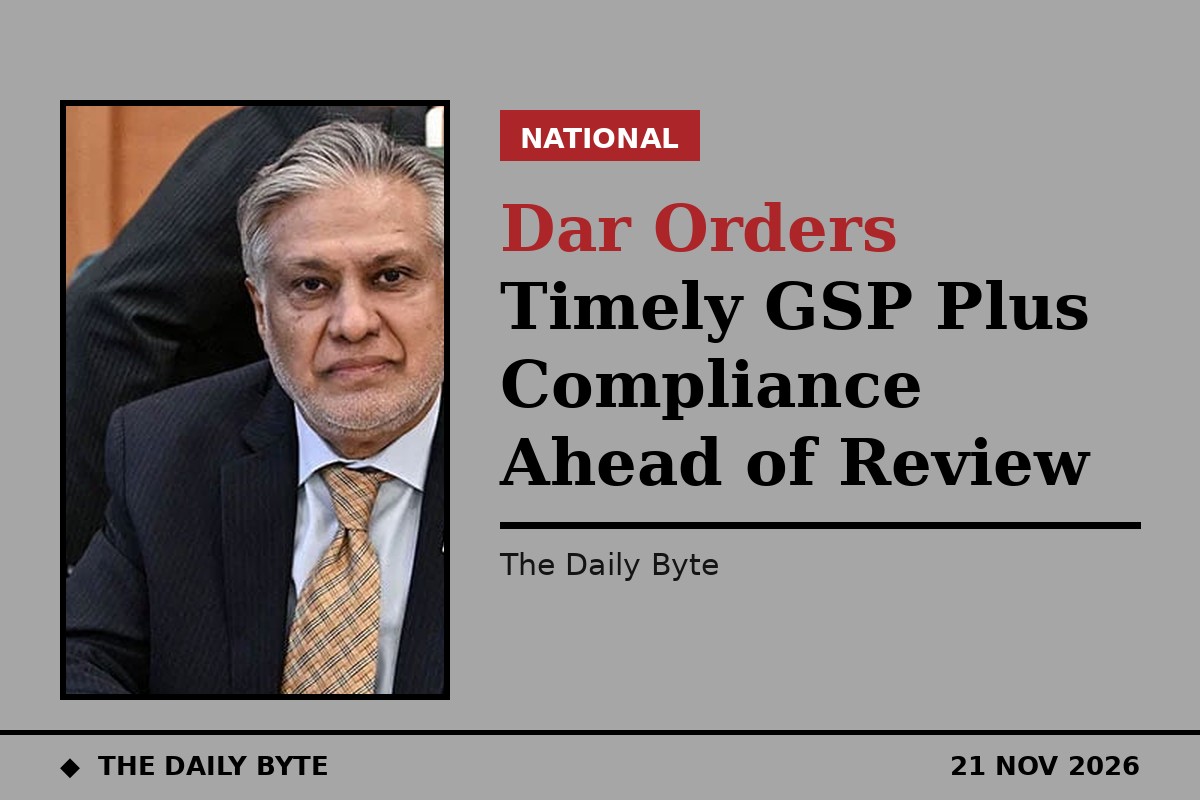
Deputy Prime Minister and Foreign Minister Ishaq Dar has directed all government ministries and departments to ensure timely compliance with the European Union’s GSP Plus scheme, as Pakistan prepares for upcoming review milestones.
Dar issued the direction on Saturday while chairing an inter-ministerial meeting in Islamabad to review Pakistan’s GSP Plus status with the European Union. The Foreign Office said the meeting assessed where Pakistan stands on the conditions attached to the preferential trade arrangement, and what still needs to be done before the next round of scrutiny.
The meeting was attended by the secretaries of foreign affairs, commerce and information and broadcasting, Pakistan’s ambassador to Belgium and the European Union, and senior officials from federal and provincial ministries and departments. Their presence reflected the breadth of the work involved, since meeting the scheme’s conditions touches trade, labour, human rights, the environment and governance at both levels of government.
According to the Foreign Office, participants assessed the ongoing implementation of the international conventions and regulatory benchmarks required under the GSP Plus framework. The session also reviewed institutional follow-up measures and evaluated the diplomatic outreach strategy Pakistan is pursuing with European partners.
Why the scheme matters
Under GSP Plus, the European Union grants developing countries reduced or zero tariffs on many exports in exchange for progress on human rights, labour standards, environmental protection and good governance. For Pakistan, the arrangement supports export earnings and bilateral trade with Europe, one of the country’s most important overseas markets.
Keeping the preferences depends not on a single decision but on a sustained record of implementation. The conventions behind the scheme cover areas that fall to different ministries, and in several cases to provincial governments, which is why the meeting brought federal and provincial officials into the same room. Dar’s instruction was for the ministries concerned to coordinate with each other rather than work in isolation, and to deal with outstanding requirements before the review milestones arrive rather than after.
The Foreign Office did not publish the dates of the upcoming milestones or a list of the specific benchmarks discussed. What it made clear was the government’s message to its own machinery: compliance work should stay ahead of the timetable, with gaps identified and closed in advance.
Review milestones ahead
The review process is the point at which Pakistan’s implementation record is examined by its European partners, and the government’s handling of the preparation will shape how that examination goes. The meeting reviewed the institutional follow-up measures already in place, suggesting that the work is being tracked department by department rather than left to a single ministry.
It also looked at diplomatic outreach, the other half of the task. Retaining preferential access involves both doing the domestic work and presenting the record to the European Union, and the meeting assessed both sides of that effort together.
For exporters, the outcome of the review process carries direct consequences, since the tariff treatment of their goods in European markets rests on it. Saturday’s meeting was the government’s latest step in preparing for that test, with Dar pressing ministries to treat compliance as a continuing obligation and to keep their work coordinated and on schedule.