Dar puts Pakistan resources at $8-10 trillion
Deputy Prime Minister and Foreign Minister Ishaq Dar has estimated the value of Pakistan’s mineral deposits, hydrocarbons and other natural resources at between $8 trillion and $10 trillion, describing the figure as the “most conservative estimate”.
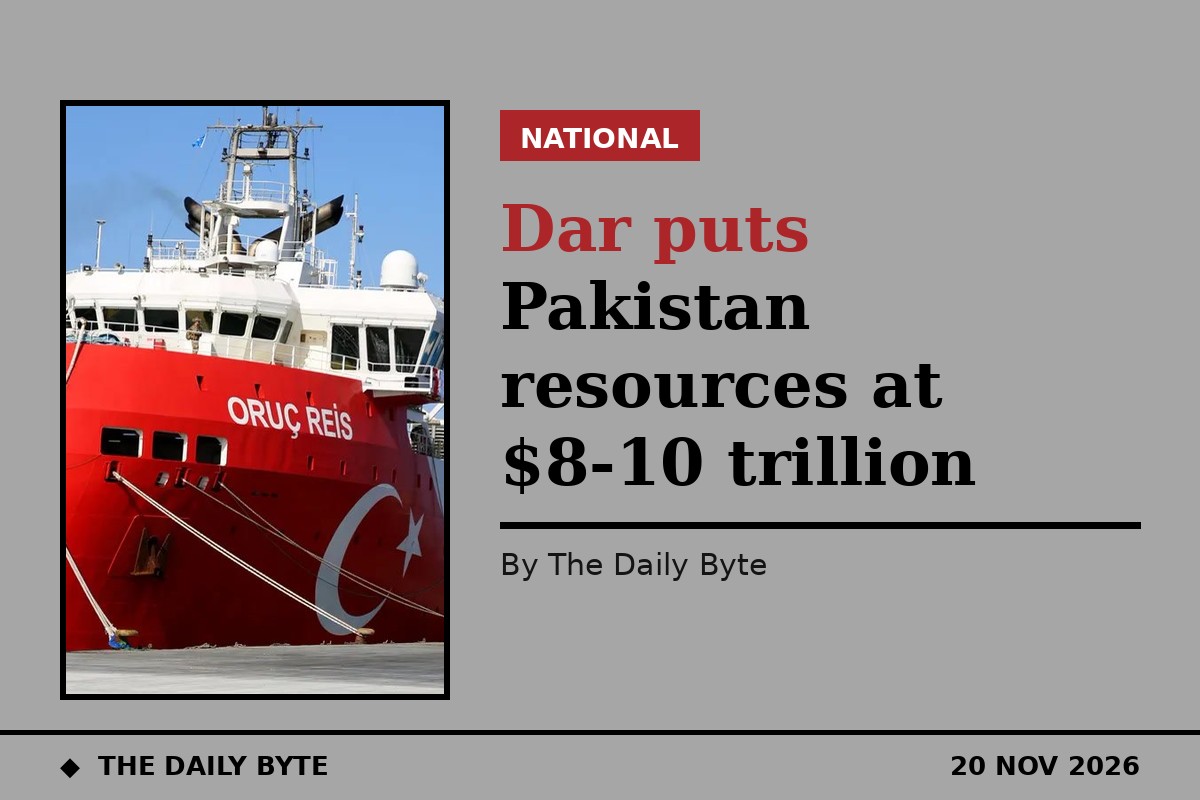
Dar made the remarks on Friday while addressing a ceremony in Karachi to mark the arrival of Türkiye’s seismic research vessel, Oruç Reis, which reached Pakistan on Thursday for offshore oil and gas exploration.
Welcoming the Turkish Petroleum leadership, technical experts, captain, crew and seismic research team, Dar described the vessel’s arrival as a “historic moment” in Pakistan-Türkiye energy cooperation.
The survey ahead
The 87-metre vessel, operated by the Turkish state energy firm TPAO, will carry out a three-dimensional seismic survey across 670 square kilometres of the Eastern Offshore Indus Block C, followed by a two-dimensional survey covering 2,353 kilometres of lines in the Makran offshore blocks. Turkish Energy Minister Alparslan Bayraktar, who attended the ceremony with Petroleum Minister Ali Pervaiz Malik, said the vessel had reached Pakistan after a 19-day voyage.
Dar said the survey mission was expected to take about five to six months. Once the data has been collected and analysed, full-scale exploration drilling in the deep sea is targeted for early 2027. The mission resumes offshore hydrocarbon exploration in Pakistan’s Indus and Makran basins after nearly two decades.
Three agreements were signed between the relevant Pakistani and Turkish agencies, and Dar said Islamabad sought a long-term energy partnership with Ankara covering offshore exploration, minerals and renewable energy. He called for closer collaboration between Pakistani and Turkish geologists, engineers, universities and research institutions, particularly in marine sciences, geoscience and offshore engineering.
What the figure covers, and what it does not
Dar said the estimate covered minerals, hydrocarbons, gemstones and rare earth materials. It is his own assessment, not an audited valuation. A similar $8 trillion figure for the country’s mineral reserves was cited by the Institute of Cost and Management Accountants of Pakistan at the Pakistan Minerals Investment Forum in Islamabad on 12 and 13 November, where it was noted that mining still contributes less than 3 per cent of Pakistan’s gross domestic product.
The Reko Diq copper-gold project in Balochistan remains the centrepiece of the government’s minerals pitch, with first production targeted for the end of 2028 under its feasibility study.
Debt, and the limits of exploration
Addressing concerns about Pakistan’s debt burden, Dar argued that the country’s natural resource potential was substantially greater than its outstanding liabilities, and he rejected descriptions of Pakistan as trapped in debt.
He also acknowledged that offshore exploration was complex, capital-intensive and inherently uncertain, stressing that seismic surveys could not guarantee commercially viable discoveries. “But no discovery can be made without seismic and exploration,” he said, adding that Pakistan was taking an important step with confidence and responsibility.
Dar assured the Turkish partners that the government would provide appropriate facilitation for the mission, while emphasising maritime safety and environmental protection. “Our seas are an economic asset, but they are also a national trust. Development and environmental stewardship must proceed together,” he said.