Dar Tells Euronews Regional Security Plan Taking Shape
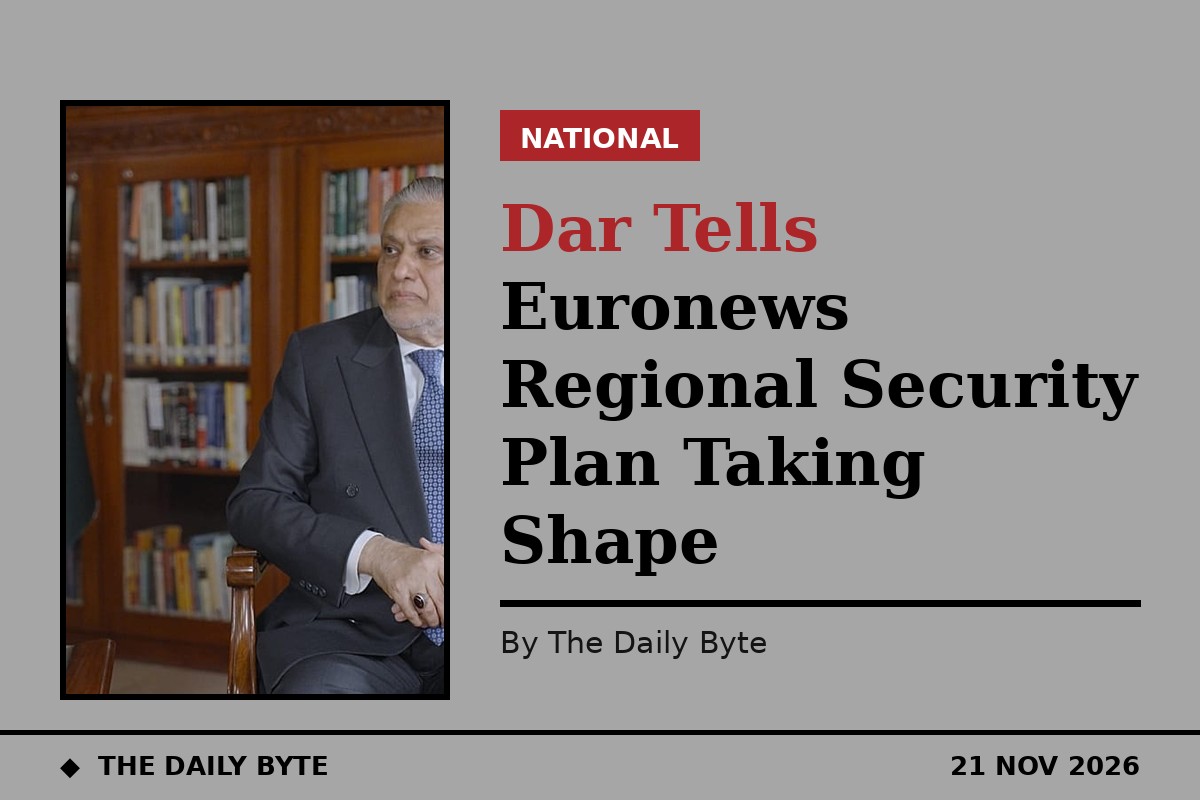
Pakistan's Deputy Prime Minister and Foreign Minister Ishaq Dar has told Euronews that a new regional security architecture is beginning to take shape after months of diplomacy linked to the war in the Middle East, with European governments now engaging in the process.
In an interview in Islamabad for Euronews' World Conversation programme, published on 19 November, Dar said regional peace should now be built through a special mechanism, arguing that “we all have to see the new security architecture (…) and the consequences on the global economy” beyond the Gulf region. He described the arrangement as something that could bring peace and stability to the region and benefit the wider world.
Mecca Pact as the starting point
Dar pointed to the mutual defence Mecca Pact, signed by Pakistan, Turkey and Saudi Arabia in August for their collective and individual security and defence, as a possible “beginning of the regional security architecture”. In his view, the pact could help not only the region but countries beyond it too.
He said the United Kingdom, France and Germany are already engaging with the emerging structure, and that Italy is also interested in joining the dialogue. He did not say what form that engagement takes, or when any wider framework might be agreed.
The mediation behind the claim
Dar used the interview to describe Pakistan's role in the early mediation between the United States and Iran. He said he telephoned Iranian Foreign Minister Abbas Araghchi in the early morning of 28 February, the first day of the war, and urged him not to react to the US-Israeli attacks, because he feared Iran might strike Gulf countries, which, he said, it unfortunately did.
“The entire (diplomatic) process began on that day,” Dar said. He described a marathon of negotiations, 21 hours with no real breaks, only consultative ones, and said that after the fifth round he was sure enough progress had been made that agreement was within reach by the sixth. “We didn't give up,” he said. The effort, he said, became the US-Iran memorandum of understanding signed on 18 June.
One of the agreement's core points, Dar said, was that there should be “no tolls, permits, fees or permissions” in the Strait of Hormuz, a point he said almost every country supported, including the European Union and the United Kingdom. “I think that the sea lanes must be seen as a free movement and Pakistan has not given up” on the principle, he said, adding that all parties are still “working hard” on it and that Pakistan continues to press both sides to “respect and honour what you signed on 18 June”.
What is still unclear
Dar gave no details of timelines, institutional design or enforcement mechanisms for the proposed architecture, and did not say which countries would ultimately join. Whether the contacts among regional and European governments develop into a defined security arrangement remains to be seen.
The interview presents the Mecca Pact as more than a three-country defence understanding: Islamabad is framing it as the foundation of a wider framework that could draw in further states. For now, though, the architecture Dar describes is a diplomatic process rather than a signed agreement, and its test will be whether the current round of contacts produces anything binding.