Dar values Pakistan resources at $8-10 trillion
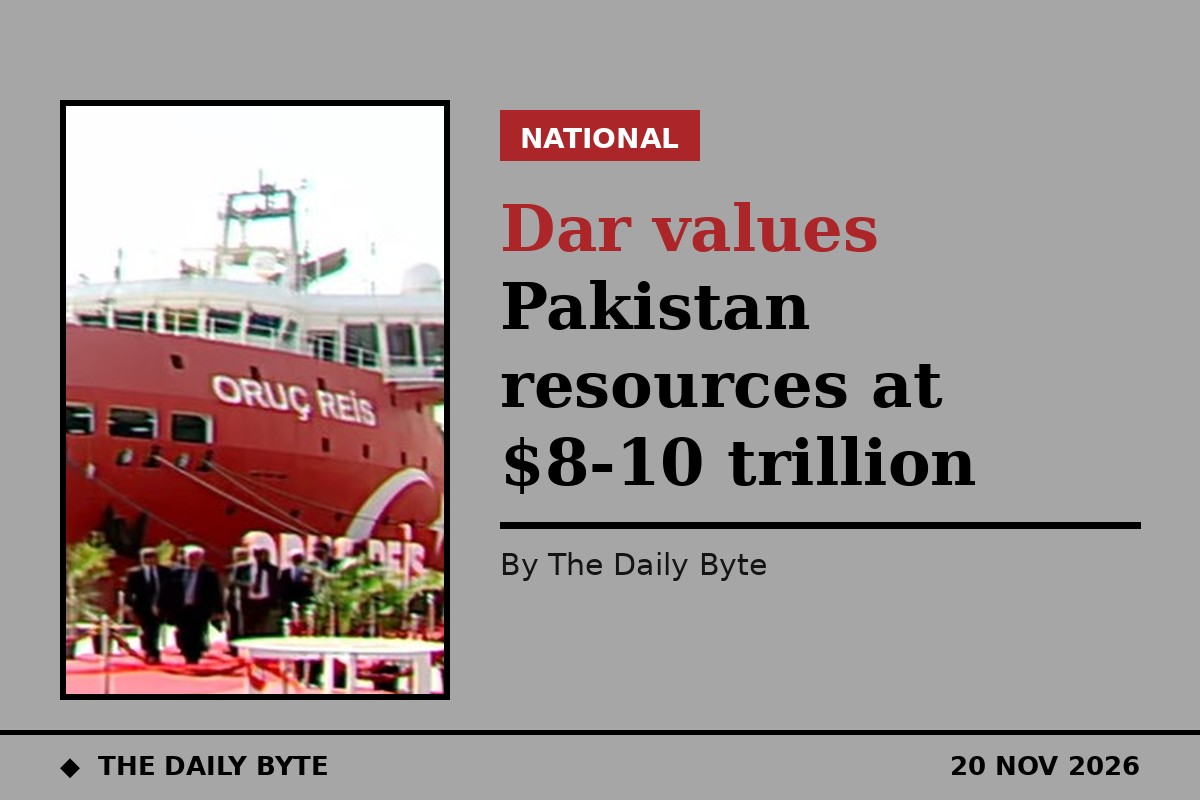
Deputy Prime Minister and Foreign Minister Ishaq Dar has estimated the value of Pakistan's mineral deposits, hydrocarbons and other natural resources at between $8 trillion and $10 trillion, describing the figure as the "most conservative estimate".
He made the remarks on Friday while addressing a ceremony at Karachi Port to mark the arrival of Türkiye's seismic research vessel, Oruç Reis, which reached Pakistan on Thursday for offshore oil and gas exploration. Welcoming the Turkish Petroleum leadership, technical experts and the vessel's crew, Dar described the arrival as a "historic moment" in Pakistan-Türkiye energy cooperation.
"Every successful journey of exploration begins with knowledge," he said, adding that data collected by the vessel could improve understanding of geological structures beneath the seabed and provide a stronger foundation for future exploration plans.
Rejecting the debt-trap label
Dar used the ceremony to push back against descriptions of Pakistan as a heavily indebted or debt-trapped country. He said the federal government's debt stood at approximately $100 billion, rising to around $130 billion when foreign-exchange liabilities of private companies and public-sector enterprises were included.
"Sometimes people talk about Pakistan being in debt, being a heavily indebted country, or being in a debt trap; I always negate that," he said. Against those liabilities, he argued, Pakistan possessed extensive reserves and potential resources, including minerals, hydrocarbons, gemstones and rare earth materials.
The $8-10 trillion figure is an estimate offered by the minister, not an audited valuation, and no independent assessment of that total was cited in the reporting. The government has been pitching the sector to investors at the Pakistan Minerals Investment Forum, held in Islamabad on 12 and 13 November, where an industry estimate put mineral reserves alone at about $8 trillion. Dar's figure is broader, adding hydrocarbons and gemstones to minerals.
What the vessel will do
Oruç Reis will collect three-dimensional seismic data across 670 square kilometres of the Indus offshore basin, in the Indus-C Block, followed by two-dimensional seismic surveys covering 2,353 kilometres of survey lines in the Makran blocks. Turkish Minister of Energy and Natural Resources Alparslan Bayraktar, who also addressed the ceremony, said exploration operations in identified fields were targeted to begin in 2027.
Bayraktar said licensing procedures had been completed for five exploration blocks, comprising three offshore and two onshore blocks, and that operational activities had already commenced. Türkiye's national oil company, Turkish Petroleum Corporation, has secured a 25 per cent stake and operatorship in Offshore Block-C, working with Pakistan's Oil and Gas Development Company, Pakistan Petroleum and Mari Energies.
Pakistan launched its Offshore Bid Round 2025 in January last year after an 18-year gap, offering licences for 40 offshore blocks in the Indus and Makran basins. Companies have committed 4,427 work units in the first phase of the three-year licensing period, with planned spending of about $80 million. If findings prove encouraging and drilling follows, total investment could reach $750 million to $1 billion, according to the Petroleum Division.
A wider energy partnership
Dar said Islamabad sought a long-term energy partnership with Ankara covering offshore exploration, minerals and renewable energy, and referred to three memorandums of understanding signed between relevant Pakistani and Turkish agencies. He called for closer collaboration between Pakistani and Turkish geologists, engineers, universities and research institutions, particularly in marine sciences, geoscience and offshore engineering.
He acknowledged that offshore exploration was complex, capital-intensive and inherently uncertain, stressing that seismic surveys could not guarantee commercially viable discoveries. "But no discovery can be made without seismic and exploration," he said, adding that Pakistan was taking an important step with confidence and responsibility.
He assured Turkish partners that the government would provide appropriate facilitation for the mission, while emphasising maritime safety and environmental protection. "Our seas are an economic asset, but they are also a national trust. Development and environmental stewardship must proceed together," he said.
Bayraktar pointed to Türkiye's own experience, recalling the discovery of significant natural gas reserves in the Black Sea in 2020 and noting that the country now produces about 10 million cubic metres of natural gas a day from those fields, supplying around four million households. In a lighter moment, Dar said he had told his Turkish counterpart that the seismic survey would take about five to six months, and joked that the Turkish team would not be allowed to leave without bringing news of a discovery.
The test of the mission will be geological, not rhetorical: seismic data alone cannot establish whether oil or gas exists in commercial quantities. That will only be known after exploration drilling, which the two sides hope to begin in 2027.
Sources
The Diplomatic Insight: Pakistan's Natural Resources Valued at $8-10tr, Dar Says
News Pulse: Pakistan's Untapped Natural Wealth Estimated at $10 Trillion: Ishaq Dar