DeepMind AI Gives Cyclone Forecasts an Extra Day
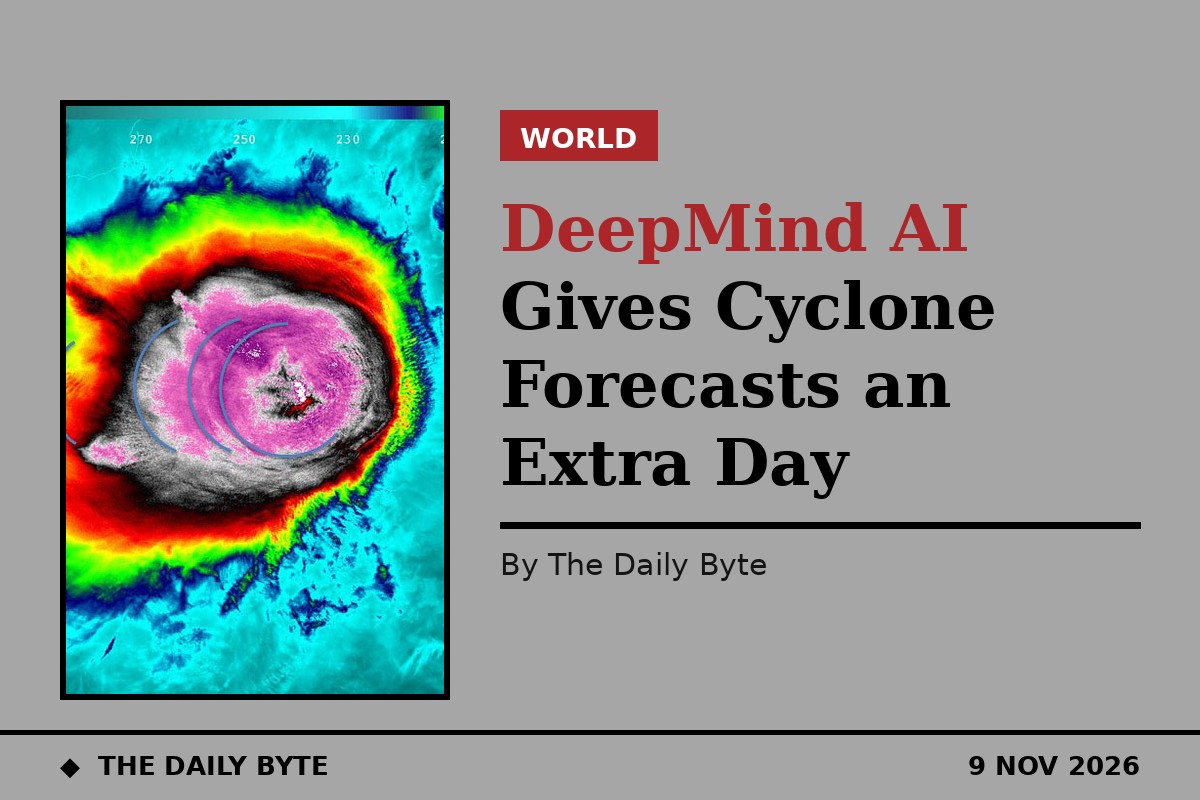
Google DeepMind's WeatherNext artificial intelligence system gives forecasters more than a full extra day of warning for tropical cyclones, according to a study published in the journal Nature on 6 August 2026. The research, carried out with the United States National Hurricane Center, the UK Met Office and the Cooperative Institute for Research in the Atmosphere, is featuring in today's AI news round-ups as one of the most significant applied AI results of the year.
The headline finding is simple: a three-day forecast from WeatherNext Cyclones is about as accurate as the forecasts that leading operational systems could previously produce only two days ahead. DeepMind describes the gain as roughly equivalent to a decade of conventional progress in meteorology. For coastal communities, an extra day can be the difference between an orderly evacuation and a chaotic one.
The numbers behind the claim are striking. At a five-day lead time, the model's average track error was 230 kilometres, compared with 370 kilometres for the European Centre for Medium-Range Weather Forecasts ensemble and 335 kilometres for Google's earlier GenCast system. The advantage held across all three things forecasters care about most: where a cyclone will go, how strong it will be, and how wide its damaging winds will spread. The model also beat NOAA's specialised Hurricane Analysis and Forecast System on intensity, despite using far coarser data.
That coarse data is the surprising part. Conventional wisdom held that very high spatial resolution was essential for predicting a cyclone's intensity, because the strongest winds are driven by fine-scale processes near the storm's core. WeatherNext Cyclones works from global atmospheric data at a resolution of 28 by 28 kilometres, about a hundred times coarser in area than the regional models traditionally used for hurricane work, and still delivers more accurate intensity forecasts. DeepMind says why this works remains an open research question.
The model was trained end to end on nearly 20 terabytes of global atmospheric data together with the International Best Track Archive for Climate Stewardship, a database of nearly 5,000 observed tropical cyclones. It was evaluated on storms from 2023 to 2025, and it generates ensembles of up to 1,000 possible futures for each cyclone, reaching 15 days ahead. A full 15-day, 1,000-member forecast runs in under a minute on a single TPU, Google's custom AI chip, letting forecasters weigh rare but devastating scenarios such as rapid intensification.
The system has already been tested in the real world. During the 2025 Atlantic hurricane season, the National Hurricane Center ran the model operationally, and it helped forecast Hurricane Melissa's rapid intensification and landfall in Jamaica, giving teams on the ground critical extra time to prepare. DeepMind says the centre continues to use the model this season, now predicting 1,000 possible scenarios for each cyclone.
Alongside the Nature paper, DeepMind released the code and model weights openly, so weather agencies, researchers and non-profit organisations can build localised versions of their own. The release covers WeatherNext Cyclones, the general-purpose WeatherNext 2 and a compact WeatherNext 2-mini variant that runs on a single TPU in a free public Colab notebook. Its interactive Weather Lab site has also been refreshed with a new interface showing global weather fields alongside cyclone tracks.
There are limits to what the study proves. The model was evaluated as forecast guidance, not as an autonomous warning system, and the official process by which cyclone watches and warnings are issued was not tested. Its results cover the 2023 to 2025 period, and the gains depend on the models, observations and verification methods used in the comparison. Even so, the work shows that an AI system trained on coarse global data and historical storm records can improve cyclone forecasting within the tested setup, and operational centres are already putting AI forecasts alongside physics-based models in everyday use.


