Delhi cloud seeding on standby as smog chokes city
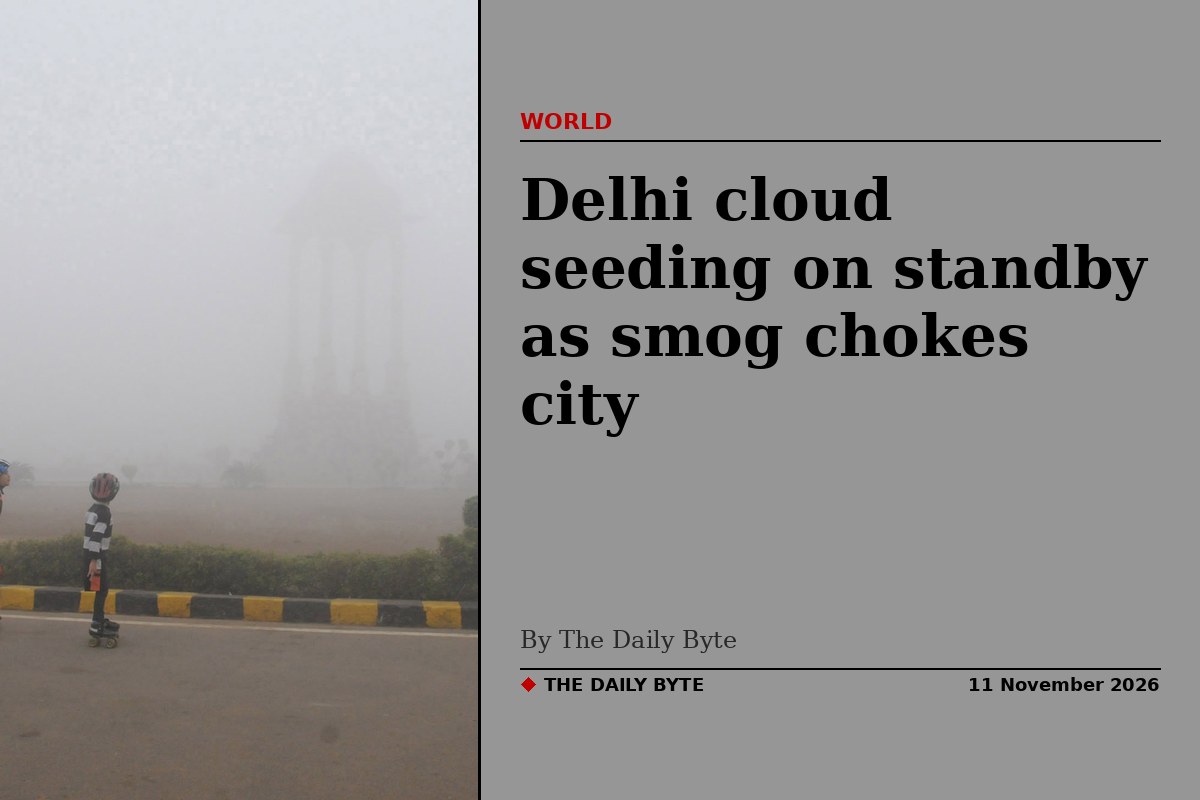
Delhi has a cloud-seeding aircraft on standby as scientists wait for suitable clouds to attempt artificial rain over the Indian capital, where air quality remained poor on 11 November 2026 after Diwali celebrations, crop burning and fireworks pushed pollution to hazardous levels. The operation is being prepared with researchers from the Indian Institute of Technology Kanpur, airport operators and specialist weather-modification contractors.
According to Central Pollution Control Board data, Delhi recorded an overall air quality index of 299, in the poor category, on Wednesday morning. Monitoring stations across the city remained in the very poor category, with the highest readings approaching 400. The capital's air had deteriorated after Diwali, compounded by falling temperatures and moderate fog.
Aircraft ready, clouds not yet
A Beechcraft King Air 200 fitted with external flare racks has been positioned to carry out high-altitude seeding runs over the National Capital Region. The deployment follows two preliminary test flights near Indira Gandhi International Airport to evaluate radar tracking and flight paths. The aircraft is certified to operate at altitudes of up to 25,000 feet, allowing scientists to target deeper, colder layers of approaching cloud systems.
Researchers are watching for a western disturbance expected to bring cloud cover over northern India this week. A final decision on the operation will only be taken once IIT Kanpur confirms favourable moisture conditions, and the aircraft would take off from Delhi if the attempt goes ahead. Cloud seeding does not create clouds. Instead, aircraft burn flares containing silver iodide or fine chemical salts into existing, moisture-rich clouds, encouraging droplets to grow until they fall as rain and wash particulates from the air.
Why seeding is so difficult in Delhi
The operation faces a basic meteorological obstacle. Delhi's winter atmosphere is typically dry and short of cloud, and cloud seeding needs a minimum cloud thickness and relative humidity above 50 to 60 per cent to be viable. In previous trials conducted by IIT Kanpur, aircraft were unable to trigger measurable precipitation because moisture levels inside the clouds were insufficient. Radar teams are tracking a frontal system moving east from the Mediterranean and Arabian Sea, looking for a narrow window of 12 to 24 hours when cloud depth and temperatures align.
Launching sorties over the capital also requires approvals from more than a dozen civil, defence and security bodies, including the Directorate General of Civil Aviation, the Ministry of Defence and the Indian Air Force, the Airports Authority of India and airport operator DIAL. Critics caution that artificial rain is only a temporary measure, with past studies indicating that rain-induced improvements in air quality can fade within 24 to 72 hours under winter inversion conditions as vehicles, factories and biomass stoves continue to fill the air with pollution.