Deutsche Telekom Unveils AI Factory 2.0 in Munich Today
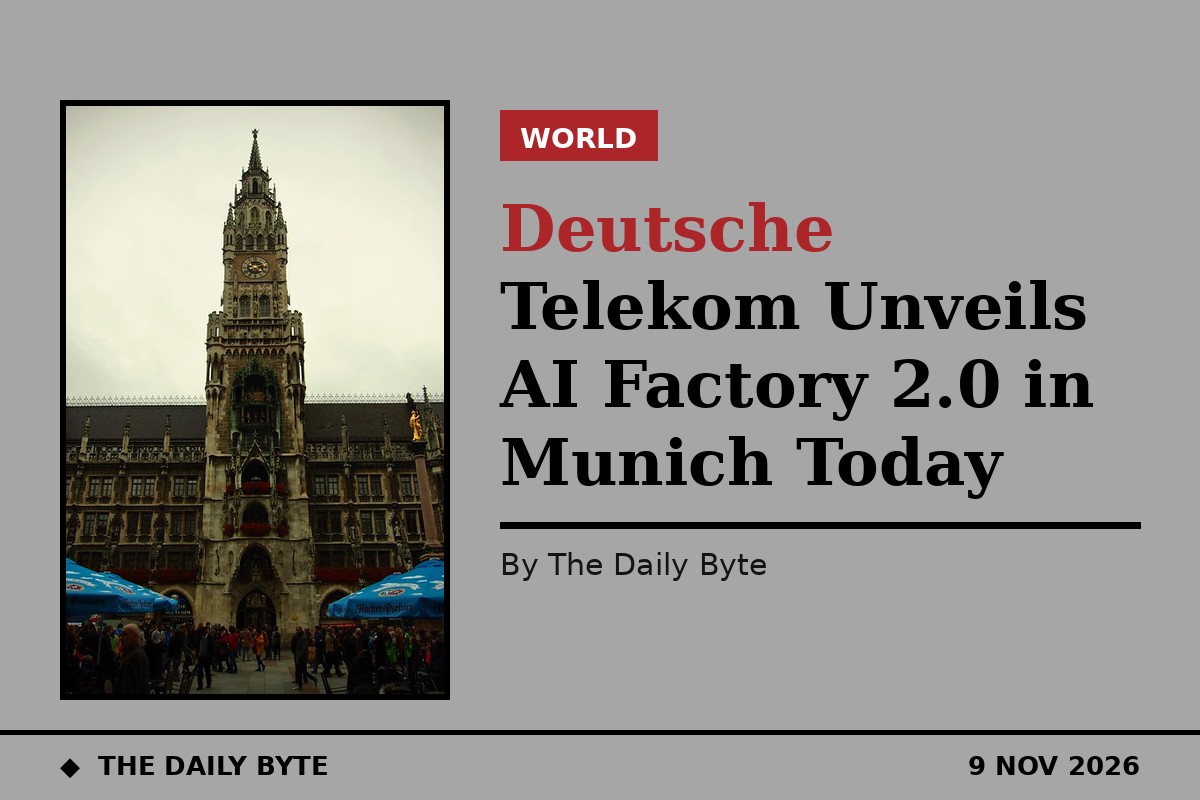
Deutsche Telekom is presenting its AI Factory 2.0 in Munich today, 9 November 2026, setting out its plan for artificial intelligence infrastructure built around digital sovereignty for customers in Germany and Europe.
The press conference, held under the theme "AI Factory 2.0: Greater Digital Sovereignty for Customers in Germany and Europe", is the centrepiece of a busy period for the Bonn-based telecoms group, which has just reported strong third-quarter results and raised its outlook for the full year.
Digital sovereignty is the thread running through the event. The idea is that German and European customers should be able to use powerful AI computing without depending entirely on infrastructure controlled outside Europe. Telekom's pitch is that it can provide the connectivity and the data-centre capacity, with partners supplying the chips and the software layer.
The presentation follows a memorandum of understanding between T-Systems, Telekom's IT services arm, and Sparxity, a Dresden-based AI infrastructure company. The two signed the agreement at the Digital Summit, and under it Sparxity's energy-efficient AI computing technology will be integrated and validated for Telekom data centres, combining the next generation of chips with T-Systems infrastructure. Rollout of that chip generation is targeted for 2028.
Energy efficiency is a deliberate part of the message. AI data centres are heavy users of power, and the Sparxity partnership is framed around computing that uses less energy per unit of work — a selling point for industrial customers that need large amounts of AI capacity but face rising energy costs and sustainability targets.
Telekom's infrastructure ambitions reach beyond its own facilities. Nexi Payments and Deutsche Telekom Business Solutions, bidding as a joint consortium, were selected by the European Central Bank to provide connectivity services for the digital euro. The ECB announced the award on 30 October, with the consortium emerging as the top-ranked provider, and the contract initially covers pilot operations.
The AI Factory presentation also sits against a strong financial backdrop. In third-quarter 2026 results published on Thursday, organic group revenue rose 5.5 percent to 31.1 billion euros. Adjusted EBITDA AL climbed 8.0 percent organically to 12.2 billion euros, while adjusted net profit advanced 12.7 percent to 3.0 billion euros.
Management has now raised its expectations for the full year, forecasting adjusted EBITDA AL of around 47.6 billion euros and free cash flow AL of roughly 20.1 billion euros. The board intends to propose a dividend of 1.10 euros per share. Results for the fourth quarter and the full 2026 financial year are due on 25 February 2027.
On the mobile side, Telekom has also reported its 15th consecutive victory in the Computer BILD network test, earning an overall grade of "very good (1.2)", with the company saying its network led rivals on both 5G availability and speed, and on latency.
The AI partnership is not T-Systems' only recent tie-up. On 28 October, Banco Sabadell reached an agreement with T-Systems to expand its use of agent-based AI across the banking group, showing how the same infrastructure push is being sold into financial services.
Chief executive Timotheus Hoettges has named AI as one of the group's biggest challenges, while pointing to more than 500 AI projects already running in Europe alone. Today's event is the moment Telekom tries to turn that activity into a clear offer: European AI computing, run on European infrastructure, for customers that want to keep their data and their workloads closer to home.
What matters next is detail. A press conference can set out the ambition, but customers and investors will want to know the capacity on offer, the pricing, and when the AI Factory 2.0 services will actually be available to buy. Those answers should start to emerge from today's Munich briefing.


