DR Congo Exits FATF Grey List After Four Years
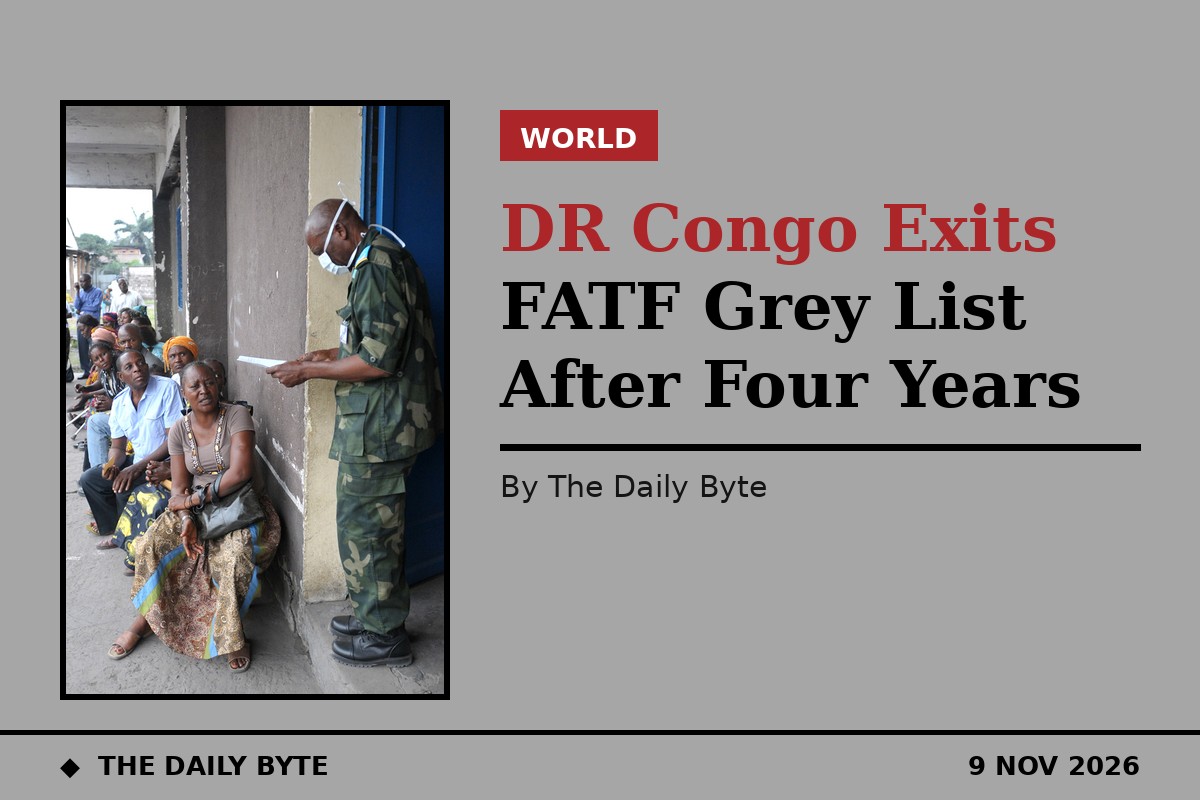
The Democratic Republic of the Congo has been removed from the grey list of the Financial Action Task Force (FATF), ending four years of increased monitoring of the country’s defences against money laundering and terrorist financing.
The decision was announced on Friday 30 October 2026, at the close of the FATF plenary in Paris. The FATF said the DRC, along with Bulgaria, Côte d’Ivoire and Monaco, had been removed from its list of jurisdictions under increased monitoring following successful on-site visits, and that each country had completed its action plan within the agreed timeframe.
The DRC had been under increased monitoring since October 2022 because of strategic deficiencies in countering money laundering, terrorist financing and the financing of weapons proliferation. To address them, the country carried out a plan of 23 measures, documented in ten progress reports and validated by an FATF on-site visit to Kinshasa in September 2026.
The reforms were led by the National Financial Intelligence Unit, known as CENAREF, under the Ministry of Finance, working with the Central Bank of the Congo, the insurance regulator ARCA, the Ministry of Justice and the courts, the Military Prosecutor’s Office and reporting entities in the private sector.
The FATF said the DRC would continue working with its regional bodies, GABAC and ESAAMLG, to sustain the improvements in its anti-money laundering and counter-terrorist financing systems. Being placed on the grey list did not mean the country was under international financial sanctions or on the FATF’s high-risk “black list”.
According to the government, leaving the grey list should strengthen the confidence of investors and partners, ease relations with correspondent banks and reduce the perceived risk of financial transactions with the DRC.
The Anti-Corruption Research Centre (CERC), a Congolese non-governmental organisation, welcomed the decision, saying it followed several recommendations from its civil society report on the DRC’s implementation of the United Nations Convention against Corruption, including strengthening CENAREF. CERC said it now records that recommendation as implemented.
But CERC cautioned that leaving the grey list was not an end in itself. It called on the authorities to keep CENAREF and the supervisory authorities properly resourced, to turn the anti-money laundering framework into effective investigations, prosecutions and confiscations, including in cases of corruption and embezzlement of public funds, and to adopt the anti-corruption law declared admissible by the National Assembly in September 2026, along with laws on access to information and whistleblower protection.
The DRC government has been urged to press on with the reforms so the progress lasts, with civil society involved in following them up.


