DraftKings Plunges 21% as Prediction-Markets Spending Slashes Its Profit Outlook
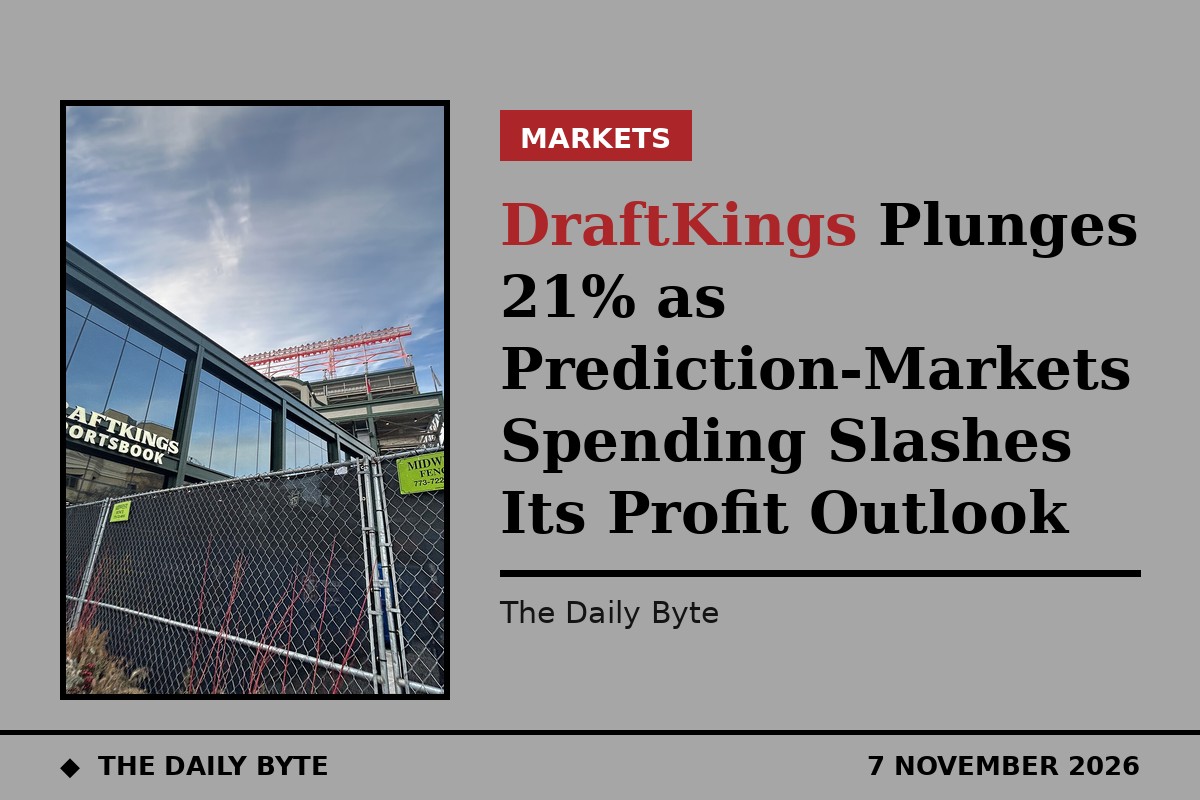
DraftKings shares plunged 21.3% on Friday, closing at $18.51, after the sports betting company cut its full-year profit outlook to fund a costly push into prediction markets.
The stock fell $5.01 on the day after DraftKings reported third-quarter results late on Thursday that missed Wall Street estimates and lowered its guidance for 2026. Revenue rose 16% to $1.329 billion, below the roughly $1.39 billion analysts had expected, while the net loss widened to $468.7 million.
Guidance cut by hundreds of millions
DraftKings cut its 2026 adjusted EBITDA forecast to $175 million to $275 million, down from $700 million to $900 million, and lowered its revenue outlook to $6.35 billion to $6.55 billion. The cut reflects plans to spend $650 million to $700 million this year building its Predictions business, up from earlier plans, with more spending expected next year.
Chief executive Jason Robins said the spending, mostly marketing to win customers for DraftKings Predictions, would pay off. The platform, launched in December 2025, lets users trade contracts tied to sports and real-world events.
Core demand still growing
The earnings miss did not reflect weak customer demand. Monthly unique payers rose 13% to 41 million, average revenue per user increased to $109, and more than 1.6 million customers have used the Predictions offering this year. Annualised prediction-market consumer volume reached $10.1 billion in October, and the company said it had already become the third-largest predictions exchange by total volume.
DraftKings also introduced guidance for 2027, forecasting revenue of $7.35 billion to $7.75 billion and adjusted EBITDA of $800 million to $1 billion. But investors want proof that prediction-market customers can be turned into profitable revenue before rewarding the strategy, and the outlook remains exposed to legal uncertainty over whether sports event contracts could be restricted.