DuPont, Microsoft and NobleAI Team Up on Agentic AI R&D
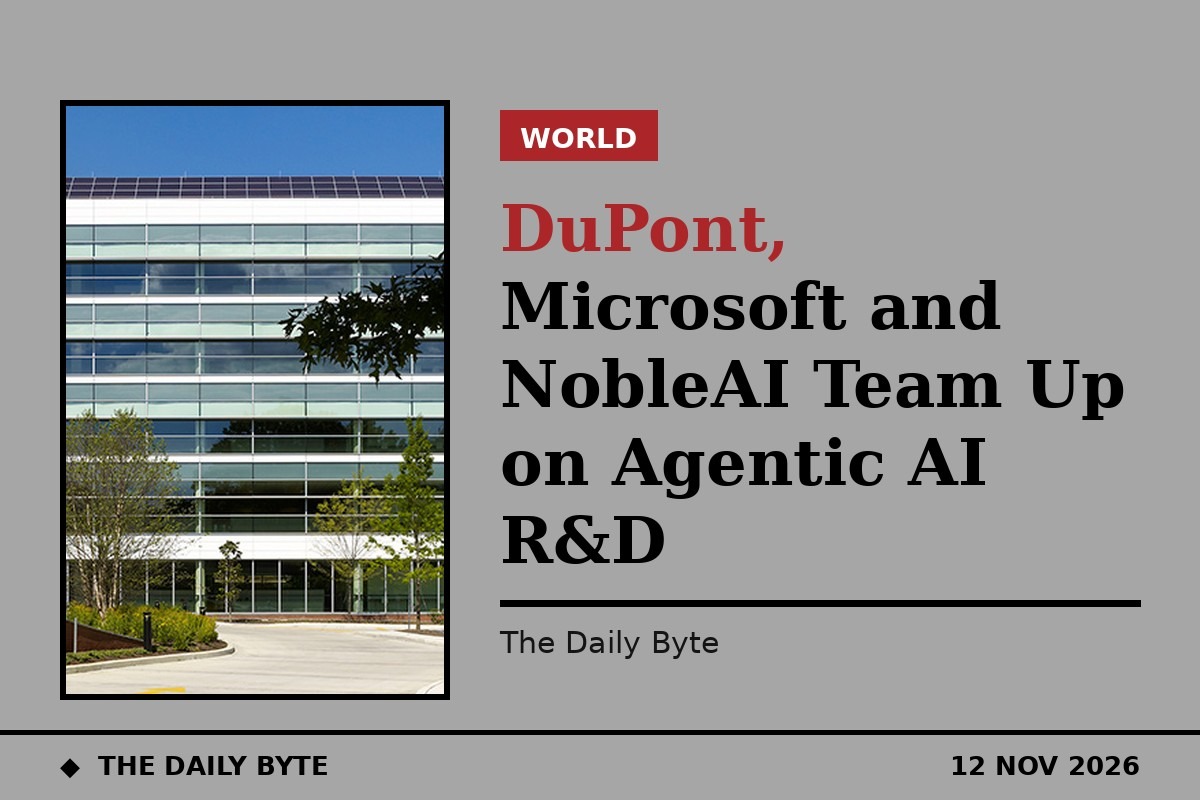
DuPont has announced a collaboration with Microsoft and NobleAI to bring agentic artificial intelligence into its research and development work, in a deal that pairs industrial science with two of the newest AI platforms for laboratory research.
The collaboration was announced on Thursday, 12 November, from Wilmington, Delaware, and is designed to expand access to advanced AI tools and machine learning for DuPont's scientists and engineers, with the aim of reducing the time needed to deliver solutions to customers.
Three partners, three roles
Each company brings a different piece of the system. DuPont contributes its expertise in advanced materials and applications across healthcare, water, construction and industrial markets. NobleAI supplies Science-Based AI modelling through its Visualizations, Insights and Predictions (VIP) Platform, which turns limited industrial data into predictive models. Microsoft contributes Discovery, its enterprise agentic AI platform for research and development.
In practice, the two platforms divide the work. Microsoft Discovery gives scientists an agentic environment to plan and orchestrate research, connecting their data, models and know-how, while NobleAI's VIP Platform powers the scientific modelling that predicts and optimises results. NobleAI is one of the first launch partners for Microsoft Discovery.
Aseem Datar, Microsoft's corporate vice president of product innovation for Microsoft Discovery and Quantum, described Discovery as an agentic environment that connects research teams' data, models and know-how for scientific discovery. NobleAI chief executive Alex Wang said the VIP Platform handles the predictive and optimisation modelling inside those agentic workflows.
Governance built in from the start
DuPont is linking the technical work to a company-wide rollout of AI. Chief Information Officer Matt Abbott said the collaboration reflects how the company is scaling AI, with security and governance designed in from the start, so that what proves out in one laboratory can be put to work across the company.
That emphasis matters because the tools will handle commercially sensitive research data. The companies said the approach is intended to help teams assess potential solutions faster, guide experiments and accelerate cycles of learning, rather than simply automating existing steps.
NobleAI's modelling approach is designed for situations where industrial data is limited, integrating scientific principles throughout the modelling workflow instead of relying on large datasets alone. That is a common constraint in chemicals and materials research, where each experiment can be slow and expensive.
What it means in practice
No financial terms were disclosed, and no new products or consumer services were announced, so the partnership changes nothing immediately for DuPont's customers. Its significance is strategic: it extends Microsoft's enterprise agentic AI platform into industrial research, and gives DuPont a structured way to test whether AI agents can shorten development cycles in materials science.
The announcement comes as agentic AI, in which software plans and carries out multi-step tasks rather than answering single questions, moves from consumer chatbots into specialist professional work, including drug discovery, engineering and now industrial research.
Source: PR Newswire (DuPont press release); see also Morningstar / Dow Jones.