Dyno Nobel shares fall 8% as profit drops 22%
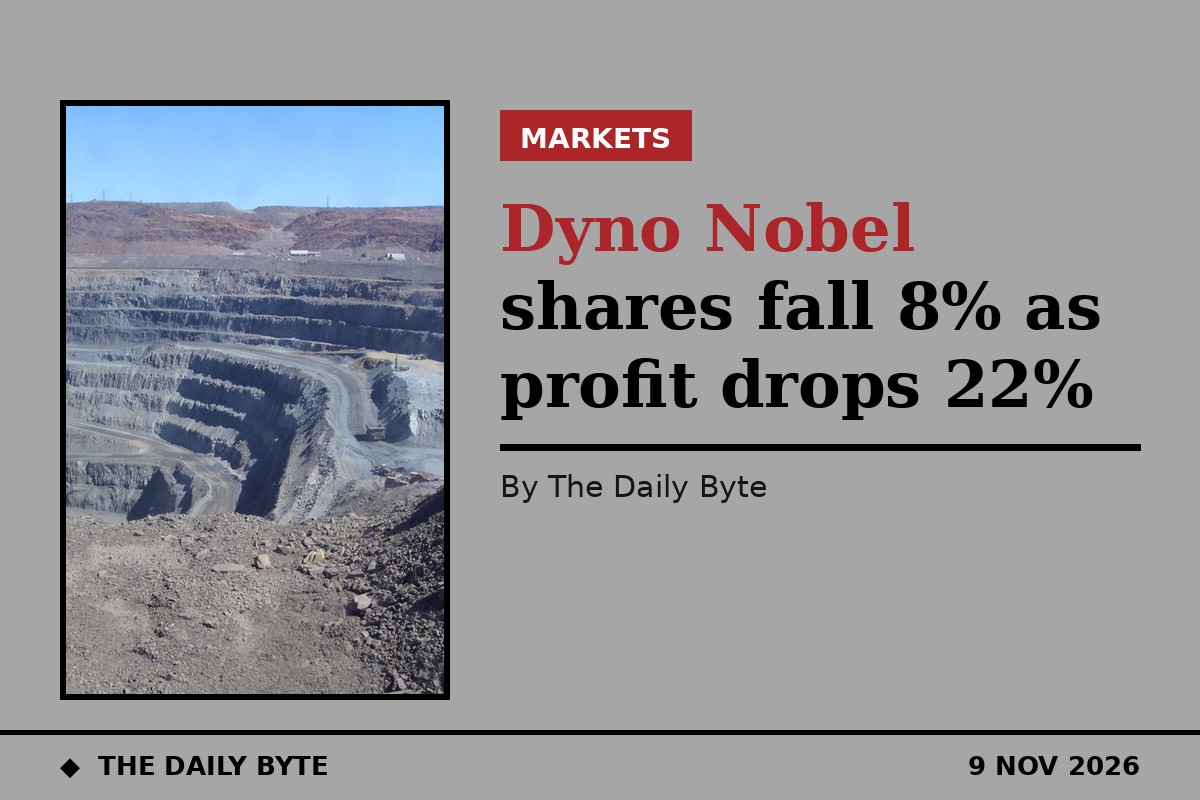
Dyno Nobel shares fell 8.1 per cent to A$3.51 in morning trading on Monday after the Australian explosives maker reported a sharp fall in underlying annual profit, even as earnings from its core explosives business rose strongly.
The company, formerly known as Incitec Pivot, reported net profit excluding individually material items of A$331 million for the year to 30 September, down almost 22 per cent on the A$423 million recorded a year earlier. Statutory profit came in at A$66 million, compared with a loss of A$53 million in the previous year, after about A$265 million in after-tax individually material item charges, mainly linked to the disposal of the Phosphate Hill fertiliser business and impairments relating to Queensland Pacific Metals arrangements.
Phosphate Hill, in north-west Queensland, was sold for $1 as part of the group's exit from fertilisers, a separation that has reshaped the company's accounts and left it as a focused explosives business.
Core explosives earnings rise 12 per cent
Underlying earnings before interest and tax from explosives rose 12 per cent to A$485 million, up from A$434 million a year earlier, on explosives revenue of A$3.406 billion and underlying explosives earnings before interest, tax, depreciation and amortisation of about A$759 million. Total statutory group revenue fell to A$3.941 billion from A$5.345 billion, a decline that largely reflects the removal of fertiliser activities from the accounts rather than a fall in demand for explosives.
The regional picture was mixed. Underlying earnings in Asia-Pacific rose 10 per cent to A$281 million despite wet weather, while earnings from the Americas increased almost 19 per cent to A$224 million, helped by transformation work and favourable conditions in copper, gold and iron ore. Earnings from Europe, Africa and Latin America dropped 40 per cent to A$18 million, with shipping routes affected by conflict in the Middle East and wider economic pressures weighing on Europe.
Chief executive Mauro Neves de Moraes said the results showed why the company had confidence in its future. "We are now a focused pure-play explosives business," he said. "We have resilient growth, strong contractual protections, and leading positions in attractive markets."
Guidance points to further growth
Dyno Nobel guided underlying earnings before interest and tax of approximately A$515 million to A$555 million for the 2027 financial year, implying growth of roughly 6 to 14 per cent on the A$485 million reported for 2026. Management expects about 40 per cent of full-year earnings to come in the first half, reflecting the timing of maintenance and other operating activity. Capital expenditure is expected to rise to about A$370 million to A$420 million, from A$282 million in 2026.
The company has set an earnings ambition of about A$600 million by the 2028 financial year and A$800 million by 2031, although management describes those as ambitions rather than formal guidance. Its transformation programme has delivered about A$185 million in earnings benefits through 2026, with further commercial initiatives expected to add about A$20 million to A$30 million in the coming year.
Shareholders will receive a final dividend of five cents per share, franked at 50 per cent. The company also bought back about A$574 million of shares at an average price of A$3.01 before ending the programme in September 2026.
Defence energetics and long-term demand
Dyno Nobel is also building a defence energetics business, with about US$1 billion in government-funded project commitments linked to its United States activities. That includes a US$435 million TNT-related project and a US$581 million IMX-104 programme, associated with its Nitradyn joint venture and facilities in Graham, Kentucky.
Chief financial officer Nitesh Naidoo said the energy transition was increasing demand for critical minerals, with the amount of copper moved expected to rise by about 50 per cent between 2021 and 2031. He also pointed to projected investment of more than $1 trillion in artificial intelligence-related infrastructure over the next three to five years, saying it would support demand for commodities, materials and energy.
Naidoo said it was too early to assess whether a new United States Congress would alter the company's longer-term outlook, adding: "We haven't seen any sign of change on the megatrends or any indication that the fundamentals that were driving them would change." Dyno Nobel is the sole dynamite manufacturer in the United States, producing the product at its facility in Carthage, Missouri. This article is for information only and is not investment advice.