E-Bikes on Pavements Terrify Blind Pedestrians, Survey Finds
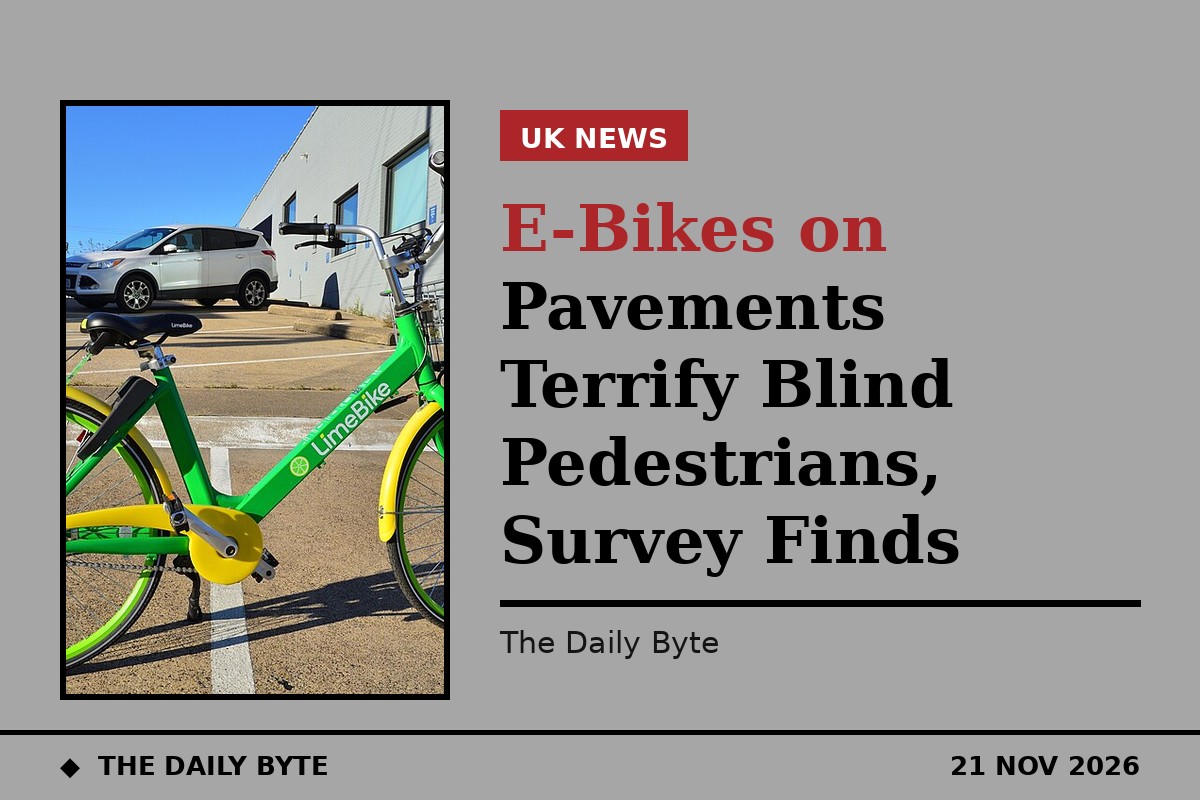
Blind pedestrians are being forced off pavements and into traffic by e-bikes and e-scooters left blocking their way, according to new research from the charity Guide Dogs.
Six in ten people with sight loss — 60 per cent — say e-bikes and e-scooters have damaged their confidence and their ability to travel independently, the survey found. Among people without sight loss, the figure was 28 per cent. The survey covered 2,300 adults across the UK, including 300 people with sight loss.
The findings, published on Saturday 21 November, paint a picture of pavements that many blind and partially sighted people no longer feel safe using. Nine in ten respondents who had come across an e-bike or e-scooter said they had seen one being ridden on the pavement, and three in ten people with sight loss said they had had a collision or a near miss with one, compared with 14 per cent of people without sight loss.
Jennie Harrison, who has a visual impairment and a guide dog called Brandy, said meeting an e-bike or e-scooter on a pavement is “terrifying”. She said the vehicles are so quiet that she only hears them when they are right upon her, and she panics that they are about to hit her or her dog. Dumped bikes are just as frightening, she said: she and Brandy often have to step into the road to get around them, which she described as “so scary”.
What the survey found
The research also found widespread doubt about enforcement. Two thirds of respondents — 66 per cent — said they believed the rules on e-bikes and e-scooters are not being enforced enough.
Eleanor Briggs, Guide Dogs’ head of policy, public affairs and campaigns, said people with vision impairment often rely on a safe route they have learned and rehearsed: the line of a building, the edge of a kerb, the tactile paving at a crossing. “A bike left across any of these routes isn’t an inconvenience,” she said. “It’s a hazard and can force people to step off the pavement and into the road to get past, putting themselves in danger.”
The charity’s findings land as the Government consults on new national standards for shared e-bike schemes, after pledging to end what it called the “wild west” of e-bike parking. The proposed rules cover schemes such as Lime, Voi and Forest, and deal with parking, fleet management and antisocial behaviour, including drunk cycling and riding on pavements.
What Guide Dogs wants changed
Guide Dogs said it welcomes the Government consultation, but it wants the new rules to go further. The charity is calling for rental e-bikes and e-scooters to be parked in designated bays in urban areas, and for rigorous identity checks on riders so that people can be held accountable for unsafe behaviour.
It also wants regulation of operators’ pricing structures, so that fares do not encourage risky riding, and a single, clear and accessible place where people can report dangerous riding and vehicles blocking pavements.
A Department for Transport spokesperson said shared e-bikes can make getting around cities easier, but they have to work for the communities they serve. “We recognise the issues raised by Guide Dogs UK and others, that’s why we are consulting on new national standards and giving local leaders the powers to keep pavements clear and journeys safe,” the spokesperson said.
For people like Ms Harrison, the change cannot come soon enough. A pavement blocked by a dumped bike, or a silent e-scooter coming at her on a footpath, turns a routine journey into a risk she has to weigh every time she leaves the house with Brandy.