ECB to hike rates to 2.75% in December, poll shows
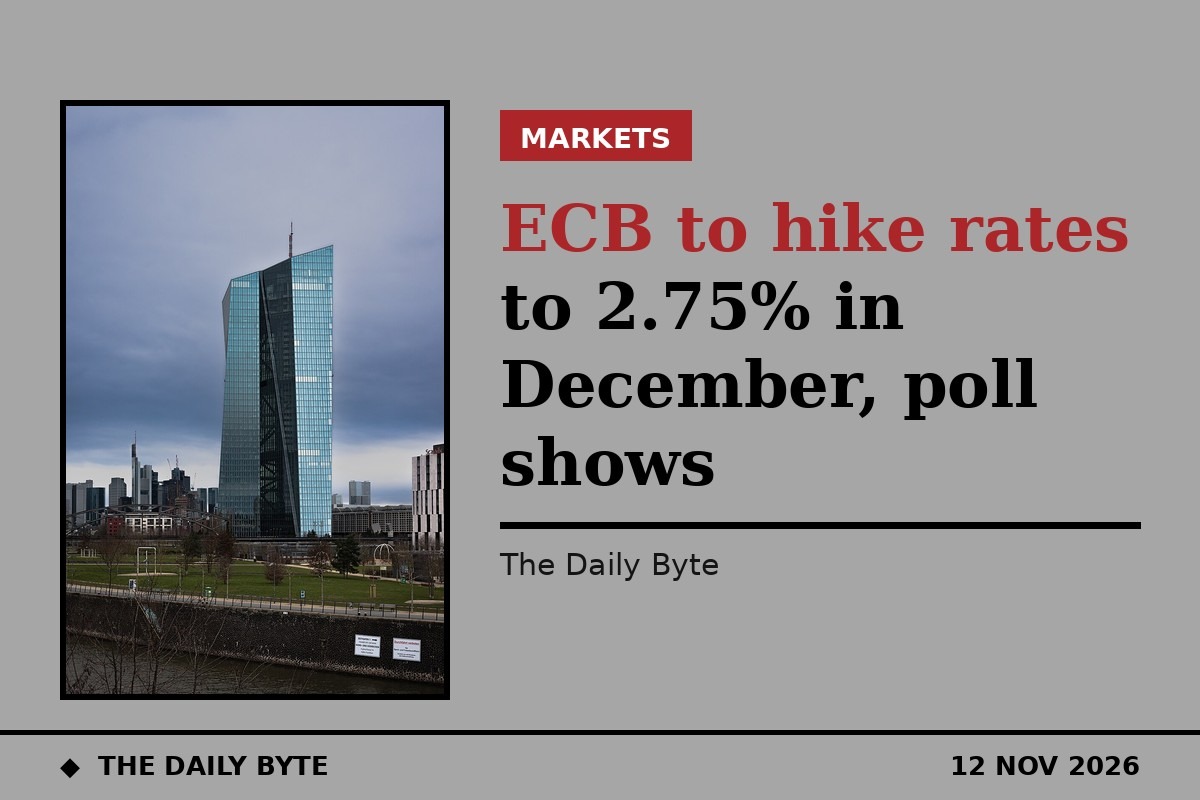
The European Central Bank is set to raise its deposit rate to 2.75% in December, according to a Reuters poll of economists published on Thursday 12 November, with most seeing it as the final increase of this tightening cycle — although more than a third expect at least one more rise in early 2027.
All 71 economists surveyed between 10 and 12 November expected the ECB to deliver a 25-basis-point increase next month, after earlier hikes in June and September. If delivered, the move would take the deposit rate above the ECB's recently estimated neutral range of 1.75% to 2.50%, the level considered neither stimulative nor restrictive for the economy.
Most see December as the peak
A 65% majority — 46 of the 71 economists polled — predicted the deposit rate would peak at 2.75% in December. But 25 expected another increase, most likely in the first quarter of 2027, as inflation runs at about double the ECB's 2% target.
Fabio Balboni, chief European economist at Wellington Management, told Reuters the December hike was "almost on autopilot", adding that policymakers appeared to have agreed in October to stick to a measured pace of increases. He put the chance of a further move in March at "50/50", saying core inflation would grind higher through to March and the ECB might want "another insurance hike".
Inflation forecasts raised again
Economists raised their inflation forecasts from a month ago and now expect price growth to stay around twice the ECB's target until at least the second quarter of 2027. Inflation is forecast to average 3.1% this year and 2.8% next year, up from 3.0% and 2.6% in the October survey.
Underlying price pressures are also expected to strengthen. Core inflation, at 2.2% in October, is forecast to average 2.6% this quarter and 2.8% next, higher than last month's predictions. Growth forecasts were lifted slightly too, to 1.1% this year and 1.3% next, up from 1.0% and 1.2%.
The poll pointed to resilient economic growth and inflation rising to a three-year high of 4% last month, alongside risks of a further pickup, as the forces behind the tightening. Markets are currently pricing in two to three hikes by the end of next year.
Energy risks keep the door open
Economists warned against drawing too much comfort from a more than 20% slump in oil futures in recent weeks. Low natural gas storage levels ahead of winter are adding to inflation risks, and a cold winter could send gas prices sharply higher.
"The downward move we have seen in energy prices is a bit misleading in terms of the risk picture. There's still plenty of uncertainty about whether we get peace in the Middle East and gas inventories continue to run at exceptionally low levels," Jan von Gerich, chief analyst at Nordea, told Reuters.
Balboni added that wage pressures were likely to build, saying it was unrealistic to expect no pickup in pay after a shock of almost 2% to real incomes. The ECB's next decision is due on 17 December, the same week the Bank of England and the US Federal Reserve also decide on rates.