Germany export model no longer viable, ECB's Schnabel warns
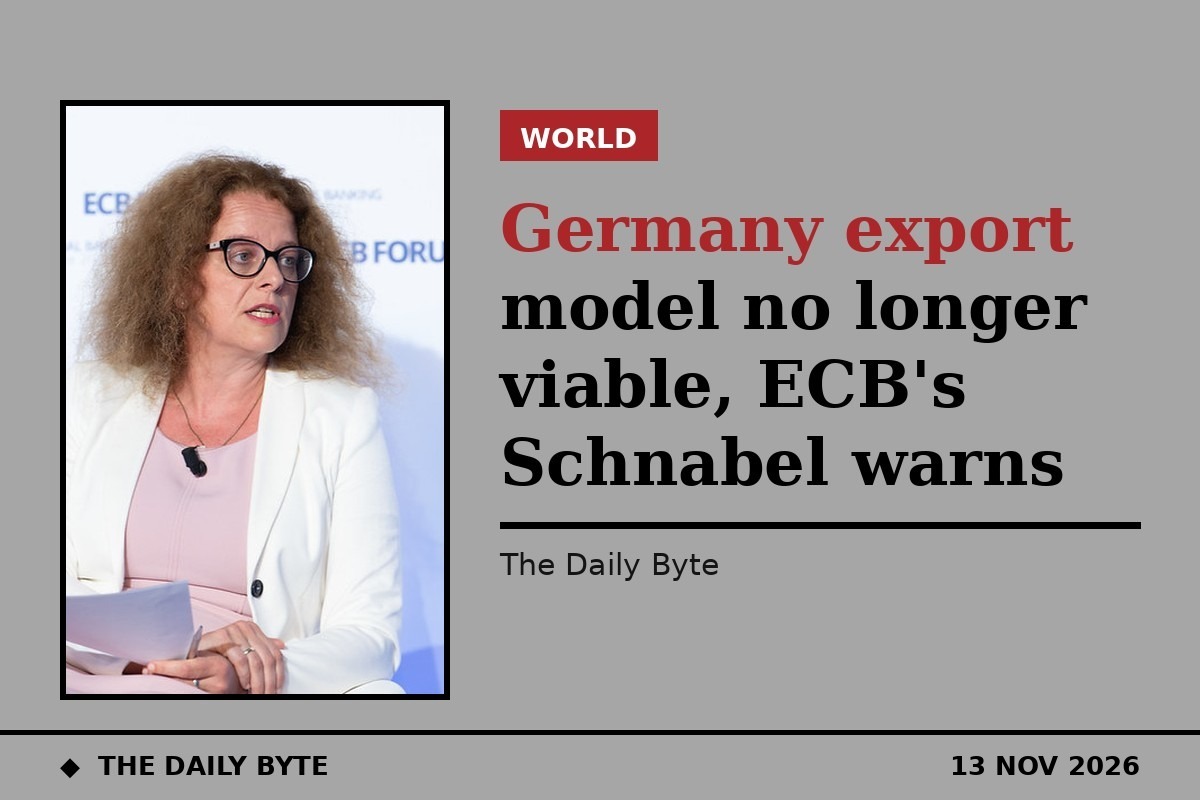
Germany's long-standing export-led growth model is no longer viable in a more fragmented world, European Central Bank board member Isabel Schnabel warned on Friday, arguing that the country's deeper problem is weak demand at home rather than lost competitiveness abroad.
Speaking at the Bank of Lithuania's Economics Conference in Vilnius, Schnabel said Germany's real GDP per person fell by 0.5% between 2019 and 2024, a period in which Europe's largest economy barely grew at all. She pointed to decades of subdued household spending and investment as the structural weakness behind that stagnation.
Real private consumption in Germany has grown by less than 1% a year on average since 1999, Schnabel said, partly reflecting reforms in the early 2000s that deliberately held back real wage growth. "Especially in a more fragmented world, its export-driven business model is no longer viable," she said in a speech entitled "Made in Europe".
Domestic demand, not exports, is the weak point
Schnabel argued that the usual diagnosis of Germany's troubles misses the point. While exporters have faced tougher competition and weaker demand from China and other markets, she said the fundamental problem is that German households and firms have spent too little for too long. Without stronger domestic demand, she said, the economy cannot return to lasting growth even if exports recover.
That message carries weight because Schnabel is one of the ECB's most influential voices on the German economy, and because it cuts against the assumption in Berlin that the answer lies mainly in helping exporters. Her speech instead frames the challenge as one of rebalancing: building an economy that can grow from demand inside Germany as well as from sales abroad.
She welcomed Germany's major fiscal expansion, describing it as the largest since the Second World War and "a welcome step in the right direction". Well-targeted public investment in infrastructure, defence and digital transformation, she said, could strengthen domestic demand and raise the economy's productive capacity. But she cautioned that spending alone would not be enough without structural reforms to lift household incomes and investment.
The case for a single European company regime
Schnabel used the Vilnius speech to press a second argument she has made since February: that Europe's real problem is not a shortage of talent, ideas or research, but a lack of scale. Firms that want to operate across the European Union still face 27 different national systems, and that fragmentation stops good ideas becoming large European businesses.
Her answer is the creation of a so-called 28th regime: a unified European corporate framework, available alongside national systems, covering company law, governance, shareholder rights and employee financial compensation. Incorporation under the regime would be digital, inexpensive and quick, and open to firms of all sizes and in all sectors.
"A 28th regime would be a true game changer," Schnabel said. "By giving firms seamless access to the entire European market, it would provide the scale needed to convert innovation into economic growth." She said it would allow Europe to compete as one economy rather than 27, and help create a genuine "Made in Europe" brand.
Labour law, social security and corporate taxation would remain in national hands under her proposal. But she warned that the regime should ideally be created through an EU regulation that applies directly in every member state, as foreseen in the current proposal. "Otherwise, Europe risks ending up with 27 versions of the 28th regime, recreating the very fragmentation it seeks to eliminate," she said.
What happens next
The speech lands at a sensitive moment for Germany. The government in Berlin has just agreed a 2027 budget built around heavy borrowing to fund defence, infrastructure and energy, and the question of whether that money revives domestic demand or simply papers over weak growth will shape the debate for years.
For the ECB, Schnabel's intervention also underlines how far the debate has moved from interest rates alone. With the bank's own leadership in transition, her speech sets out a longer-term agenda: a single market that works as one market, and a German economy that can grow from within. Whether governments take up the 28th regime idea will be tested in the coming months as the Commission advances its proposals.


